
Dhiraj Dutta v. Anirban Sen & Ors., 2026
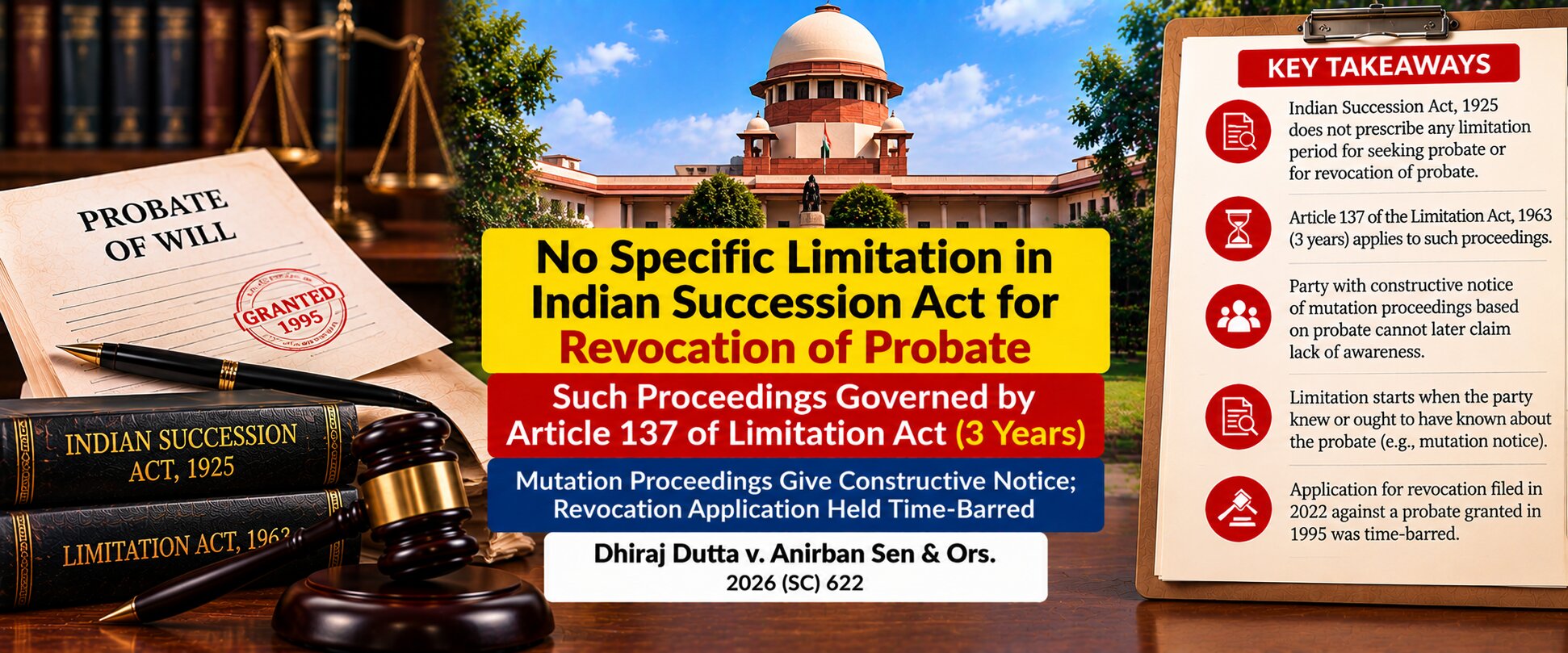
The Indian Succession Act, 1925 contains no specific limitation period for an application seeking revocation of probate.
Judgement Details
Court
Supreme Court of India
Date of Decision
1 September 2026
Judges
Justice Sanjay Karol and Justice Vipul M. Pancholi
Citation
Acts / Provisions
Facts of the Case
-
The dispute concerned properties inherited by Gouriprova Sen from her husband.
-
Before her death in October 1989, Gouriprova Sen executed a Will dated 9 July 1989.
-
Under the Will, her nephew Dhiraj Dutta was appointed as the sole executor and beneficiary.
-
Probate of the Will was granted in September 1995.
-
After obtaining probate, Dhiraj Dutta initiated proceedings for mutation of the revenue records concerning the properties.
-
According to Dhiraj Dutta, notices relating to the mutation proceedings were served upon the predecessors-in-interest of the respondents in or around 2013.
-
The respondents disputed having knowledge of the probate at that stage and claimed that they became aware of it only in 2019.
-
After allegedly becoming aware of the probate, the respondents instituted proceedings concerning the disputed properties.
-
In 2022, the respondents filed an application under Section 263 of the Indian Succession Act, 1925, seeking revocation of the probate granted in 1995.
-
The Single Judge rejected the application on the ground that it was barred by limitation.
-
The Division Bench, however, took a different view and allowed the challenge to proceed.
-
Dhiraj Dutta thereafter approached the Supreme Court.
-
The principal question before the Supreme Court was whether an application seeking revocation of probate, when the Indian Succession Act does not prescribe a specific limitation period, would be governed by Article 137 of the Limitation Act.
-
The Court also considered whether the respondents could rely upon their alleged lack of actual knowledge when circumstances surrounding the mutation proceedings provided them with constructive notice of the probate.
Issues
-
Whether an application seeking revocation of probate under Section 263 of the Indian Succession Act, 1925 is governed by Article 137 of the Limitation Act, 1963 when the Succession Act prescribes no specific limitation period?
-
Whether the three-year limitation period under Article 137 begins when the affected party acquires or is deemed to have acquired knowledge of the probate?
-
Whether notice of mutation proceedings arising from a probate can constitute constructive notice of the probate for determining limitation?
-
Whether the respondents could claim that limitation commenced only in 2019 when they had earlier received notice relating to mutation proceedings connected with the property?
-
Whether the application for revocation of probate filed in 2022 against a probate granted in 1995 was barred by limitation?
Judgement
-
The Supreme Court allowed the appeal filed by Dhiraj Dutta.
-
The Court held that the Indian Succession Act, 1925 does not prescribe a specific period of limitation either for seeking probate or for seeking revocation of an already granted probate.
-
Consequently, the Court held that Article 137 of the Limitation Act, 1963 applies to such an application.
-
Article 137 prescribes a three-year limitation period for applications for which no specific period is provided elsewhere in the Limitation Act or any other applicable law.
-
The Court rejected the respondents' contention that limitation should necessarily be calculated from 2019, when they claimed to have obtained actual knowledge of the probate.
-
The Court considered the earlier mutation proceedings and the notices issued in connection with those proceedings.
-
According to the Court, such notice amounted to constructive notice, requiring the recipients to make reasonable inquiries concerning the basis on which mutation proceedings had been initiated.
-
The Court observed that when a person receives a notice from a court or authority, the person is expected to make reasonable efforts to determine why the notice was issued and what action is required.
-
The respondents therefore could not simply rely upon their alleged later date of actual knowledge while disregarding the earlier circumstances that ought to have alerted them to the existence of the probate.
-
The Court concluded that the 2022 application for revocation was hopelessly barred by limitation.
-
The Supreme Court set aside the Division Bench's decision.
-
The decision of the Single Judge dismissing the revocation application as time-barred was restored.
Held
-
Article 137 of the Limitation Act, 1963 applies to an application for revocation of probate under Section 263 of the Indian Succession Act.
-
The applicable limitation period is three years.
-
The limitation period is connected with the point at which the applicant knew or ought reasonably to have known about the probate.
-
Notice received during mutation proceedings can constitute constructive notice of the probate forming the basis of those proceedings.
-
A party cannot deliberately or negligently remain unaware of the basis of a court or revenue proceeding and subsequently use alleged lack of actual knowledge to extend the limitation period.
-
The respondents' 2022 application was time-barred.
Analysis
-
Article 137 fills the limitation gap: The central legal issue was the absence of a limitation provision in the Indian Succession Act for revocation of probate. The Supreme Court applied Article 137 because it is the residuary provision governing applications for which no specific limitation period is prescribed.
-
Three-year limitation: The judgment establishes that a party seeking revocation of probate cannot treat the remedy as indefinitely available merely because the Succession Act does not expressly specify a limitation period.
-
Actual knowledge is not the only consideration: The respondents relied upon 2019 as the year in which they allegedly acquired knowledge of the probate. The Court, however, examined whether circumstances existing earlier should have put them on notice.
-
Constructive notice through mutation: The mutation proceedings were particularly important. Since those proceedings arose from the probate, the Court treated the relevant notice as constructive notice requiring the recipients to make reasonable inquiries.
-
Duty to make reasonable inquiry: The Court emphasized that receiving a court or official notice cannot ordinarily be treated as an event having no significance. A person receiving such notice is expected to investigate its purpose and determine the action required.
-
Limitation cannot be indefinitely postponed: Accepting the respondents' argument would effectively allow a party to postpone limitation simply by claiming that actual knowledge was acquired at a later date, despite circumstances that should reasonably have revealed the existence of the probate earlier.
-
Probate proceedings and property disputes: The judgment also demonstrates the importance of distinguishing between a challenge to the underlying property rights and a challenge to the probate itself. Once probate has been granted, a party seeking its revocation must comply with the applicable limitation framework.
-
Importance of procedural diligence: The decision places significance on diligence by persons who receive notices concerning property or mutation proceedings. Ignoring such notices can have consequences when limitation is subsequently calculated.
-
Restoration of the Single Judge's order: Since the Supreme Court concluded that the 2022 revocation application was barred by limitation, the Single Judge's original dismissal was restored.