
Dharmendra v. State of Madhya Pradesh, 2026
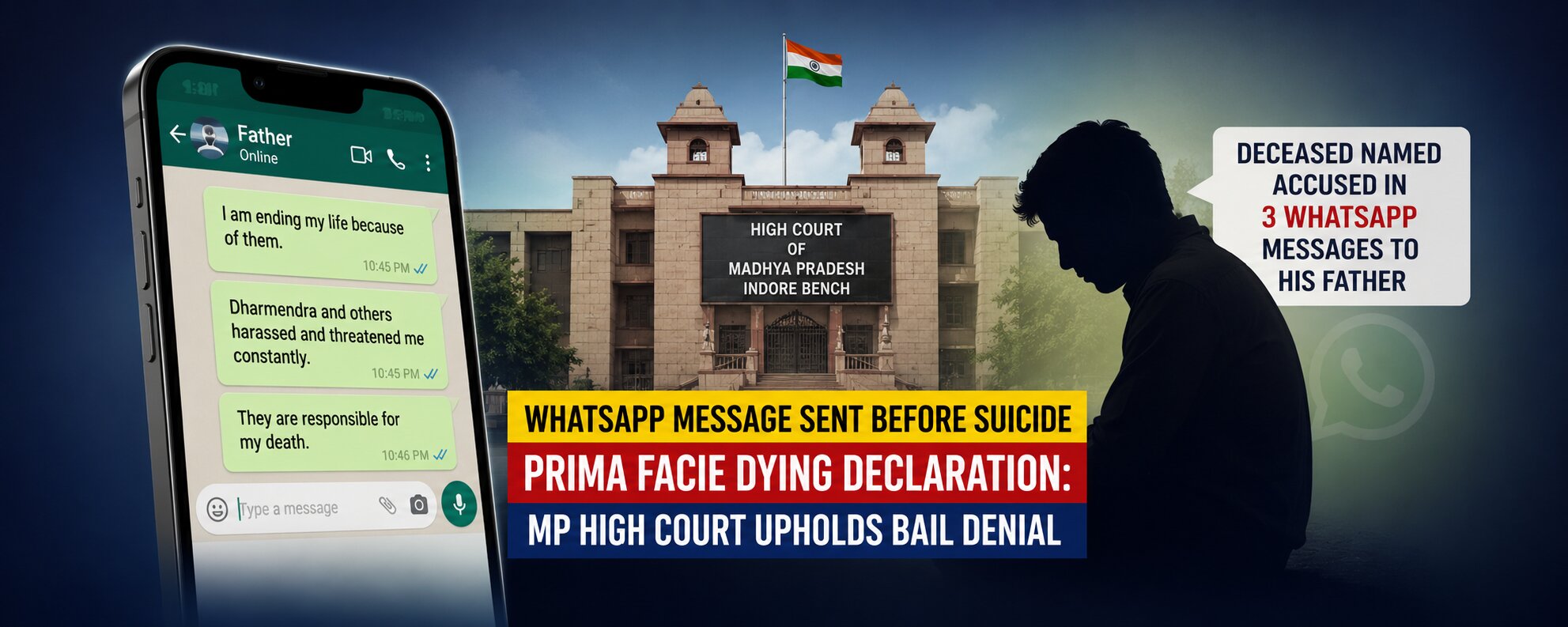
The WhatsApp messages allegedly sent by the deceased to his father shortly before his death were treated as prima facie significant evidence, akin to a dying declaration, at the bail stage.
Judgement Details
Court
High Court of Madhya Pradesh
Date of Decision
3 August 2026
Judges
Justice Jai Kumar Pillai
Citation
Acts / Provisions
Facts of the Case
-
Santosh, aged approximately 25 years, was a resident of village Jharipada and belonged to the Bhil Scheduled Caste community.
-
The police received information concerning his suspicious death and initiated proceedings.
-
Santosh was found dead, and the post-mortem examination indicated the cause of death as asphyxia.
-
According to the prosecution, the appellants had an old dispute with the deceased concerning agricultural land.
-
The deceased's father and brother alleged that the appellants repeatedly threatened, abused and insulted Santosh and subjected him to continuing threats of death.
-
The prosecution alleged that this conduct caused the deceased considerable fear and distress and ultimately contributed to his decision to commit suicide.
-
A particularly important piece of prosecution evidence was the Panchnama concerning the deceased's mobile phone.
-
According to the Panchnama, shortly before his death, Santosh sent three WhatsApp messages to his father's mobile number.
-
The messages allegedly referred to the circumstances surrounding his suicide and named the appellants.
-
The High Court regarded these messages as significant electronic evidence and described them, at the prima facie stage, as a “crucial prima facie dying declaration.”
-
The statements of the deceased's father, Bhuralal Ausari, and his brother, Bhima Ausari, were also relied upon by the prosecution.
-
Both witnesses allegedly stated during the investigation that the appellants had systematically threatened, abused and insulted the deceased in connection with the agricultural-land dispute.
-
The appellants disputed the prosecution case and contended that they had been falsely implicated because of previous enmity.
-
The appellants argued that the father's official statement did not refer to the alleged WhatsApp messages, which, according to them, created a contradiction in the prosecution case.
-
They further argued that the prosecution had failed to file the relevant CAF form concerning the mobile connection along with the chargesheet.
-
The appellants relied upon the mobile-phone Panchnama to contend that the material actually indicated friendly relations between them and the deceased and did not establish an old land dispute.
-
They also contended that the complainant side was exploiting the deceased's caste identity to falsely implicate them.
-
The Trial Court nevertheless refused bail, following which the appellants approached the High Court under Section 14A of the SC/ST Act.
Issues
-
Whether the material collected during investigation, including the three WhatsApp messages allegedly sent by the deceased to his father shortly before his death, was sufficient at the bail stage to constitute prima facie evidence implicating the appellants in the alleged abetment of suicide?
-
Whether the statements of the deceased's father and brother, alleging repeated threats, abuse and harassment by the appellants, sufficiently corroborated the prosecution case for the purpose of deciding the appellants' bail application?
-
Whether the alleged absence of the CAF form relating to the deceased's mobile phone was sufficient to disregard the WhatsApp messages relied upon by the prosecution at the stage of bail?
-
Whether the alleged absence of documentary evidence concerning the agricultural-land dispute and the appellants' assertion of friendly relations with the deceased justified interference with the Trial Court's order refusing bail?
-
Whether the material available on the case diary disclosed a strong prima facie case sufficient to justify denial of bail under the appellate jurisdiction conferred by Section 14A of the SC/ST (Prevention of Atrocities) Act, 1989?
Judgement
-
The High Court dismissed the criminal appeal filed by the appellants.
-
The Court upheld the Trial Court's order refusing bail to the three appellants.
-
The Court examined the case diary and gave particular importance to the Panchnama relating to the deceased's mobile phone.
-
The Court noted that the deceased had sent three WhatsApp messages to his father shortly before his death and that the messages allegedly named the appellants.
-
The Court treated this electronic material as a crucial prima facie dying declaration for the limited purpose of assessing the bail application.
-
The Court also found that the statements of the deceased's father and brother supported the prosecution's allegation that the deceased had been subjected to repeated threats, abuse and insults.
-
The Court rejected the appellants' objections concerning the CAF form, the absence of documentary proof relating to the land dispute and the alleged friendly relationship between the accused and deceased.
-
The Court emphasized that a court deciding bail is not required to meticulously weigh the entire evidence or conduct a mini-trial.
-
Having considered the material collectively, the Court concluded that a strong prima facie case existed against the appellants.
-
Consequently, there was no sufficient ground to interfere with the Trial Court's decision refusing bail.
Held
-
The appeal was dismissed.
-
The Trial Court's order denying bail was upheld.
-
The statements of the deceased's father and brother provided prima facie corroboration of the allegations of continuing threats, abuse and harassment.
-
The objections concerning the CAF form, the alleged friendly relationship between the parties and the absence of documentary proof of the land dispute were insufficient, at the bail stage, to displace the prosecution material.
-
The Court found a strong prima facie case and held that the appellants were not entitled to bail on the material then before the Court.
Analysis
-
Prima facie treatment of WhatsApp evidence: The most notable aspect of the decision is the Court's treatment of the deceased's WhatsApp messages. Because the messages were allegedly sent shortly before death and identified the accused, the Court regarded them as highly significant at the bail stage.
-
Limited scope of the finding: The Court did not finally determine that the WhatsApp messages constituted a legally admissible dying declaration for purposes of conviction. The observation was made within the limited framework of deciding bail.
-
Electronic evidence: The decision illustrates the increasing importance of electronic communications in criminal investigations. A message sent through a mobile application can become important evidence when its authenticity, timing, attribution and surrounding circumstances are established.
-
Bail stage versus trial stage: The Court maintained the distinction between deciding bail and determining guilt. At the bail stage, the court is not expected to conduct a detailed appreciation of evidence equivalent to a trial.
-
Cumulative assessment of evidence: The Court did not rely solely on the WhatsApp messages. It considered them along with the statements of the deceased's father and brother and other circumstances appearing in the case diary.
-
Corroborative witness statements: The statements of Bhuralal Ausari and Bhima Ausari were important because they allegedly described a continuing pattern of threats and harassment. Thus, the electronic messages were considered in the context of other prosecution material.
-
CAF-form objection: The appellants argued that the absence of the CAF form weakened the electronic evidence. The Court did not consider this objection sufficient to warrant bail at the preliminary stage.
-
No mini-trial at bail stage: The judgment reinforces the principle that a bail court should avoid conducting a detailed examination of contradictions, admissibility questions and competing factual versions as though it were deciding the trial itself.
-
Section 14A appellate jurisdiction: Since the appeal arose under Section 14A of the SC/ST Act, the High Court examined whether the material justified continued denial of bail. The Court concluded that the record disclosed circumstances sufficiently strong to support the Trial Court's decision.
-
Alleged friendly relationship: The appellants' argument that the mobile-phone material suggested friendly relations between them and the deceased was not considered sufficient to overcome the prosecution case at this stage.
-
Significance for dying declarations: The decision demonstrates that a digital communication made immediately before death may be considered prima facie analogous to a dying declaration when assessing a bail application.
-
No automatic rule: The judgment should not be interpreted as establishing that every WhatsApp message made before suicide automatically constitutes a dying declaration. Its significance lies in recognizing the potential evidentiary value of contemporaneous digital communications.
-
Impact on existing law: The judgment highlights how courts may consider modern forms of electronic communication while applying traditional principles concerning dying declarations, circumstantial evidence and prima facie assessment.
-
Practical implication: Investigating agencies may increasingly rely upon mobile-phone Panchnamas, digital communications and other electronic material in cases involving suicide and alleged abetment. Questions concerning authentication, integrity, attribution and statutory admissibility nevertheless remain important at trial.
-
Overall assessment: The judgment is best understood as a bail-stage decision based on the cumulative strength of the prosecution material, rather than as a final determination of the accused's guilt or the ultimate admissibility and probative value of the WhatsApp messages.