
Devendra Pratap Singh alias Rahul Farji and Connected Matters v. State of Uttar Pradesh, 2026
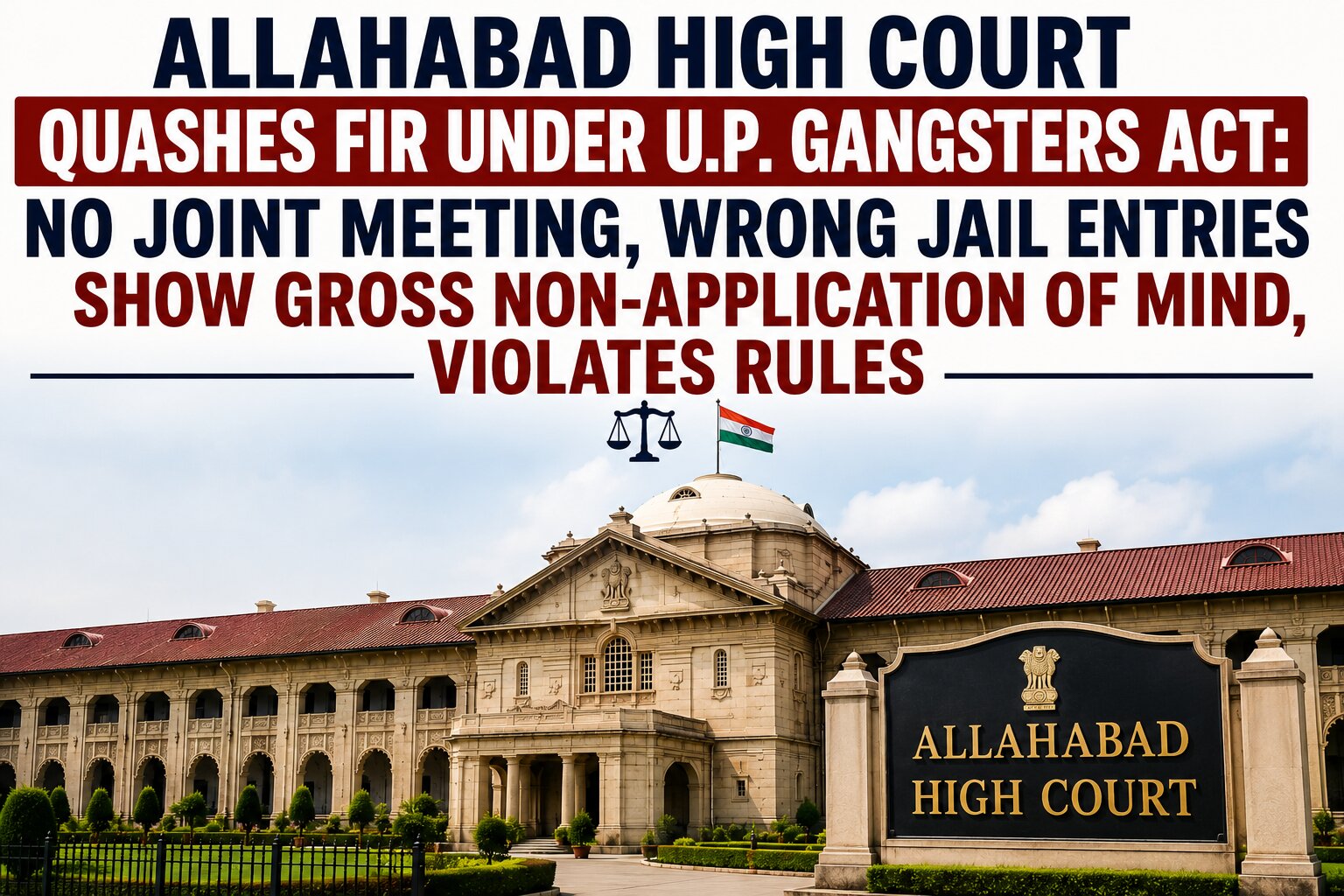
Gangster Act proceedings cannot rest on a mechanically approved gang chart; mandatory joint consideration, accurate factual verification and independent application of mind are essential before an FIR can validly proceed.
Judgement Details
Court
Allahabad High Court
Date of Decision
21 August 2026
Judges
Justice J.J. Munir and Justice Tarun Saxena
Citation
Acts / Provisions
Facts of the Case
-
The petitions challenged an FIR registered under the Uttar Pradesh Gangsters and Anti-Social Activities (Prevention) Act, 1986 at a police station in Prayagraj.
-
The FIR was based on a gang chart dated November 18, 2025 and was registered on November 19, 2025.
-
The petitioners contended that the mandatory joint meeting required before approval of the gang chart had not been conducted.
-
The Commissioner of Police and Deputy Commissioner of Police had made separate endorsements rather than approving the chart after a joint discussion.
-
The gang chart incorrectly recorded several accused persons as being in jail, despite the fact that they had already been granted bail.
-
In the case of Devendra Pratap Singh, the gang chart showed him as being in custody even though the High Court had granted him bail in September 2025.
-
Similar incorrect custody entries were found concerning Atul Pratap Singh, Durgesh Kumar Singh, Ajay Yadav, Pushpendra Singh and Ranvijay Singh.
-
The Court found that the authorities had failed to properly examine the documents and records accompanying the gang chart.
-
The petitioners challenged the legality of the gang chart approval and the consequential FIR.
Issues
-
Whether approval of a gang chart without conducting the mandatory joint meeting renders the subsequent proceedings legally unsustainable?
-
Whether incorrect recording of an accused as being in jail despite an existing bail order demonstrates non-application of mind by the approving authority?
-
Whether approval of a gang chart without proper examination of the accompanying records and material violates the statutory safeguards governing proceedings under the Gangsters Act?
-
Whether registration of the impugned FIR can be sustained when the underlying gang chart was approved in violation of the mandatory procedural requirements?
-
Whether proceedings under the Gangsters Act can be initiated against a person on the basis of a solitary base case when the material does not establish membership of a gang?
Judgement
-
The High Court found that the gang chart had not been approved after the required joint meeting between the competent authorities.
-
The separate endorsements of the Commissioner of Police and Deputy Commissioner of Police could not substitute the mandatory joint discussion.
-
The Court found several incorrect and false custody entries in the gang chart.
-
The authorities had recorded persons as being in jail even though they had already obtained bail.
-
The Court held that these errors demonstrated gross non-application of mind.
-
The approving authorities had failed to properly scrutinize the material accompanying the gang chart.
-
The Court also observed that, in the case of Devendra Pratap Singh, reliance upon a solitary base case in which he was already on bail did not, by itself, establish that he was a member of a gang.
-
The Court found violations of the prescribed procedural safeguards governing preparation and approval of gang charts.
-
Accordingly, the High Court allowed all four connected writ petitions.
-
The FIR dated November 19, 2025 was quashed.
-
The Court further directed that an appropriate red-ink entry be made in the General Diary recording that the proceedings had been quashed.
Held
-
Mandatory procedural safeguards under the Gangsters Rules cannot be treated as mere formalities.
-
Approval of a gang chart through a mechanical or routine exercise is impermissible.
-
Authorities must independently examine the material accompanying the gang chart before recording their satisfaction.
-
Incorrect custody information can materially vitiate the satisfaction of the approving authority.
-
A person who has been granted bail cannot mechanically be shown as being in custody while approving a gang chart.
-
The failure to conduct the prescribed joint meeting rendered the approval legally defective.
-
The FIR based upon the defective gang chart was therefore quashed.
Analysis
-
Procedural compliance: The judgment emphasizes that safeguards governing gang-chart preparation and approval are substantive protections, not empty procedural formalities.
-
Joint meeting requirement: The Court treated the mandatory joint meeting as an essential safeguard against unilateral or mechanical approval of proceedings under the Gangsters Act.
-
Application of mind: The repeated errors in the custody status of the accused demonstrated that the authorities had not adequately scrutinized the underlying records.
-
Effect of bail orders: Recording a person as being in jail despite a judicial order granting bail was particularly significant because it directly affected the factual foundation on which the authorities proceeded.
-
Mechanical exercise of power: The Court relied upon the principle that statutory powers involving serious consequences cannot be exercised through a routine or mechanical process.
-
Gang membership: The Court also highlighted that being implicated in a solitary criminal case, particularly while being on bail, does not automatically establish membership of a gang.
-
Judicial scrutiny: The decision demonstrates that courts will examine whether statutory authorities actually complied with mandatory safeguards before allowing coercive proceedings under special criminal legislation to continue.
-
Precedential significance: The Court relied upon Sanni Mishra alias Sanjayan Kumar Mishra v. State of U.P. and the Supreme Court's decision in Vinod Bihari Lal v. State of Uttar Pradesh, reinforcing the requirement of independent scrutiny and proper consideration of the gang chart and supporting material.
-
Impact on administration: The ruling serves as a warning to authorities that inaccurate factual entries and failure to follow mandatory procedures can invalidate proceedings at their foundation.