
Deepak & Another v. State of Chhattisgarh & Others, 2026
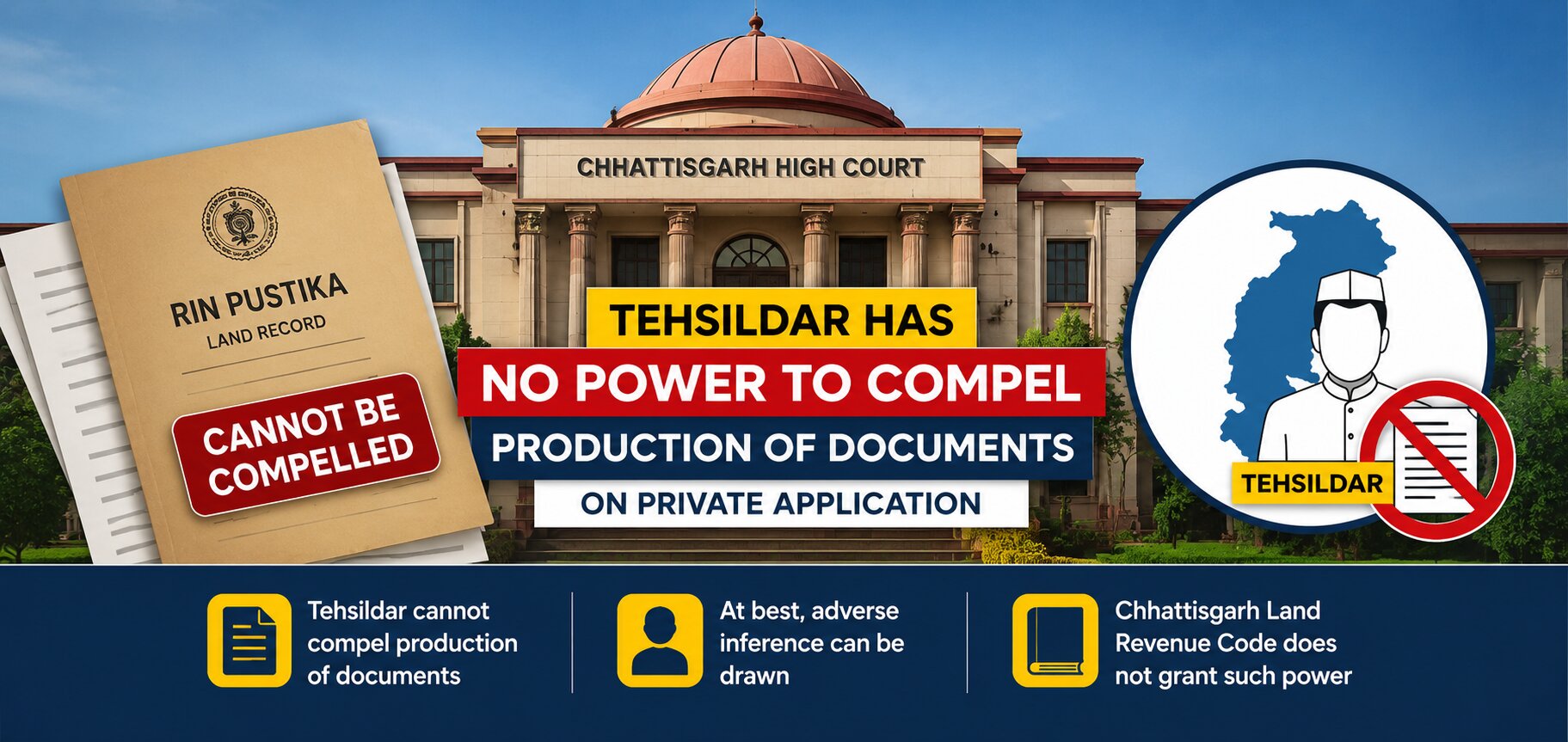
A Tehsildar has no statutory authority under the Chhattisgarh Land Revenue Code to compel a party to produce documents solely on the application of a private respondent.
Judgement Details
Court
Chhattisgarh High Court
Date of Decision
20 July 2026
Judges
Justice Amitendra Kishore Prasad
Citation
Acts / Provisions
Facts of the Case
-
The petitioners challenged an order dated 17.03.2021 passed by the Tehsildar directing them to produce the Rin Pustika (land record booklet) relating to their land.
-
The Tehsildar had issued the direction solely on the basis of an application filed by Respondent No. 3, who was a private party.
-
The petitioners contended that the Chhattisgarh Land Revenue Code does not confer any authority on the Tehsildar to compel a party to produce documents merely because a private respondent seeks their production.
-
The petitioners further challenged the order dated 30.05.2022 passed by the Additional Collector, which affirmed the Tehsildar's order.
-
The respondents argued that the Tehsildar had rightly exercised his powers in directing production of the Rin Pustika for deciding the dispute.
-
The Court noted that the parties had been engaged in multiple litigations before the Civil Court, Revenue Authorities, and even the Supreme Court.
-
The High Court examined whether the Tehsildar possessed statutory authority under the Chhattisgarh Land Revenue Code to compel production of documents at the request of a private party.
Issues
-
Whether a Tehsildar has authority under the Chhattisgarh Land Revenue Code to compel a party to produce documents merely on an application filed by a private respondent?
-
Whether the Tehsildar can direct production of a Rin Pustika in the absence of any statutory provision empowering such compulsion?
-
Whether the Tehsildar is entitled to draw an adverse inference instead of compelling production of documents?
-
Whether the Additional Collector erred in affirming the Tehsildar's order directing compulsory production of documents?
-
Whether an order directing production of documents would be legally permissible only when necessary in a pending proceeding for proper adjudication?
Judgement
-
The Chhattisgarh High Court allowed the writ petition.
-
The Court held that the Chhattisgarh Land Revenue Code does not authorize a Tehsildar to compel production of documents merely because a private respondent has filed an application.
-
It observed that filing an independent application seeking production of documents before the Tehsildar is foreign to the scheme of the Land Revenue Code.
-
The Court clarified that even if a party fails to produce documents, the Tehsildar's remedy is limited to drawing an adverse inference and not compelling production.
-
It held that the power to compel production of documents cannot be assumed in the absence of express statutory authority.
-
The Court observed that if production of documents becomes necessary in a properly instituted pending proceeding for adjudication, an order requiring their production may be legally sustainable.
-
Since no such circumstances existed in the present case, the Tehsildar exceeded his jurisdiction.
-
The Court found that the Additional Collector committed an error in affirming the Tehsildar's order.
-
Accordingly, both the orders dated 17.03.2021 and 30.05.2022 were quashed.
Held
-
The proper consequence of non-production of documents is the drawing of an adverse inference, not compulsory production.
-
Powers not expressly conferred by statute cannot be exercised by revenue authorities.
-
The Tehsildar acted without jurisdiction in directing compulsory production of the Rin Pustika.
-
The Additional Collector erred in affirming the illegal order.
-
The writ petition was allowed, and both impugned orders were quashed.
Analysis
-
The judgment reinforces the principle that statutory authorities must act strictly within the powers conferred upon them by law.
-
The Court emphasized that administrative or revenue authorities cannot assume procedural powers that are not expressly provided under the governing statute.
-
By distinguishing between drawing an adverse inference and compelling production of documents, the Court clarified the limits of a Tehsildar's jurisdiction in revenue proceedings.
-
The ruling protects litigants from arbitrary procedural directions issued at the request of private parties without statutory backing.
-
The Court recognized that while production of documents may be necessary in certain judicial or quasi-judicial proceedings, such power must arise from an express legal provision or be exercised in accordance with established procedural law.
-
The decision strengthens the doctrine of limited statutory jurisdiction, ensuring that revenue authorities do not exceed their lawful powers.
-
The judgment is significant for future land revenue disputes as it prevents misuse of revenue proceedings to compel disclosure of documents outside the framework of the Chhattisgarh Land Revenue Code.
-
The ruling also underscores the importance of procedural fairness by ensuring that parties cannot be compelled to produce documents unless authorized by law.