
Debojit Pankika Charaideo Sonari v. State of Assam, 2026
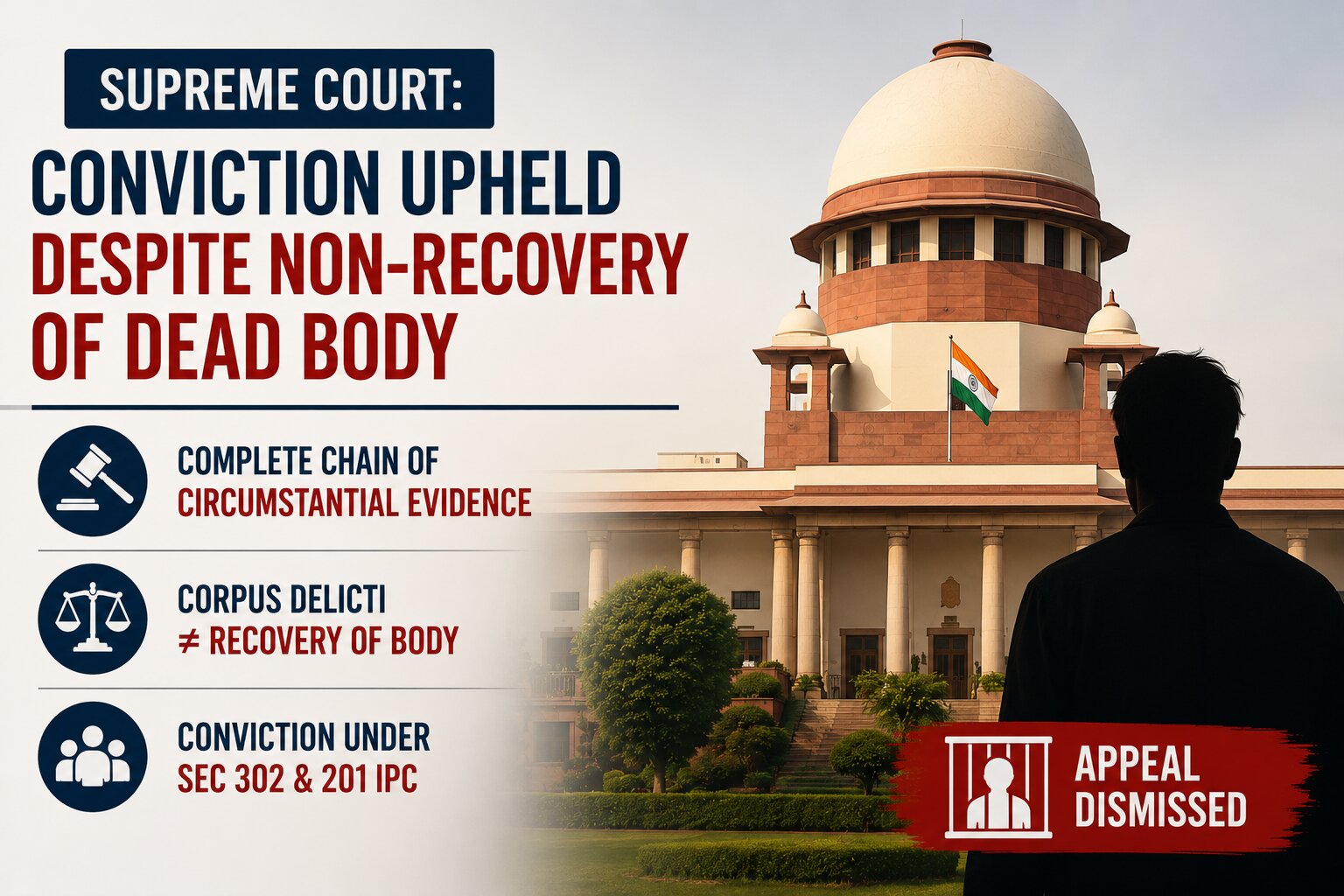
Corpus delicti refers to proof that the offence has occurred and does not require production of the victim's body.
Judgement Details
Court
Supreme Court of India
Date of Decision
18 July 2026
Judges
Justice Sanjay Karol & Justice Prasanna B. Varale
Citation
Acts / Provisions
Facts of the Case
- The deceased was a 10-year-old girl, Soru Kharia (also referred to as Haru Kharia), who had been adopted by the appellant's mother and had lived with the appellant's family for nearly seven years.
-
In June 2015, the appellant's mother left home for medical treatment, leaving the child in the exclusive care of the appellant.
-
Shortly thereafter, the child went missing.
-
Despite the child remaining missing for 22 days, the appellant neither informed the police nor contacted the child's relatives or made any genuine effort to search for her.
-
On 27 June 2015, the child's maternal uncle lodged an FIR under Section 365 IPC.
-
During investigation, the police relied upon the disclosure made by PW-4 Kishore Mall, who stated that the appellant confessed that the child had been burnt and compelled him at dagger-point to help dispose of the body by placing it in a sack and throwing it into the Teok River.
-
Despite extensive efforts, the dead body was never recovered.
-
After investigation, the police filed a charge-sheet under Sections 365, 302 and 201 IPC.
-
The Trial Court convicted the appellant for murder and causing disappearance of evidence, and the conviction was affirmed by the High Court.
-
The appellant challenged the conviction before the Supreme Court, primarily contending that non-recovery of the dead body made the prosecution case unsustainable.
Issues
-
Whether a conviction for murder can be sustained even when the dead body of the deceased is not recovered?
-
Whether non-recovery of the corpus delicti is fatal to a prosecution for murder under Section 302 IPC?
-
Whether the prosecution had established a complete chain of circumstantial evidence proving the guilt of the appellant beyond reasonable doubt?
-
Whether the appellant's failure to explain the disappearance of the child, who was last in his exclusive custody, attracted the principle under Section 106 of the Indian Evidence Act?
-
Whether the testimony of PW-4 was reliable and sufficient to support the prosecution case?
-
Whether the conviction under Sections 302 and 201 IPC warranted interference by the Supreme Court?
Judgement
-
The Supreme Court dismissed the appeal and affirmed the conviction of the appellant.
-
The Court held that non-recovery of the dead body is not fatal where the prosecution establishes a complete and reliable chain of circumstantial evidence.
-
It reiterated that corpus delicti means proof that the offence has been committed and does not require recovery of the victim's body.
-
The Court relied upon Sevaka Perumal v. State of Tamil Nadu (1991) 3 SCC 471, reiterating that murder can be proved by direct or circumstantial evidence, even if the body is not traced.
-
The Court observed that accepting the appellant's argument would mean that every accused could escape punishment simply by successfully disposing of the victim's body.
-
The Court found the appellant's conduct highly incriminating, particularly his silence for 22 days after the child went missing.
-
It observed that a reasonable person would have immediately informed the police or relatives if a child under his care had disappeared.
-
The Court held that the prosecution had discharged its initial burden under Section 106 of the Evidence Act, since the facts relating to the child's disappearance were within the exclusive knowledge of the appellant.
-
The appellant failed to provide any satisfactory explanation during his examination under Section 313 Cr.P.C.
-
The Court found the testimony of PW-4 Kishore Mall to be natural, trustworthy and consistent.
-
It noted that PW-4 had no common intention with the appellant and had merely assisted under threat of a dagger.
-
The Court also observed that if PW-4 intended to falsely implicate the appellant, he could have falsely claimed to be an eyewitness to the murder, but instead confined his testimony only to the facts he actually witnessed.
-
The Court held that the entire chain of circumstantial evidence conclusively established the appellant's guilt beyond reasonable doubt.
Held
-
Recovery of the dead body is not an essential requirement for proving the offence of murder.
-
A conviction under Section 302 IPC can be based entirely on credible circumstantial evidence.
-
The appellant's unexplained conduct and failure to account for the child's disappearance strengthened the prosecution case under Section 106 of the Evidence Act.
-
The testimony of PW-4 was reliable and corroborated the prosecution case.
-
The convictions under Sections 302 and 201 IPC were rightly upheld.
Analysis
- The judgment reaffirms the settled principle that absence of the dead body does not defeat a prosecution for murder if the prosecution proves the case through convincing evidence.
-
The Court clarified the true meaning of corpus delicti, distinguishing it from the physical recovery of a corpse.
-
The decision strengthens the law governing circumstantial evidence, emphasizing that an unbroken chain of circumstances can form the basis of conviction.
-
The Court correctly invoked Section 106 of the Evidence Act, placing the burden on the accused to explain facts exclusively within his knowledge after the prosecution had discharged its initial burden.
-
The judgment highlights that unnatural conduct, such as remaining silent despite a child going missing for several weeks, can constitute a significant incriminating circumstance.
-
By accepting PW-4's testimony, the Court reaffirmed that a witness acting under coercion is not necessarily an accomplice and may still be a credible witness.
-
The ruling prevents offenders from escaping criminal liability merely because they succeed in destroying or concealing the victim's body.
-
The judgment serves as an important precedent on the evidentiary value of circumstantial evidence, last seen circumstances, conduct of the accused, and Section 106 of the Evidence Act in murder prosecutions.