
Debashish Mohapatra & Ors. v. District and Session Judge, Jagatsinghpur & Ors., 2026
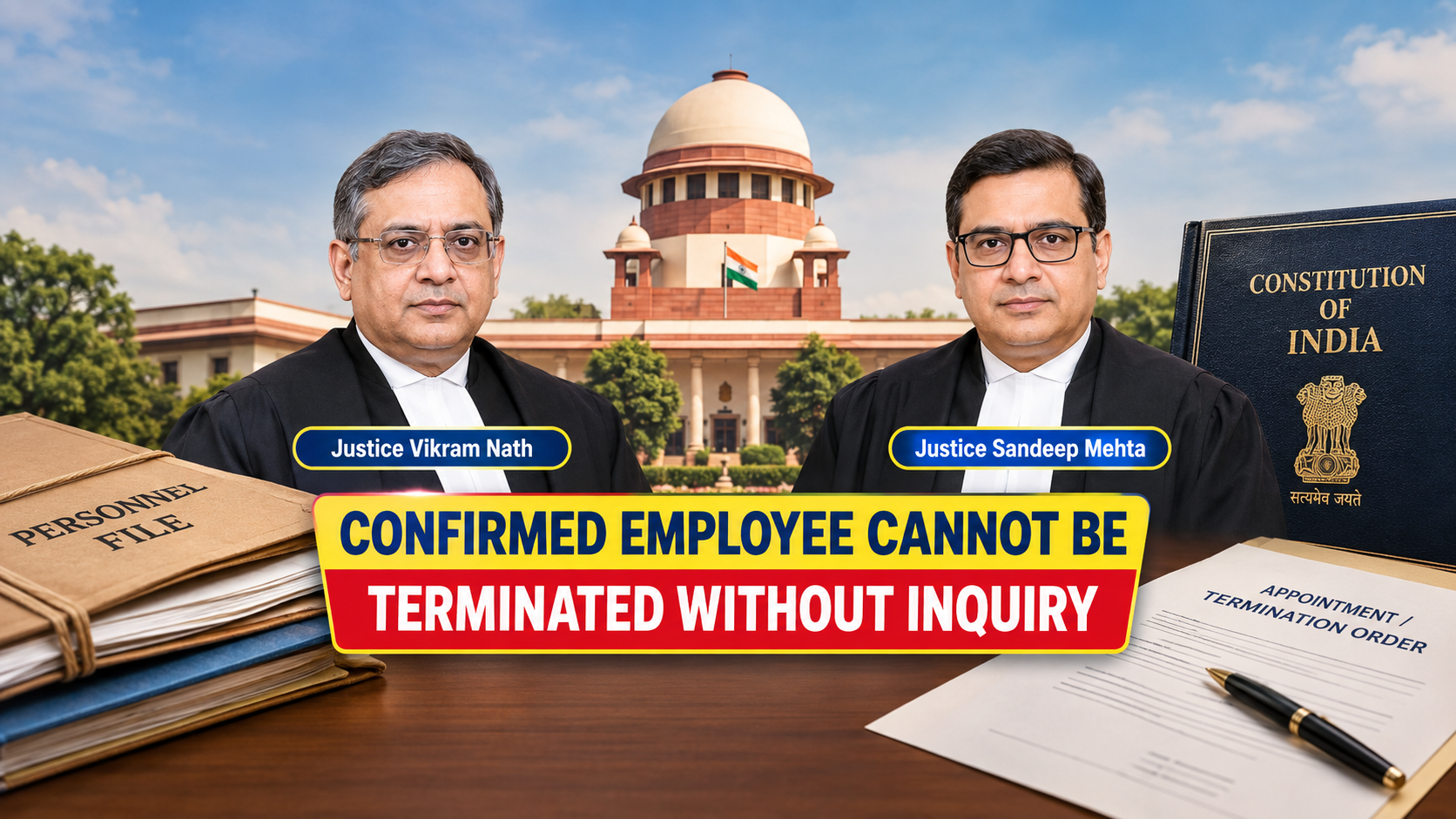
Confirmed Employee Cannot Be Terminated Without Inquiry
Judgement Details
Court
Supreme Court of India
Date of Decision
17 September 2026
Judges
Justice Vikram Nath and Justice Sandeep Mehta
Citation
Acts / Provisions
Facts of the Case
-
An advertisement dated 16 October 2017 was issued for eight posts of Junior Clerk-cum-Copyist in the Jagatsinghpur subordinate judiciary. The appellants participated in the regular recruitment process and were selected on merit.
-
Appellant Nos. 1 and 2 received appointment orders on 23 July 2018 and joined on 1 August 2018, while appellant No. 3 was appointed on 8 March 2019 and joined on 18 March 2019.
-
On 25 April 2022, all three were confirmed in service against substantive posts.
-
Subsequently, a show-cause notice dated 28 February 2023 alleged that the appellants and other employees had been appointed against vacancies exceeding those advertised. On 10 March 2023, their services were terminated on the premise that the appointments were void ab initio.
-
The employees challenged the termination before the High Court's Appeal Committee, but their appeal was dismissed on 12 December 2023. The Orissa High Court subsequently dismissed their writ petition on 11 December 2024.
-
The matter ultimately reached the Supreme Court.
Issues
-
Whether confirmed government employees could be terminated merely through an administrative order without conducting a departmental inquiry.
-
Whether termination based upon alleged irregularity or illegality in the original appointment attracted the protection of Article 311(2).
-
Whether the employees' appointments were invalid merely because the appointments allegedly exceeded the number of vacancies advertised.
-
Whether Provision (5) of Appendix-A to the 2008 Rules permitted appointments against vacancies that had occurred or might occur within the prescribed period.
-
Whether the absence of fraud, misrepresentation or wrongdoing on the part of the selected employees affected the legality of their termination.
Judgement
-
The Supreme Court allowed the appeal and set aside the earlier decisions sustaining the termination.
-
The Court emphasized that Article 311(2) provides a substantive constitutional safeguard to a confirmed civil servant. Once the appellants had attained confirmed status, their services could not be terminated through a simple administrative order founded upon allegations concerning the validity of their appointments.
-
The Court found that no departmental inquiry had been conducted and that none of the constitutionally recognized exceptions permitting dispensing with such inquiry had been established.
-
The Court also examined the 2008 Rules and found that Provision (5) of Appendix-A contemplated appointments not only against existing vacancies but also vacancies that had occurred or might occur within the relevant one-year period.
Held
The Supreme Court held, in substance, that:
-
Confirmation in service confers substantive status and enhanced security of tenure.
-
A confirmed civil servant cannot ordinarily be dismissed or removed on allegations affecting the validity of service without complying with Article 311(2).
-
The employees could not be punished for an alleged recruitment irregularity attributable to the appointing authority when no fraud, misrepresentation or mala fide conduct was alleged against them.
-
The termination order dated 10 March 2023, the Appeal Committee's order dated 12 December 2023, and the Orissa High Court judgment dated 11 December 2024 were set aside.
-
The appellants were directed to be reinstated with continuity of service and all consequential benefits.
-
The competent authority was left free to proceed afresh, if advised, but only in accordance with law and after complying with Article 311(2).
-
Similarly situated persons whose services had been terminated on identical grounds were also granted the benefit of the directions.
Analysis
-
The judgment is significant for service jurisprudence and constitutional procedural safeguards.
-
First, Article 311(2) was treated as a substantive protection rather than a mere procedural technicality. The Court connected this safeguard with the broader constitutional principle against arbitrary State action under Article 14.
-
Second, the judgment distinguishes between the legality of an appointment and the procedure required to terminate a confirmed employee. Even where an authority subsequently questions the validity of an appointment, the employee's confirmed status cannot simply be ignored when taking an adverse service action.
-
Third, the Court examined the recruitment rules themselves. Provision (5) of Appendix-A to the 2008 Rules permitted appointments against vacancies that had occurred or might occur within one year from the first appointment. This was relevant to the respondents' contention that the appointments exceeded the advertised vacancies.
-
Fourth, the Court considered the employees' own conduct. There was no allegation that the appellants had obtained their appointments through fraud, misrepresentation or mala fides. The Court therefore treated it as inequitable to deprive them of employment because of an alleged irregularity attributable to the appointing authority.
-
Finally, the judgment does not create an absolute immunity from disciplinary action. The competent authority remains entitled to proceed against the employees afresh, but any such action must comply with the constitutional requirements of Article 311(2).