
Danish Karim v. Ranjana Chowdhury, 2026
Mutual Consent Divorce & Voluntary Mediation
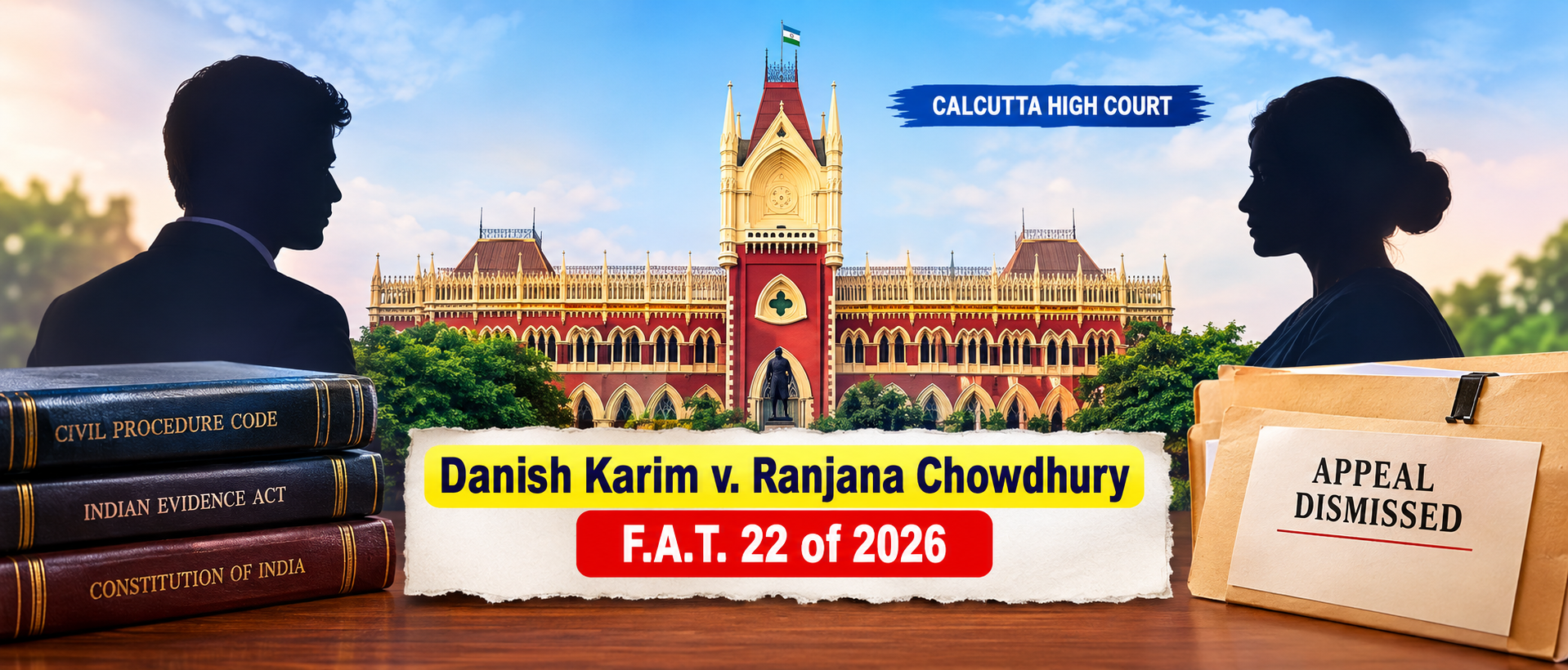
Judgement Details
Court
Calcutta High Court
Date of Decision
22 September 2026
Judges
Justice Sabyasachi Bhattacharyya and Justice Supratim Bhattacharya
Citation
Acts / Provisions
Facts of the Case
-
The parties, Danish Karim and Ranjana Chowdhury, had jointly approached the matrimonial court seeking divorce by mutual consent under Section 28 of the Special Marriage Act, 1954.
-
During the proceedings, the Trial Court, by an order dated 12 August 2025, directed the parties to appear before a mediator for settlement of their disputes.
-
The parties did not appear for mediation on the subsequent dates.
-
The Trial Court treated the non-compliance with its mediation direction as a deliberate violation of its order and criticized the conduct of the parties and their counsel.
-
Ultimately, the Additional District Judge, First Court at Sealdah, dismissed the matrimonial suit arising from the mutual-consent divorce application by Order No. 5 dated 15 January 2026.
-
Danish Karim appealed against the dismissal. Importantly, Ranjana Chowdhury, who was herself a co-applicant in the mutual-consent divorce proceedings, supported the appeal and agreed that the Trial Court's order should be set aside.
Issues
-
Whether a matrimonial court can compel parties seeking divorce by mutual consent to undergo mediation against their wishes.
-
Whether non-appearance before a mediator can constitute a valid ground for dismissing an application for divorce by mutual consent under Section 28 of the Special Marriage Act, 1954.
-
Whether Section 89 CPC permits compulsory mediation when the parties themselves do not consent to mediation.
-
Whether the Trial Court was justified in dismissing the mutual-consent divorce proceedings merely because the parties failed to comply with the direction to participate in mediation.
Judgement
-
The Calcutta High Court allowed F.A.T. 22 of 2026 on consent and set aside the Trial Court's order and decree dated 15 January 2026.
-
The High Court held that mediation cannot be forcibly imposed upon parties. Referring to Section 89 CPC, the Court explained that referral to mediation is subject to the agreement and consent of the parties.
-
The Court emphasized that although a matrimonial court may ordinarily explore reconciliation in contested matrimonial disputes, the position is different where the parties have jointly sought divorce by mutual consent.
-
In such a proceeding, there is little or no scope for adjudicating matrimonial disputes on their merits. If both parties do not agree to mediation, there is no legal basis for forcing them into mediation.
-
The Court therefore held that the Trial Court had proceeded on a “palpable misconception of law” by treating mediation as mandatory and by dismissing the mutual-consent divorce proceedings because of non-compliance with the mediation direction.
-
Set aside Order No. 5 dated 15 January 2026 and the decree of the same date.
-
Remanded the parties' application under Section 28 of the Special Marriage Act to the Trial Court.
-
Directed the Trial Court to dispose of the application in accordance with law and within the statutory timeline.
-
Disposed of CAN 1 of 2026 consequentially.
-
Made no order as to costs.
Held
-
The Calcutta High Court held that consent of both parties is a sine qua non for referring a matter to mediation under Section 89 CPC. Parties cannot be forced against their will to undergo mediation.
-
In a mutual-consent divorce proceeding under Section 28 of the Special Marriage Act, the court cannot dismiss the application merely because the parties failed to attend a mediation session that they did not agree to undertake.
-
The Trial Court's approach was therefore legally unsustainable, and the matter was remanded for fresh disposal according to law.
Analysis
-
The central principle established by the judgment is that mediation depends upon consent. Section 89 CPC enables courts to facilitate ADR, but the High Court emphasized that mediation cannot be transformed into a compulsory process against the wishes of the parties.
-
The Court made an important distinction between an ordinary contested matrimonial suit and a mutual-consent divorce application. In a contested matrimonial case, reconciliation may have a meaningful role because the court is dealing with an existing dispute between spouses. In a mutual-consent divorce, however, both parties have already expressed their intention to dissolve the marriage.
-
The judgment illustrates that procedural directions issued by a court must remain within the framework of statutory law. The Trial Court could not use its mediation direction as a basis for terminating the parties' substantive matrimonial proceeding when the legal framework did not make such mediation mandatory.
-
The High Court rejected the reasoning that failure to participate in mediation automatically justified dismissal of the mutual-consent divorce proceeding. The consequence imposed by the Trial Court was therefore not legally sustainable.
-
The Court stated that the consent of both parties to mediation is a sine qua non—an essential condition—for referring the matter to mediation.
-
The ruling reinforces the principle that ADR should facilitate consensual settlement rather than become a coercive procedural requirement. It also clarifies that reconciliation and mediation should not be mechanically applied in every matrimonial proceeding.
-
A party pursuing mutual-consent divorce cannot be required to undergo mediation merely because the Trial Court believes that mediation should take place. Where both spouses have already jointly sought dissolution of the marriage and do not consent to mediation, their application cannot be dismissed solely for that reason.
-
The High Court did not itself grant the divorce. Instead, it restored the Section 28 application to the Trial Court for disposal according to the statutory requirements of the Special Marriage Act.