
Chappidi Ravindranatha Reddy & Ors. v. Challa Narasamma & Ors., 2026
Expert examination of a disputed thumb impression is relevant where execution of the underlying document is specifically denied.
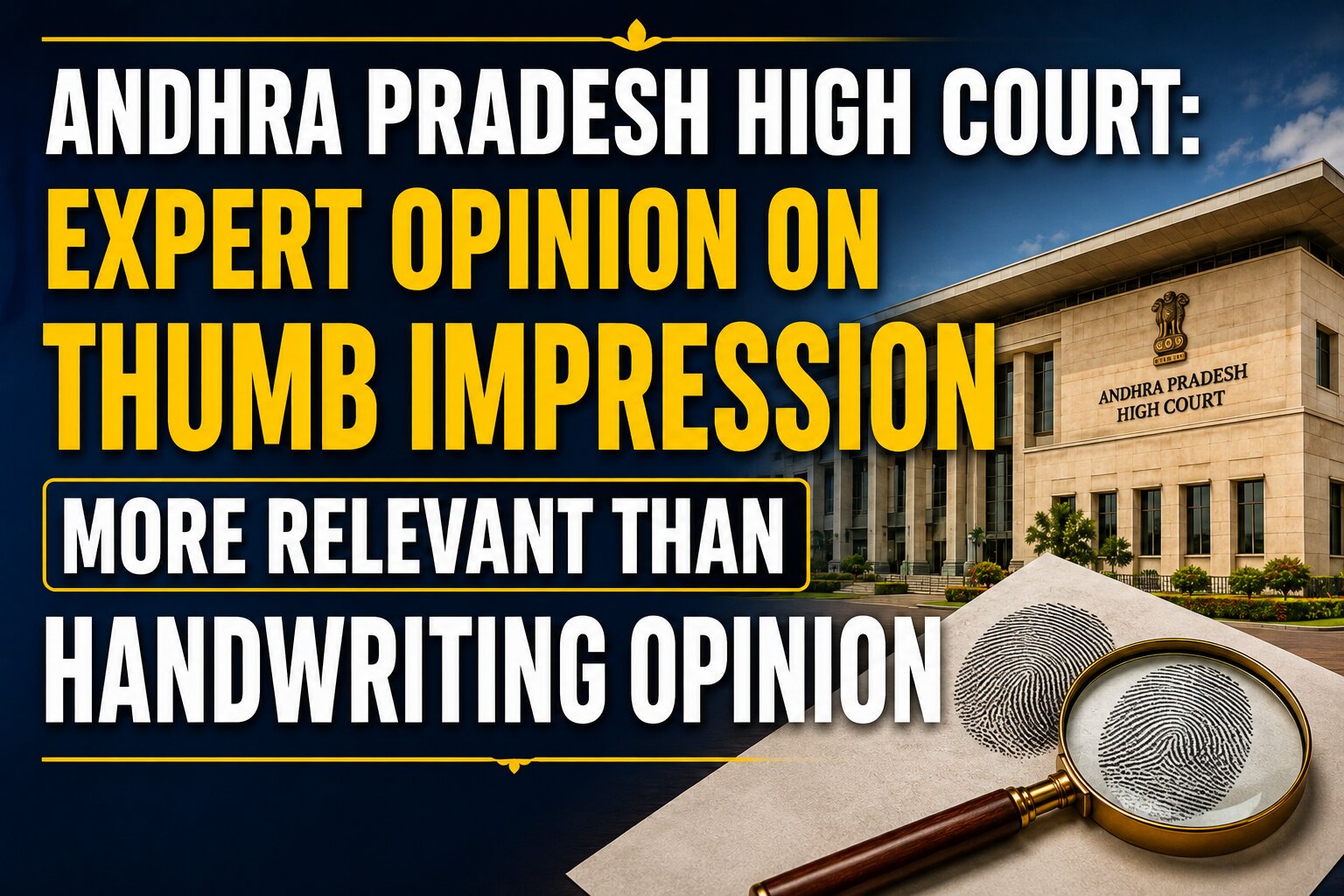
Judgement Details
Court
Andhra Pradesh High Court
Date of Decision
1 August 2026
Judges
Justice Subba Reddy Satti
Citation
Acts / Provisions
Facts of the Case
- The dispute arose from a suit for specific performance based upon an alleged agreement of sale.
-
The defendants disputed the execution of the agreement.
-
They alleged that the signatures were forged and that the document had been fabricated.
-
The plaintiffs therefore sought expert examination of the thumb impression appearing on the disputed agreement.
-
The plaintiffs filed applications requesting that the first defendant be directed to appear before the Court and provide her thumb impression.
-
They further sought a direction to send the disputed agreement, along with the admitted thumb impression, to a fingerprint expert for comparison.
-
The Trial Court rejected both applications.
-
The Trial Court reasoned that the defendants had raised a plea of limitation, which was yet to be decided.
-
It also observed that substantial issues had not yet been framed.
-
According to the Trial Court, obtaining expert evidence at that stage was premature.
-
Aggrieved by the orders, the plaintiffs approached the Andhra Pradesh High Court through two Civil Revision Petitions.
-
The High Court examined whether expert comparison of the disputed thumb impression should have been permitted at that stage of the proceedings.
-
The High Court found that comparison of the thumb impressions could assist in determining whether the disputed document had actually been executed by the concerned defendant.
-
It also considered the scientific nature of fingerprint identification.
-
The Court noted that ageing may reduce the sharpness of fingerprint ridges but does not alter the underlying ridge pattern.
-
The High Court concluded that the Trial Court had failed to properly exercise the jurisdiction vested in it.
Issues
-
Whether a disputed thumb impression appearing on an agreement of sale should be referred to a fingerprint expert for comparison when its execution is specifically denied?
-
Whether expert examination of a disputed thumb impression can be refused merely because an issue relating to limitation remains to be decided?
-
Whether obtaining expert evidence regarding thumb impressions is premature merely because substantial issues have not yet been framed by the Trial Court?
-
Whether expert opinion concerning thumb impressions has greater evidentiary relevance than handwriting opinion when the execution of a document is disputed?
-
Whether the Trial Court's refusal to obtain expert examination of the disputed thumb impression amounted to failure to exercise jurisdiction warranting interference under Article 227 of the Constitution?
Judgement
-
The Andhra Pradesh High Court allowed both Civil Revision Petitions.
-
It set aside the orders passed by the Trial Court.
-
The Court held that the disputed thumb impression should be subjected to expert examination.
-
The first defendant was directed to provide her thumb impression before the Court.
-
The disputed agreement of sale and the admitted thumb impression were directed to be sent to a fingerprint expert for comparison.
-
The High Court held that the Trial Court's reasoning that expert examination was premature was legally unsustainable.
-
The Court observed that the expert examination could assist in the effective adjudication of the dispute.
-
The pendency of the limitation issue did not justify refusing the application for expert examination.
-
The Court distinguished cases concerning handwriting comparison, holding that they were not applicable to a dispute concerning thumb impressions.
-
The Court relied upon the scientific character attributed to fingerprint identification.
-
It observed that ageing may affect the clarity of fingerprints but does not alter the fundamental ridge pattern.
-
The Court concluded that the Trial Court ought to have exercised its jurisdiction and permitted the expert examination.
-
Failure to do so resulted in a miscarriage of justice.
-
The High Court therefore exercised its supervisory jurisdiction under Article 227.
Held
- Fingerprint identification was treated by the Court as an exact science that does not ordinarily admit of mistake or doubt.
-
The existence of a pending limitation issue does not necessarily make expert examination of a disputed document premature.
-
The absence of framed substantial issues is not, by itself, sufficient reason to reject an application seeking scientific examination of disputed thumb impressions.
-
The Trial Court should have permitted comparison of the disputed and admitted thumb impressions.
-
Authorities concerning handwriting comparison cannot automatically be applied to cases concerning fingerprint or thumb-impression identification.
-
The Trial Court's refusal amounted to failure to exercise jurisdiction vested in it.
-
The High Court therefore interfered under Article 227 of the Constitution.
-
The revision petitions were allowed and the Trial Court was directed to obtain and send the relevant thumb impressions for expert comparison.
Analysis
-
Scientific evidence: The central feature of the judgment is the Court's reliance on the scientific character of fingerprint identification. Unlike handwriting, fingerprint ridge patterns are considered highly distinctive.
-
Disputed execution: Where a party specifically denies executing a document, scientific comparison of a disputed thumb impression can provide important evidence regarding authenticity.
-
Expert evidence as an aid: The Court treated expert examination as a mechanism that could assist the Trial Court in reaching a proper conclusion rather than as an unnecessary procedural step.
-
Limitation issue: The Trial Court had considered the pending limitation question a reason to postpone expert examination. The High Court rejected that reasoning because the expert evidence could remain relevant to the substantive dispute depending upon the outcome of the limitation issue.
-
Prematurity: The judgment makes clear that an application for expert examination should not automatically be rejected merely because the proceedings are at an earlier procedural stage.
-
Handwriting versus thumb impression: The High Court specifically distinguished authorities dealing with handwriting. It emphasized that the scientific basis for fingerprint identification is different and therefore handwriting-related precedents could not simply be transplanted into the present dispute.
-
Ageing of fingerprints: The Court noted that ageing can reduce the sharpness or clarity of ridge impressions but does not necessarily destroy the underlying identifying ridge pattern.
-
Article 227 jurisdiction: The case illustrates the High Court's supervisory power to intervene where a subordinate court fails to exercise jurisdiction properly.
-
Miscarriage of justice: The High Court considered the Trial Court's refusal to permit examination of the disputed thumb impression capable of affecting the proper adjudication of the suit and therefore warranting intervention.
-
Specific performance proceedings: In a suit seeking specific performance, establishing whether the alleged agreement was genuinely executed can be fundamental to determining the plaintiff's entitlement.
-
Balanced approach: The judgment does not itself conclusively determine that the disputed document is genuine. Instead, it directs that the relevant scientific evidence be obtained so that the Trial Court can make the appropriate determination.
-
Evidentiary significance: The ruling demonstrates the importance of scientific evidence where documentary execution is disputed, particularly where the dispute concerns a biometric identifier such as a thumb impression.
-
Overall significance: The decision reinforces that procedural objections should not unnecessarily prevent courts from obtaining potentially decisive scientific evidence required for the proper adjudication of a dispute.