
Chandrikaben Kishor Dafda v. State of Gujarat & Anr., 2026
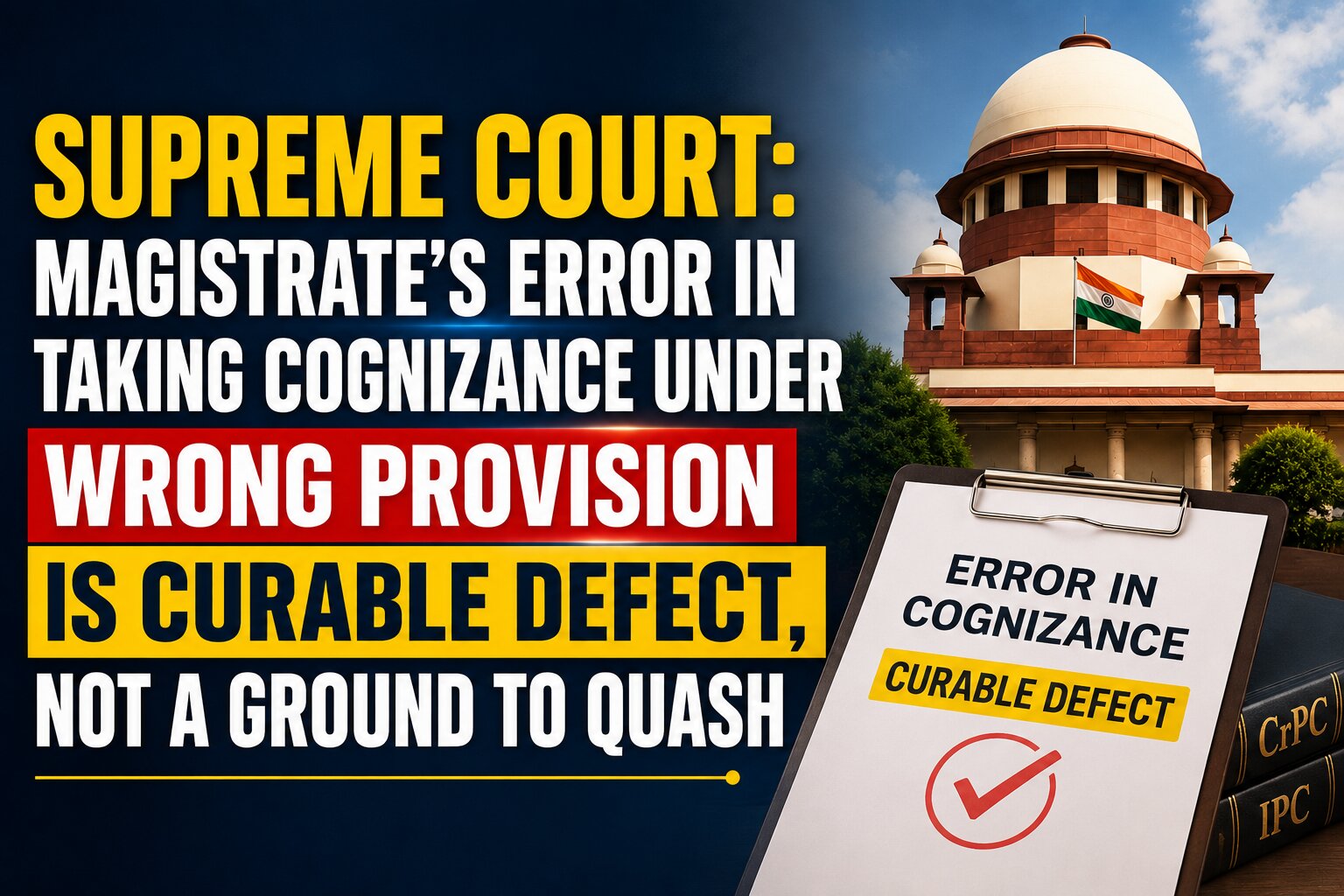
An incorrect statutory provision cited while taking cognizance does not automatically invalidate the proceedings.
Judgement Details
Court
Supreme Court of India
Date of Decision
3 August 2026
Judges
Justice Sanjay Karol and Justice Nongmeikapam Kotiswar Singh
Citation
Acts / Provisions
Facts of the Case
-
The appellant had won the 2015 Bhuj Civic Body Election.
-
Allegations were made that she failed to disclose four agricultural properties owned by her husband in her election affidavit.
-
A private complaint alleged offences under Sections 192, 193 and 196 IPC, along with Section 125A of the Representation of the People Act.
-
The Magistrate took cognizance only under Section 125A RPA and issued summons.
-
The appellant argued that the RPA does not govern municipal elections.
-
The Gujarat High Court declined to quash the cognizance order.
-
The matter was then brought before the Supreme Court.
-
The Supreme Court agreed that the Magistrate had invoked an incorrect statutory provision.
-
However, the Court held that this error was curable because the Magistrate had jurisdiction to take cognizance of the other offences mentioned in the complaint.
Issues
-
Whether taking cognizance under an incorrect statutory provision automatically invalidates the cognizance order?
-
Whether an error by a Magistrate in citing the wrong penal provision can be cured under Section 465 CrPC when the Magistrate otherwise possesses jurisdiction to take cognizance of the offence?
-
Whether cognizance taken under Section 125A of the Representation of the People Act in relation to a municipal election constitutes a fatal jurisdictional defect?
-
Whether the proceedings can continue when the complaint itself refers to other applicable penal provisions under the IPC?
Judgement
-
The Supreme Court partly allowed the appeal.
-
It held that the Magistrate had erred by taking cognizance under the Representation of the People Act in relation to a municipal election.
-
However, the Court held that the error was a curable irregularity.
-
Section 465 CrPC protects proceedings from being invalidated merely because of an incorrect statutory reference, unless the error causes a failure of justice.
-
The Court reiterated that cognizance is taken of an offence, not merely of a particular statutory section.
-
The cognizance order was therefore not treated as automatically void.
-
The matter was remanded to the Magistrate to take cognizance afresh under the appropriate provisions and proceed according to law.
-
The Supreme Court clarified that it had not expressed any opinion on the merits of the allegations.
Held
- Such an error is a curable defect where the Magistrate otherwise has jurisdiction over the offence.
-
Section 465 CrPC can save an incorrect cognizance order where there is no failure of justice.
-
Cognizance is taken of the offence, rather than merely the statutory section mentioned by the Magistrate.
-
The Magistrate must reconsider the matter under the correct applicable provisions.
Analysis
-
Curable irregularity: The Court distinguished between a fundamental lack of jurisdiction and a mere error in identifying the applicable statutory provision.
-
Section 465 CrPC: The provision prevents criminal proceedings from being unnecessarily invalidated because of technical errors that have not resulted in a failure of justice.
-
Cognizance of offence: The judgment reinforces the principle that the substance of the alleged offence is more important than an erroneous statutory label attached to it at the cognizance stage.
-
Municipal election context: Although the Magistrate invoked Section 125A RPA, the complaint had also referred to IPC provisions. Therefore, the error did not necessarily terminate the entire prosecution.
-
No automatic quashing: The Court refused to adopt an approach under which every incorrect citation of a statutory provision would result in automatic quashing.
-
Remand: Instead of ending the proceedings, the Court directed the Magistrate to reconsider cognizance under the appropriate provisions.
-
Protection against prejudice: Section 465 CrPC ensures that procedural mistakes do not become a technical escape route unless the accused demonstrates actual failure of justice.
-
Limited ruling: The Supreme Court expressly avoided deciding whether the allegations against the appellant were true. The decision was limited to the propriety of the cognizance order.