
Chandra Bhan and Another v. State of Uttar Pradesh, 2026
The Court reaffirmed that a mere allegation or demand for dowry is insufficient unless accompanied by evidence establishing a proximate and live connection between the demand and the death.
Judgement Details
Court
Allahabad High Court
Date of Decision
15 July 2026
Judges
Justice Salil Kumar Rai and Justice Dr. Ajay Kumar
Citation
Acts / Provisions
Facts of the Case
-
The father of the deceased lodged an FIR on 1 March 1988 alleging that his daughter had been subjected to cruelty and was burnt to death by her husband, Chandra Bhan, and his relatives for failing to meet a dowry demand of a scooter or ₹10,000.
-
Although the FIR was initially registered under Section 302 IPC, the Investigating Officer filed a charge-sheet only under Sections 304-B and 498-A IPC and Sections 3 and 4 of the Dowry Prohibition Act.
-
The Trial Court framed charges only under Sections 304-B and 498-A IPC, omitting any charge under Section 302 IPC despite the allegations of homicidal death.
-
On 4 October 1989, the Trial Court convicted Chandra Bhan and another accused, Jairam, under Section 304-B IPC and sentenced them to life imprisonment.
-
During the pendency of the appeal, co-accused Jairam died, and the appeal survived only with respect to Chandra Bhan.
-
The appellant argued that the prosecution failed to prove cruelty or harassment in connection with dowry demand soon before the deceased's death, which is an essential ingredient of Section 304-B IPC.
-
The High Court examined a letter written by the deceased to her father in November 1987, which revealed that her distress stemmed from her husband's frequent visits to his widowed sister-in-law, giving rise to suspicion of an illicit relationship rather than dowry-related harassment.
-
The Court also found that the evidence of the deceased's parents regarding dowry harassment was vague, general, and lacking in specific instances of cruelty.
-
Medical evidence showed that the husband had sustained burn injuries while attempting to save the deceased and had himself taken her to the hospital instead of absconding.
-
Although the deceased's dying declaration alleged that her husband and in-laws poured kerosene on her and set her on fire, the Court found that surrounding circumstances created serious doubts regarding its reliability.
Issues
-
Whether the prosecution proved that the deceased was subjected to cruelty or harassment in connection with dowry demand soon before her death as required under Section 304-B IPC?
-
Whether the prosecution established the necessary proximate and live link between the alleged dowry-related cruelty and the death of the deceased?
-
Whether the statutory presumption under Section 113-B of the Indian Evidence Act could be invoked in the absence of proof of cruelty soon before death?
-
Whether the dying declaration was reliable enough to establish the offence of murder?
-
Whether the appellate court could convict the appellant under Section 302 IPC despite no charge having been framed under that provision by the Trial Court?
-
Whether Trial Courts are required to frame the principal charge under Section 302 IPC and an alternative charge under Section 304-B IPC when the investigation discloses prima facie evidence of homicidal death inside the matrimonial home?
Judgement
-
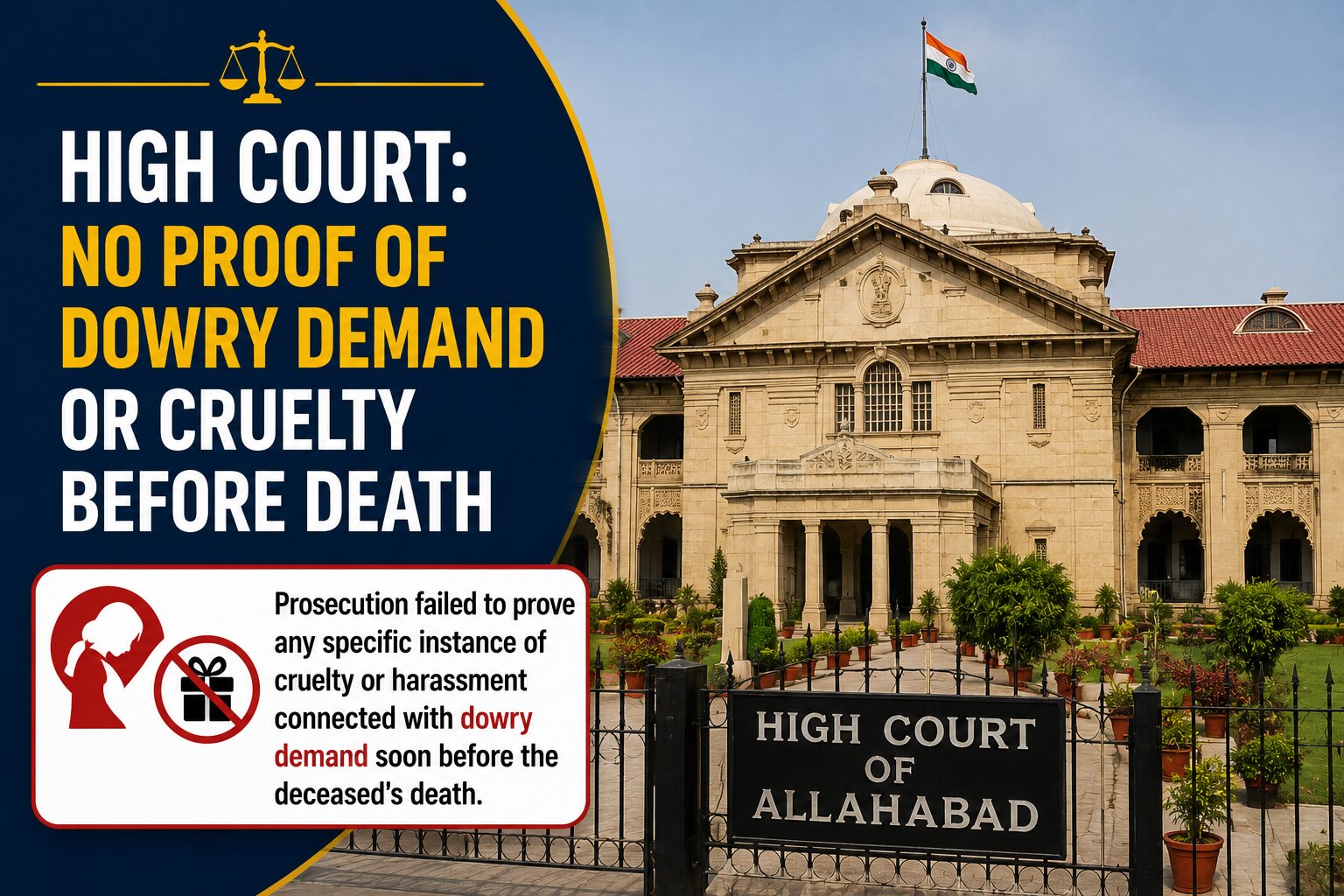
The High Court held that the prosecution failed to prove any specific instance of cruelty or harassment connected with dowry demand soon before the deceased's death.
-
The Court observed that the evidence disclosed no proximate and live link between the alleged dowry demand and the death, thereby rendering the ingredients of Section 304-B IPC unfulfilled.
-
The Court held that the statutory presumption under Section 113-B of the Indian Evidence Act could not be invoked because the prosecution failed to discharge its initial burden.
-
The Court found that the deceased's letter indicated that her distress was primarily due to suspicion regarding her husband's relationship with his widowed sister-in-law rather than any dowry dispute.
-
The Court held that the dying declaration was not free from doubt in light of the surrounding circumstances, including the husband's burn injuries and his conduct in taking the deceased to the hospital.
-
The Court ruled that it could not convict the appellant under Section 302 IPC because no charge under that provision had been framed and no opportunity had been given to the accused to defend himself against such a charge during examination under Section 313 CrPC.
-
The Court declined to order a retrial under Section 302 IPC considering that the incident had occurred in 1988 and such a course would be inappropriate after several decades.
-
The Court allowed the appeal and acquitted the surviving appellant of all charges.
-
The High Court issued mandatory directions to all Trial Courts in Uttar Pradesh requiring careful scrutiny of the evidence while framing charges in matrimonial death cases.
-
The Court directed that whenever prima facie evidence indicates a homicidal death inside the matrimonial home, the principal charge should ordinarily be framed under Section 302 IPC, with an alternative charge under Section 304-B IPC, wherever justified by the material on record.
-
The Court further directed that a copy of the judgment be circulated to all Judicial Officers in Uttar Pradesh through the Registrar (Compliance).
Held
-
The prosecution failed to establish the essential ingredients of Section 304-B IPC.
-
There was no proximate and live link between the alleged dowry harassment and the death of the deceased.
-
The presumption under Section 113-B of the Indian Evidence Act was not attracted.
-
The dying declaration was not sufficiently reliable to sustain a conviction for murder.
-
The appellant could not be convicted under Section 302 IPC in the absence of a specific charge and compliance with procedural safeguards.
-
The conviction under Section 304-B IPC was set aside, and the appellant was acquitted.
-
Trial Courts across Uttar Pradesh were directed to frame the principal charge under Section 302 IPC, with an alternative charge under Section 304-B IPC, whenever the investigation discloses prima facie evidence of homicidal death within the matrimonial home.
Analysis
-
The judgment reinforces that conviction under Section 304-B IPC requires proof of every statutory ingredient, particularly cruelty or harassment for dowry soon before the death.
-
The decision strengthens procedural fairness by holding that an accused cannot be convicted for murder without being formally charged and given an opportunity to defend against that accusation.
-
The Court clarified the distinction between Section 302 IPC and Section 304-B IPC, emphasizing that murder is not a minor or cognate offence of dowry death and cannot be substituted at the appellate stage.
-
The judgment highlights the importance of proper charge-framing by Trial Courts and seeks to prevent situations where clear evidence of homicide is overlooked in favour of a dowry death charge alone.
-
The Court balanced substantive justice with procedural safeguards by refusing to order a retrial after nearly four decades while simultaneously issuing prospective directions to prevent similar lapses.
-
The directions issued to all Trial Courts in Uttar Pradesh are significant because they aim to ensure comprehensive prosecution of matrimonial deaths involving homicidal evidence without mechanically adding Section 302 IPC in every case.
-
The judgment is likely to influence future dowry death prosecutions by encouraging courts to distinguish carefully between homicide and dowry death while preserving the rights of the accused through proper framing of charges.