
Chairman, Central Board of Trustees, Employees Provident Fund Organization and Others v. Deepak Tigga and Another, 2026
A mere mistake of law or wrong interpretation of law by a quasi-judicial authority does not, by itself, constitute misconduct.
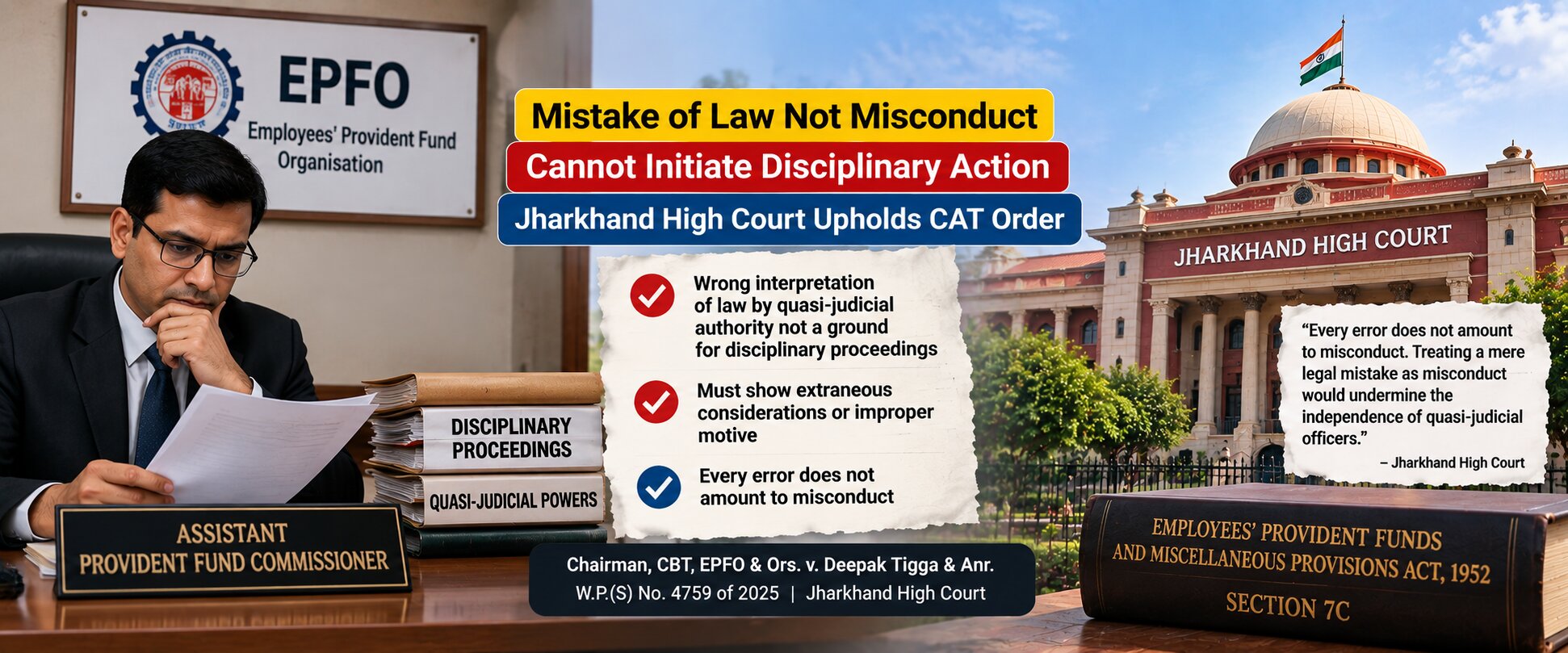
Judgement Details
Court
High Court of Jharkhand
Date of Decision
21 September 2026
Judges
Justice Sujit Narayan Prasad and Justice Pradeep Kumar Srivastava
Citation
Acts / Provisions
Facts of the Case
-
The dispute arose from disciplinary proceedings initiated against Deepak Tigga, who was serving as an Assistant Provident Fund Commissioner.
-
The officer was exercising quasi-judicial powers under Section 7C of the Employees' Provident Funds and Miscellaneous Provisions Act, 1952.
-
The proceedings concerned Katihar Medical College.
-
During the course of the proceedings, the matter was remanded by the EPF Appellate Tribunal.
-
Following the remand, the officer passed an order dated 4 November 2010 closing the proceedings.
-
Subsequently, disciplinary proceedings were initiated against the officer.
-
The allegations essentially concerned alleged negligence and recklessness in conducting the inquiry and passing the order.
-
A disciplinary penalty was ultimately imposed, involving a 30% cut in pension for five years.
-
The officer challenged the disciplinary action before the Central Administrative Tribunal (CAT).
-
The Tribunal held that disciplinary proceedings could not be sustained merely because the officer had exercised his quasi-judicial powers in a manner allegedly involving an erroneous interpretation or application of law.
-
The Tribunal accordingly quashed the disciplinary proceedings.
-
The Employees' Provident Fund Organisation (EPFO) challenged the Tribunal's decision before the Jharkhand High Court.
-
Before the High Court, the EPFO sought to sustain the disciplinary action on the basis that the officer's conduct amounted to negligence and recklessness.
-
The High Court examined whether the officer's alleged legal error in exercising his statutory jurisdiction could, without allegations of improper motive or extraneous considerations, constitute misconduct warranting disciplinary proceedings.
-
The Court also examined the contents of the charge memorandum to determine whether it contained allegations going beyond the alleged incorrectness of the officer's quasi-judicial order.
Issues
-
Whether a mistake of law or wrong interpretation of law by a quasi-judicial authority while exercising lawful jurisdiction can, by itself, constitute misconduct warranting disciplinary proceedings?
-
Whether disciplinary proceedings can be sustained against a quasi-judicial officer merely because the order passed by the officer is alleged to be legally erroneous or incorrect?
-
Whether the charge memorandum disclosed any extraneous consideration, improper motive, lack of integrity, moral turpitude or other circumstances sufficient to convert the alleged legal error into misconduct?
-
Whether the disciplinary penalty imposed upon the Assistant Provident Fund Commissioner could be sustained in the absence of allegations demonstrating misconduct beyond the alleged error in exercising quasi-judicial jurisdiction?
-
Whether the Central Administrative Tribunal was justified in quashing the disciplinary proceedings initiated against the respondent officer?
Judgement
-
The Jharkhand High Court dismissed the writ petition filed by the EPFO.
-
The Court upheld the decision of the Central Administrative Tribunal quashing the disciplinary proceedings.
-
The Bench held that a mistake of law or wrong interpretation of law, committed by a quasi-judicial officer while exercising lawful jurisdiction, cannot by itself constitute a basis for disciplinary proceedings.
-
The Court emphasised that the legality or correctness of a quasi-judicial order ordinarily has to be examined through the appropriate appellate or judicial mechanism, rather than by treating every legal error as departmental misconduct.
-
The Court held that the charge memorandum must clearly demonstrate how the impugned order or conduct amounted to misconduct.
-
The Court found that the allegations against the officer did not sufficiently go beyond the alleged legal error.
-
The charge memorandum did not contain allegations concerning integrity, moral turpitude, extraneous influence or improper motive.
-
The Court held that every error does not amount to misconduct.
-
It further observed that treating an ordinary legal mistake as misconduct could undermine the independence of quasi-judicial officers.
-
For disciplinary proceedings against such officers to be sustained, the allegations must disclose circumstances such as extraneous considerations or improper motives, rather than merely demonstrate that the officer's legal conclusion was allegedly wrong.
-
Finding no error in the Tribunal's decision, the High Court dismissed the EPFO's petition.
Held
-
A quasi-judicial officer exercising lawful jurisdiction cannot ordinarily be subjected to disciplinary proceedings merely because the order subsequently turns out to be legally erroneous.
-
The charge memorandum must disclose specific circumstances demonstrating misconduct, rather than simply challenging the correctness of the officer's decision.
-
Allegations of extraneous considerations, improper motive, lack of integrity or moral turpitude may take a case beyond a mere legal error.
-
The independence of quasi-judicial authorities must be protected against disciplinary action based solely on alleged errors in adjudication.
-
Every error does not amount to misconduct.
-
The disciplinary proceedings and resulting penalty against Deepak Tigga were therefore not sustainable on the facts presented.
-
The Central Administrative Tribunal's decision quashing the disciplinary action was affirmed.
Analysis
-
Legal error versus misconduct: The central principle of the judgment is the distinction between an incorrect judicial or quasi-judicial decision and disciplinary misconduct. An erroneous interpretation of law does not automatically establish that the officer acted improperly.
-
Protection of quasi-judicial independence: The Court recognised that quasi-judicial authorities must be able to interpret and apply the law without the constant possibility that an incorrect conclusion will result in departmental punishment. Otherwise, decision-makers could become reluctant to exercise independent judgment.
-
Correctness of an order: The Court's reasoning indicates that the correctness of a quasi-judicial order should ordinarily be tested through the legally prescribed appeal, revision or judicial review mechanism. Disciplinary proceedings are not intended to function as an alternative appellate process.
-
Requirement of misconduct: For disciplinary action to be justified, there must be something more than an incorrect legal conclusion. The allegations must disclose circumstances demonstrating actual misconduct, such as improper motive, extraneous considerations or other culpable conduct.
-
Charge memorandum: The contents of the charge memorandum were important. The Court found that it did not sufficiently explain how the officer's order constituted misconduct beyond being allegedly erroneous.
-
Mens rea and improper motive: The Court's reasoning gives particular importance to circumstances showing that the officer was influenced by considerations unrelated to the lawful exercise of his statutory jurisdiction. Mere disagreement with the legal conclusion is insufficient.
-
Every error is not misconduct: This principle provides an important safeguard against converting ordinary mistakes made in adjudicatory functions into disciplinary offences.
-
Impact on administrative law: The judgment reinforces the separation between administrative discipline and adjudicatory review. A department cannot necessarily use disciplinary proceedings simply because it disagrees with the legal reasoning adopted by its quasi-judicial officer.
-
Practical significance: The ruling is relevant to disciplinary proceedings involving officers who exercise statutory adjudicatory or quasi-judicial powers. It indicates that a charge-sheet should identify concrete misconduct rather than merely reproduce the department's disagreement with the officer's legal conclusion.
-
Limitation of the principle: The judgment does not mean that a quasi-judicial officer can never face disciplinary action. Where there is evidence of corruption, bad faith, extraneous influence, improper motive, lack of integrity or other genuine misconduct, disciplinary proceedings may stand on a different footing.