
Brajesh Kumar @ Birjesh Kumar Singh v. State of Bihar, 2026
Mere marital relationship with the deceased cannot justify prosecution in the absence of credible evidence.
Judgement Details
Court
Supreme Court of India
Date of Decision
13 July 2026
Judges
Justice Sanjay Kumar & Justice K. Vinod Chandran
Citation
Acts / Provisions
Facts of the Case
-
The appellant's wife sustained approximately 40% burn injuries at her matrimonial home in Mirzapur, Uttar Pradesh, in the year 2000 and subsequently died.
-
Nearly one month after the incident, the deceased's father lodged an FIR alleging that the husband and his family had harassed the deceased for a dowry demand of ₹50,000, resulting in her dowry death.
-
The FIR named 17 members of the matrimonial family, including the husband, his parents, siblings, and several other relatives.
-
During investigation, the police initially implicated all the accused but, on the direction of the Superintendent of Police, filed the first charge sheet only against the parents-in-law while continuing investigation against the remaining accused.
-
Consequently, two separate criminal trials were conducted.
-
The father-in-law and mother-in-law were acquitted in the first trial.
-
In the second trial, the husband alone was convicted, whereas 14 other relatives were acquitted.
-
The High Court remanded the matter to the trial court on the ground that certain prosecution witnesses had not been cross-examined.
-
The husband challenged his conviction before the Supreme Court.
Issues
-
Whether the prosecution proved beyond reasonable doubt that the deceased was subjected to cruelty or harassment in connection with dowry demand so as to constitute an offence under Sections 498A and 304B IPC?
-
Whether the conviction of the husband could be sustained when the prosecution failed to establish the allegations against the remaining family members?
-
Whether the High Court was justified in remanding the matter solely on the ground that certain witnesses had not been cross-examined?
-
Whether the evidence on record indicated that the deceased died due to accidental burns rather than a dowry death?
Judgement
-
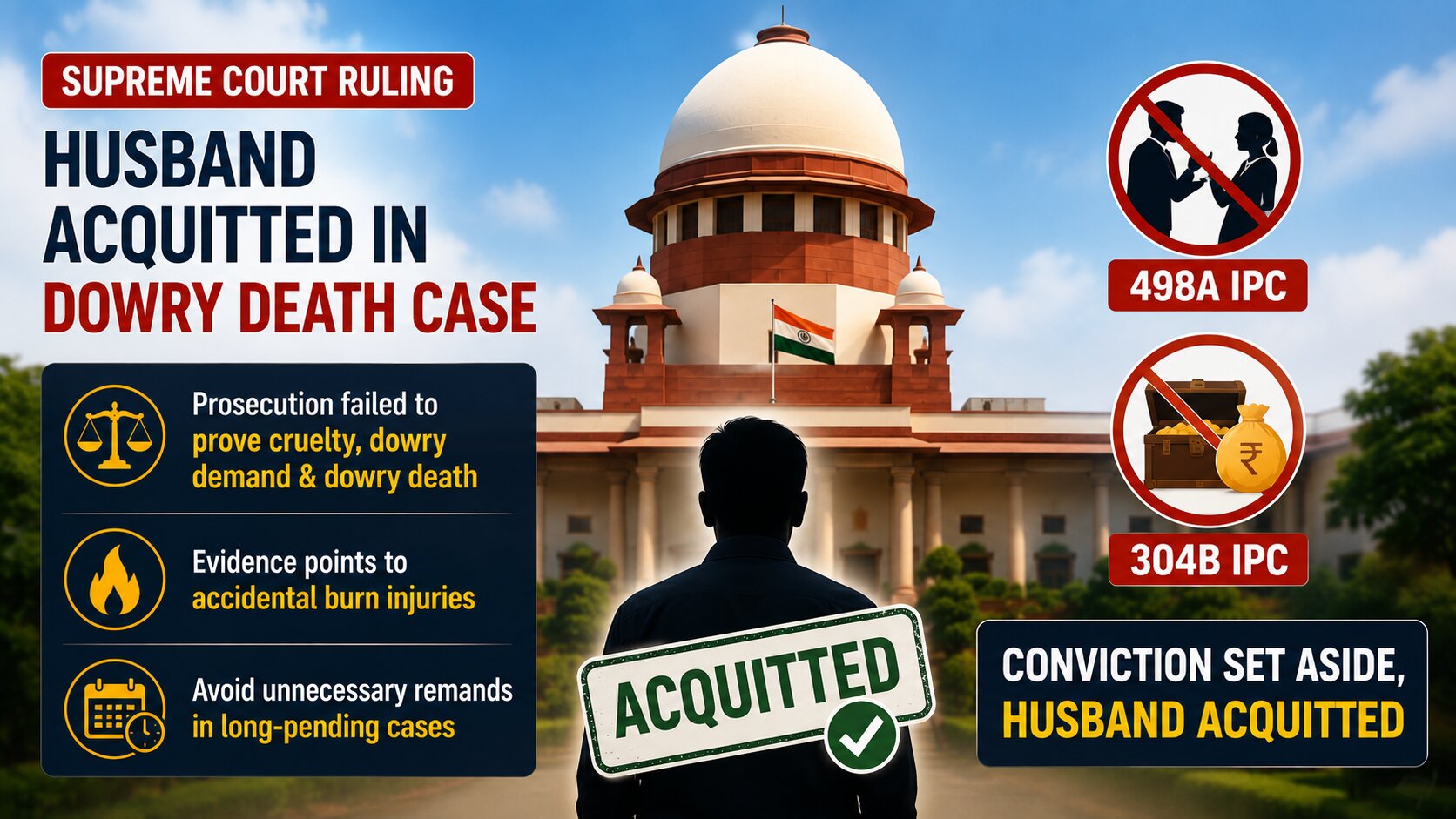
The Supreme Court allowed the appeal and acquitted the husband.
-
The Court held that the prosecution failed to establish the alleged demand for dowry or cruelty beyond reasonable doubt.
-
The Bench observed that the evidence, including medical records, contemporaneous documents, and an exculpatory dying declaration, indicated that the deceased had most probably sustained accidental burn injuries while cooking.
-
The Court noted that despite implicating 17 members of the matrimonial family, the prosecution failed to prove the allegations against almost all of them.
-
It observed that the father-in-law and mother-in-law had already been acquitted, while fourteen other relatives were also acquitted during trial.
-
The Court described the prosecution of seventeen family members merely because of their relationship with the deceased as a "clear travesty of justice."
-
The Bench expressed concern regarding the conduct of the investigation, particularly the filing of two separate charge sheets arising out of the same FIR, resulting in separate trials.
-
The Court also criticized the Patna High Court for adopting a casual approach by remanding the matter solely because certain witnesses had not been cross-examined, even though their evidence was inconsequential.
-
The Supreme Court emphasized that appellate courts should exercise greater caution before ordering remands in criminal cases that have remained pending for decades.
-
Finding that the prosecution failed to prove its case beyond reasonable doubt, the Court set aside the conviction and acquitted the appellant.
Held
-
The prosecution failed to establish cruelty, dowry demand, and dowry death beyond reasonable doubt.
-
The evidence indicated that the deceased most probably suffered accidental burn injuries.
-
Appellate courts should avoid unnecessary remands that prolong criminal proceedings, particularly in long-pending cases.
-
The husband's conviction under Sections 498A and 304B IPC was set aside, and he was acquitted.
Analysis
-
The judgment reinforces the principle that criminal liability must be based on legally admissible evidence and not merely on familial relationships.
-
The Supreme Court strongly condemned the common investigative practice of arraying every member of the matrimonial family as an accused without individualized evidence of involvement.
-
The Court reaffirmed that prosecutions under Sections 498A and 304B IPC require strict proof of cruelty or harassment connected with dowry demands and cannot rest on generalized allegations.
-
By relying upon the medical evidence and the exculpatory dying declaration, the Court emphasized that objective contemporaneous evidence carries significant weight while evaluating allegations of dowry death.
-
The decision also serves as an important reminder that appellate courts must exercise restraint while ordering remands, especially where proceedings have remained pending for several decades, as such orders unnecessarily prolong litigation and prejudice the accused.
-
The judgment underscores that procedural fairness and careful judicial scrutiny are essential to prevent misuse of criminal law in matrimonial disputes.
-
Overall, the ruling strengthens the requirement that courts carefully distinguish between genuine cases of dowry death and cases where suspicion alone forms the basis of prosecution.