
Braham Dutt and Others v. State of Haryana, 2026
The last-seen theory alone was insufficient to sustain conviction without adequate corroborative circumstances.
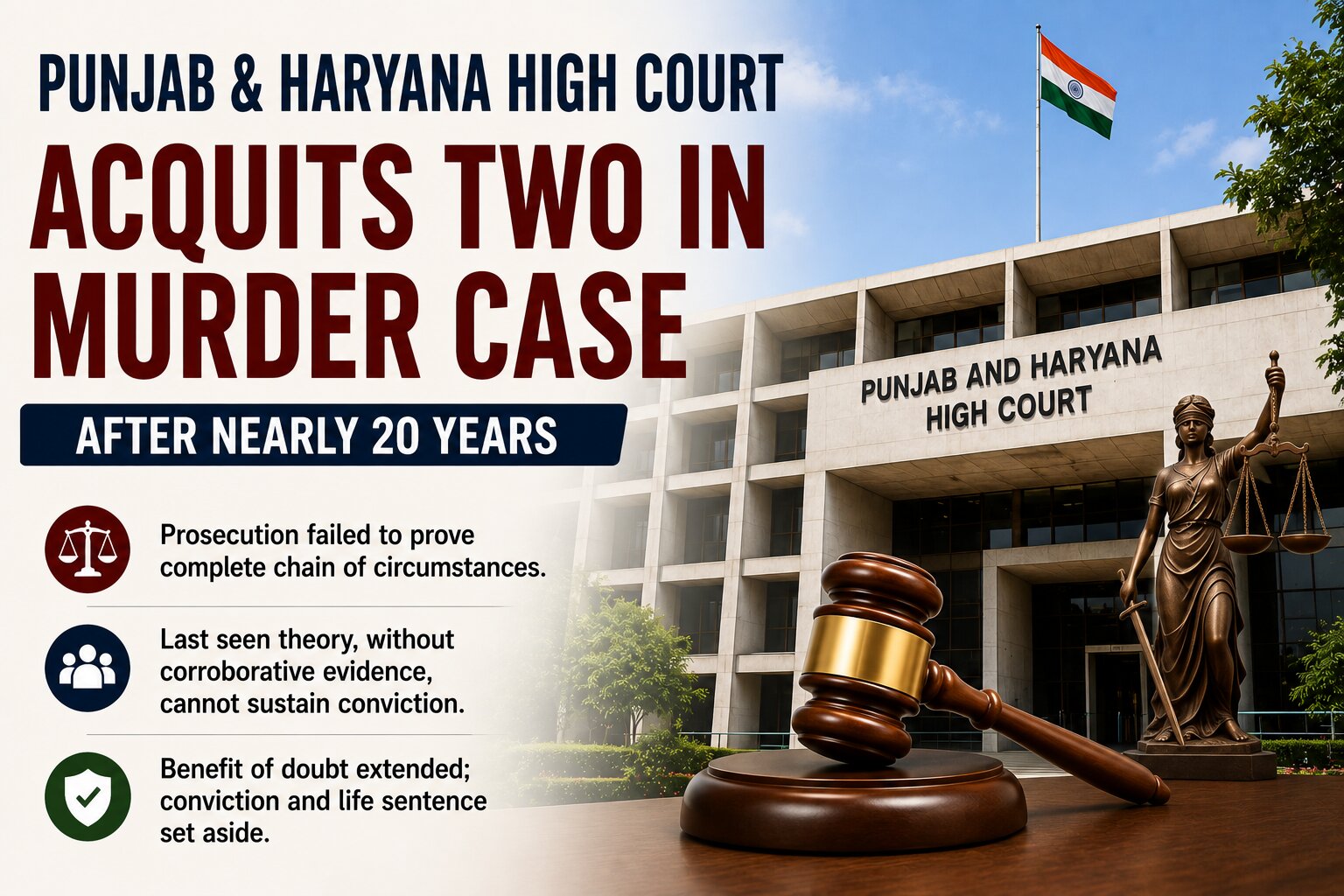
Judgement Details
Court
Punjab and Haryana High Court
Date of Decision
4 August 2026
Judges
Justice Rajesh Bhardwaj and Justice Deepak Manchanda
Citation
Acts / Provisions
Facts of the Case
-
The case concerned the murder of Prem Lata and her 11-year-old son, Vimal @ Poppy.
-
The murders occurred during the intervening night of 5–6 November 2006.
-
Prem Lata had resumed living with her husband, Krishan, after a period of matrimonial dispute and reconciliation.
-
The prosecution alleged that Prem Lata had complained to her family about harassment.
-
Her brother Surender (PW-1) and cousin Baljit (PW-2) went to her matrimonial home to mediate.
-
They allegedly remained at the house overnight.
-
At around 2:00 a.m., PW-1 and PW-2 allegedly saw Krishan, Braham Dutt, Kitabo and Lokesh leaving the house.
-
Upon entering the house, they allegedly found Prem Lata and her son dead.
-
The prosecution alleged that both victims had been strangled.
-
A chargesheet was filed against four accused persons.
-
During the trial, Krishan died in custody, and proceedings continued against the remaining accused.
-
The Trial Court convicted Braham Dutt, Kitabo and Lokesh under Section 302 read with Section 34 IPC.
-
They were sentenced to life imprisonment.
-
During the pendency of the appeal before the High Court, Braham Dutt also died.
-
Consequently, the appeal survived only concerning Kitabo and Lokesh.
-
The prosecution case was based substantially on circumstantial evidence, particularly the alleged last-seen evidence of PW-1 and PW-2.
-
The defence argued that Kitabo and Lokesh were falsely implicated because they were relatives of Krishan.
-
It was also argued that they lived separately outside the village and that there was no independent motive for them to commit the murders.
-
The defence challenged the reliability of the last-seen witnesses.
-
It was pointed out that PW-1, despite being a Haryana Police employee, produced no official record establishing his presence in the village at the relevant time.
-
The defence also highlighted contradictions in PW-2's testimony.
-
The defence further relied upon the alleged delay in registration of the FIR despite the police station being approximately four kilometres away.
-
The State argued that PW-1 and PW-2 had consistently supported the prosecution version.
-
The State also contended that the accused had harassed Prem Lata and had participated in the murders.
-
The High Court examined the evidence and found several gaps and inconsistencies in the prosecution case.
-
The Court concluded that the prosecution had failed to establish a complete chain of circumstances connecting Kitabo and Lokesh with the murders.
Issues
-
Whether the prosecution established beyond reasonable doubt that Kitabo and Lokesh were responsible for the murders of Prem Lata and her 11-year-old son?
-
Whether the evidence of PW-1 and PW-2, who were allegedly last-seen witnesses and not eyewitnesses to the murders, was sufficient to sustain the conviction?
-
Whether the last-seen theory, in the absence of sufficient corroborative evidence, could by itself form the basis of conviction under Section 302 read with Section 34 IPC?
-
Whether the prosecution established a complete chain of circumstances consistent only with the guilt of the appellants and inconsistent with every other reasonable hypothesis?
-
Whether the alleged matrimonial dispute involving Prem Lata and her husband established an independent motive against Kitabo and Lokesh, who allegedly lived separately?
-
Whether the contradictions concerning the presence of the prosecution witnesses and the delay in registration of the FIR created reasonable doubt regarding the prosecution case?
-
Whether the appellants were entitled to the benefit of doubt when the prosecution failed to prove their guilt beyond reasonable doubt?
Judgement
-
The Punjab and Haryana High Court allowed the appeal insofar as it concerned Kitabo and Lokesh.
-
The Court held that the prosecution case rested entirely upon circumstantial evidence.
-
PW-1 and PW-2 were not eyewitnesses to the actual murders.
-
Their evidence primarily placed the accused in the vicinity of the occurrence under the last-seen theory.
-
The Court found material weaknesses in the evidence establishing the presence of PW-1 and PW-2 at the relevant time.
-
PW-1, despite being a Haryana Police employee, produced no official record confirming his presence at the village.
-
The Court also found contradictions in PW-2's testimony.
-
The delay in registration of the FIR was another circumstance that created doubt.
-
The absence of timings in the inquest reports further weakened the prosecution's version.
-
The Court found that the prosecution failed to establish an independent and convincing motive against Kitabo and Lokesh.
-
The matrimonial dispute was primarily between Prem Lata and her husband Krishan.
-
The appellants were living separately, and no sufficient evidence connected them independently to the alleged motive.
-
The Court relied upon established principles governing circumstantial evidence.
-
It reiterated that every circumstance relied upon by the prosecution must be firmly established.
-
The circumstances must form a complete chain pointing only towards the guilt of the accused.
-
The Court further held that the last-seen theory cannot ordinarily be the sole basis of conviction without adequate corroboration.
-
The prosecution failed to satisfy this standard.
-
The Court therefore extended the benefit of doubt to Kitabo and Lokesh.
-
Their convictions and life sentences were set aside.
-
The surviving appellants were consequently acquitted of the charges.
Held
-
The prosecution failed to establish the guilt of Kitabo and Lokesh beyond reasonable doubt.
-
The case was based entirely on circumstantial evidence.
-
PW-1 and PW-2 were last-seen witnesses and were not eyewitnesses to the murders.
-
The prosecution failed to establish a complete and unbroken chain of circumstances.
-
Material doubts existed regarding the presence and credibility of the prosecution witnesses.
-
The delay in registration of the FIR and absence of timings in the inquest reports further weakened the prosecution case.
-
No sufficient independent motive against Kitabo and Lokesh was established.
-
The prosecution therefore failed to exclude reasonable alternative hypotheses consistent with the innocence of the accused.
-
The appellants were entitled to the benefit of doubt.
-
Their convictions under Section 302 read with Section 34 IPC were set aside.
-
The appellants were acquitted.
Analysis
-
Circumstantial evidence requires a complete chain: The judgment reinforces the principle that a conviction based entirely on circumstances requires every important circumstance to be firmly established.
-
Chain must point exclusively to guilt: It is not enough that the circumstances create suspicion against the accused. The circumstances must collectively lead to the conclusion that the accused committed the offence and must exclude reasonable alternative explanations.
-
Last-seen theory has limitations: Merely establishing that an accused was seen with or near the deceased before the crime does not automatically establish guilt.
-
Need for corroboration: Last-seen evidence becomes significantly stronger when supported by other reliable circumstances such as forensic evidence, recovery, motive, medical evidence or other independent evidence.
-
Witness credibility: The Court carefully examined whether PW-1 and PW-2 were actually present at the relevant time. The absence of supporting official records concerning PW-1 and contradictions in PW-2's testimony weakened their evidence.
-
Police employee as witness: The fact that PW-1 was a Haryana Police employee made the absence of official documentation concerning his claimed presence particularly relevant to the Court's assessment.
-
FIR delay: Although delay in lodging an FIR does not automatically destroy a prosecution case, unexplained delay can become significant where the prosecution case already contains other inconsistencies.
-
Inquest report: The absence of timings in the inquest reports contributed to uncertainty concerning the sequence and timing of events.
-
Motive: The Court distinguished between the matrimonial dispute involving Prem Lata and her husband and the alleged involvement of Kitabo and Lokesh. A motive against one person cannot automatically be attributed to other accused without supporting evidence.
-
Section 34 IPC: Common intention cannot be presumed merely because persons are related or allegedly associated with the principal accused. There must be evidence establishing participation in furtherance of a shared intention.
-
Benefit of doubt: Where significant gaps remain in a circumstantial evidence case, the accused must receive the benefit of doubt.
-
Presumption of innocence: The judgment reinforces that suspicion, even strong suspicion, cannot substitute proof beyond reasonable doubt.
-
No conviction on incomplete chain: The Court refused to sustain the conviction merely because the accused were allegedly seen leaving the premises around the relevant time.
-
Importance of corroborative evidence: The decision demonstrates why courts must look for independent evidence before converting last-seen circumstances into a finding of guilt.
-
Relevance of Supreme Court precedents: The Court relied upon principles stated in Sharad Birdhichand Sarda v. State of Maharashtra, Ramanand @ Nandlal Bharti v. State of Uttar Pradesh, Bodh Raj @ Bodha v. State of Jammu and Kashmir, and Nizam v. State of Rajasthan.
-
Overall significance: The judgment reinforces the fundamental criminal-law principle that where the prosecution relies on circumstantial evidence, every link must be proved and the complete chain must lead unmistakably to the guilt of the accused.