
Bombay Garage Ahmedabad Limited & Ors. v. J P Iscon Private Limited & Anr., 2026
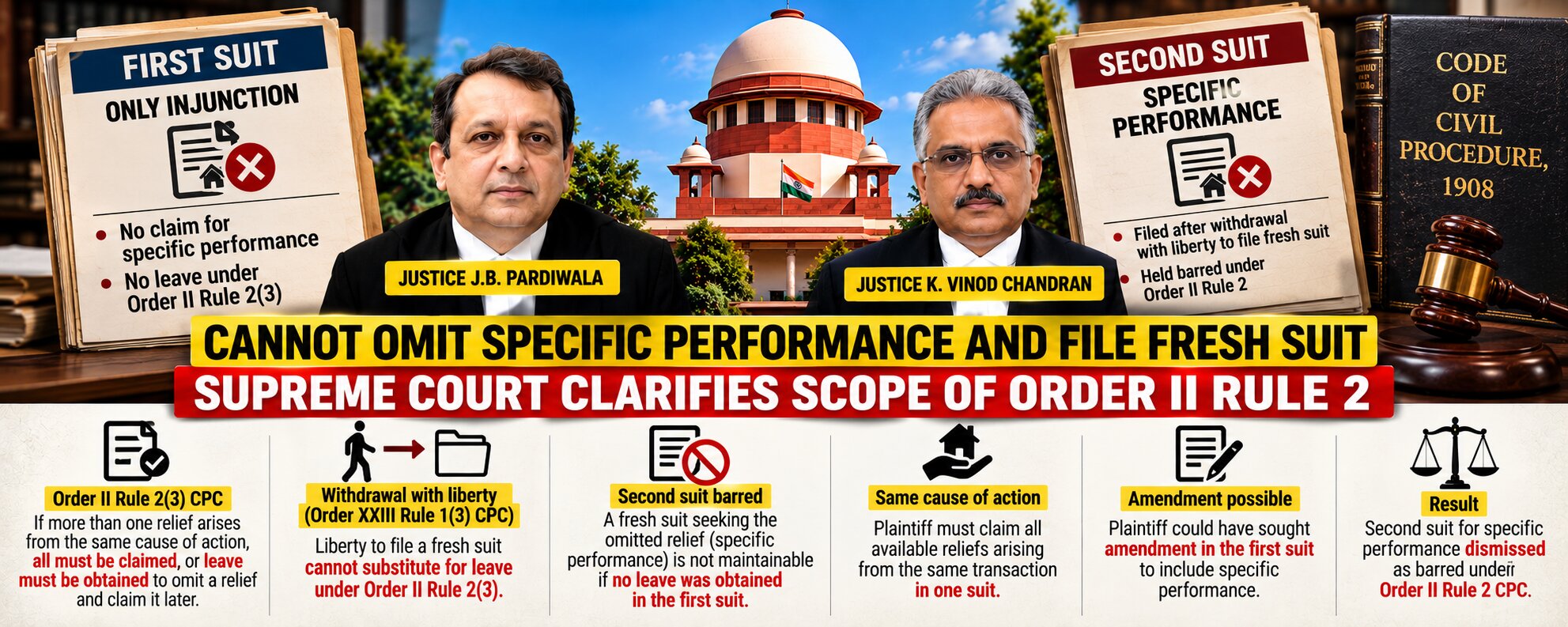
A plaintiff cannot omit an available relief arising from the same cause of action and later claim that relief without obtaining leave under Order II Rule 2(3) CPC.
Judgement Details
Court
Supreme Court of India
Date of Decision
30 September 2026
Judges
Justice J. B. Pardiwala and Justice K. Vinod Chandran
Citation
Acts / Provisions
Facts of the Case
-
The dispute arose out of an alleged oral agreement concerning the sale of immovable property.
-
The plaintiff claimed rights arising from the alleged oral agreement.
-
The plaintiff initially instituted a suit seeking permanent injunction.
-
At the time of filing the first suit, the plaintiff did not seek the relief of specific performance.
-
The plaintiff also did not obtain leave under Order II Rule 2(3) CPC to reserve the right to claim specific performance in a subsequent proceeding.
-
Subsequently, the plaintiff withdrew the first suit.
-
At the time of withdrawal, the plaintiff obtained liberty to institute a fresh suit.
-
The plaintiff thereafter instituted a second suit seeking, among other reliefs, specific performance of the alleged oral agreement.
-
The defendants challenged the maintainability of the second suit.
-
The dispute ultimately reached the Supreme Court after the Trial Court and the Gujarat High Court granted relief to the plaintiff.
-
The appellant-property purchaser argued that the second suit was barred by Order II Rule 2 CPC.
-
The plaintiff contended that the liberty granted by the court while permitting withdrawal of the first suit under Order XXIII Rule 1(3) enabled the plaintiff to institute the fresh suit.
-
The Supreme Court examined whether the permission obtained at the time of withdrawal could cure the failure to obtain leave under Order II Rule 2(3) when the original suit was instituted.
Issues
-
Whether a plaintiff who files a suit for injunction without seeking specific performance of an available relief arising from the same cause of action is barred from subsequently claiming specific performance when no leave was obtained under Order II Rule 2(3) CPC?
-
Whether liberty granted by the Court under Order XXIII Rule 1(3) CPC at the time of withdrawal of the first suit can cure the plaintiff's failure to obtain leave under Order II Rule 2(3) CPC at the time of institution of the first suit?
-
Whether a second suit seeking specific performance is maintainable when the plaintiff had an opportunity to claim such relief in the first suit but omitted to do so without obtaining the required leave?
-
Whether Order XXIII Rule 1(3) CPC can be used as a substitute for the leave contemplated under Order II Rule 2(3) CPC?
-
Whether the subsequent suit for specific performance is barred under Order II Rule 2 CPC when the first suit for injunction was withdrawn with liberty to file a fresh suit?
Judgement
-
The Supreme Court allowed the appeal filed by the appellant-property purchaser.
-
The Court set aside the findings of the Trial Court and the Gujarat High Court to the extent they granted relief to the plaintiff.
-
The Supreme Court held that the second suit seeking specific performance was barred by Order II Rule 2 CPC.
-
The Court found that the relief of specific performance was already available to the plaintiff when the first suit was instituted.
-
The plaintiff could have sought specific performance in the first suit or obtained the necessary leave under Order II Rule 2(3) to claim the omitted relief in a subsequent suit.
-
The plaintiff did not obtain such leave at the time of filing the first suit.
-
The Court held that the liberty subsequently obtained while withdrawing the first suit under Order XXIII Rule 1(3) could not cure this omission.
-
The Supreme Court made clear that leave under Order II Rule 2(3) and liberty under Order XXIII Rule 1(3) operate in different fields.
-
The Court held that Order XXIII Rule 1(3) cannot be used as a substitute for the specific statutory requirement under Order II Rule 2(3).
-
The Court observed that the plaintiff could also have sought an amendment of the original suit to incorporate the relief of specific performance but did not do so.
-
The subsequent suit therefore attracted the statutory bar under Order II Rule 2 CPC.
-
Consequently, the second suit for specific performance was dismissed.
Held
-
The relevant leave under Order II Rule 2(3) must be obtained at the time of institution of the first suit.
-
Liberty granted under Order XXIII Rule 1(3) at the time of withdrawal of the first suit does not cure the absence of leave under Order II Rule 2(3).
-
Order XXIII Rule 1(3) cannot be used as a substitute for leave under Order II Rule 2(3).
-
Where specific performance was available when the first suit was filed, failure to claim it or obtain the requisite leave may bar a subsequent suit seeking that relief.
-
Withdrawal of the first suit does not automatically remove the consequences of Order II Rule 2.
-
The fact that the first suit was withdrawn with liberty to file a fresh suit does not permit the plaintiff to introduce a relief that was omitted in violation of Order II Rule 2.
-
The second suit for specific performance was therefore barred and dismissed.
Analysis
-
Purpose of Order II Rule 2: The provision is intended to prevent a plaintiff from splitting claims arising from the same cause of action and subjecting the defendant to multiple rounds of litigation.
-
Complete relief in one proceeding: Where several reliefs arise from the same cause of action, the plaintiff is generally expected to claim all available reliefs in the same suit.
-
Specific performance was already available: The important factual circumstance was that the relief of specific performance was available to the plaintiff when the first injunction suit was instituted.
-
Leave is the statutory safeguard: If the plaintiff deliberately omits an available relief but wants to preserve the possibility of pursuing it later, the plaintiff must obtain the leave contemplated by Order II Rule 2(3).
-
Timing of leave is crucial: The Supreme Court emphasised that the leave must be obtained at the time of institution of the first suit. Obtaining permission at a later stage does not retrospectively satisfy this requirement.
-
Order II Rule 2 and Order XXIII Rule 1 operate differently: Order II Rule 2 deals with the consequences of omitting a relief arising from the same cause of action. Order XXIII Rule 1 deals with withdrawal of a suit and, in appropriate circumstances, permission to bring a fresh suit on the same subject matter.
-
Liberty to withdraw is not equivalent to leave to omit a relief: This is the central distinction in the judgment. A court granting liberty to file a fresh suit under Order XXIII does not necessarily grant the specific statutory leave required under Order II Rule 2.
-
Order XXIII cannot cure Order II Rule 2: The plaintiff cannot rely on the withdrawal order to retrospectively cure the failure to obtain leave when the original suit was filed.
-
Amendment was another possible course: The Court noted that the plaintiff could have sought amendment of the first suit to incorporate the relief of specific performance. The failure to pursue that course was relevant to the maintainability of the later suit.
-
Settlement negotiations do not remove statutory requirements: The first suit was withdrawn in the context of settlement discussions. However, the Court made clear that such circumstances did not eliminate the statutory requirement under Order II Rule 2.
-
Prevention of repeated litigation: The ruling promotes procedural efficiency by preventing a plaintiff from filing one suit for a limited relief, withdrawing it, and subsequently commencing another proceeding for an additional relief arising from the same cause of action.
-
Protection of defendants: The principle protects defendants from being repeatedly subjected to litigation concerning the same transaction or cause of action.
-
Effect of withdrawal: Withdrawal of a suit does not necessarily erase all procedural consequences flowing from the manner in which the original suit was instituted.
-
Practical lesson for litigants: Before filing an injunction suit, a plaintiff should carefully identify all reliefs arising from the same cause of action. If an available relief is intentionally omitted, the necessary leave under Order II Rule 2 should be obtained at the appropriate stage.
-
Relationship between procedural provisions: The judgment demonstrates that different provisions of the CPC must be applied according to their respective purposes. Permission under one provision cannot automatically be treated as compliance with another independent statutory requirement.
-
Final consequence: Since the plaintiff had failed to obtain leave under Order II Rule 2 when the first suit was filed, the subsequent suit seeking specific performance was held to be barred.