
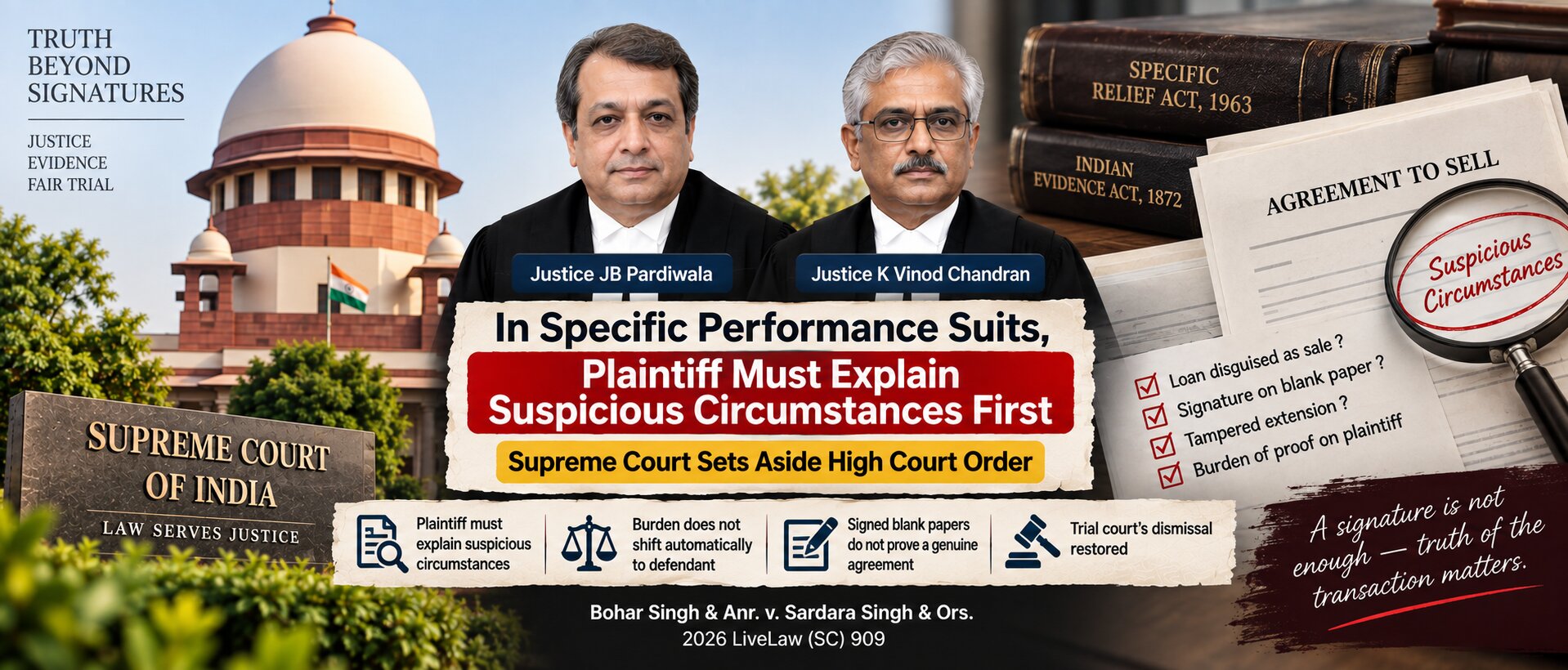
Bohar Singh & Anr. v. Sardara Singh & Ors., 2026
A plaintiff relying upon an agreement to sell must satisfactorily explain material suspicious circumstances surrounding the document before the burden can be shifted to the defendant.
Judgement Details
Court
Supreme Court of India
Date of Decision
11 September 2026
Judges
Justice J.B. Pardiwala & Justice K. Vinod Chandran
Citation
Acts / Provisions
Facts of the Case
-
The dispute concerned a suit for specific performance of an agreement to sell land.
-
According to the appellant-defendant, the underlying transaction was actually a loan transaction and not a genuine agreement to sell.
-
The appellant's signature had allegedly been obtained on blank papers.
-
Those signed blank papers were subsequently used to prepare an agreement showing that the appellant had agreed to sell his land to the respondent.
-
The amount advanced in the loan transaction was portrayed in the document as earnest money.
-
The alleged agreement provided for payment of the remaining amount at the time of execution of the sale deed.
-
The respondent-plaintiff filed a suit for specific performance alleging that the appellant had failed to execute the sale deed.
-
The respondent further relied upon an alleged extension of the period for execution of the sale deed by one year, claiming that the extension had been made at the appellant's request.
-
The Trial Court examined the circumstances surrounding the document and found several suspicious circumstances.
-
The Trial Court held that those circumstances had not been satisfactorily explained by the plaintiff.
-
The Trial Court consequently dismissed the suit for specific performance.
-
The First Appellate Court reversed the Trial Court's decision and accepted the genuineness of the appellant's mark on the agreement to sell.
-
The First Appellate Court also relied upon the document recording the extension of the period for execution.
-
The High Court affirmed the First Appellate Court's decision.
-
The defendant thereafter approached the Supreme Court challenging the concurrent appellate findings.
Issues
-
Whether a plaintiff seeking specific performance of an agreement to sell surrounded by suspicious circumstances must first satisfactorily explain those circumstances before the evidentiary burden can shift to the defendant?
-
Whether the First Appellate Court and the High Court were justified in placing the burden upon the defendant to prove that the agreement to sell was fabricated?
-
Whether the suspicious circumstances surrounding the agreement and the alleged extension of the period for execution were properly considered before shifting the onus of proof to the defendant?
Judgement
-
The Supreme Court allowed the appeal filed by the defendant.
-
The Court set aside the findings of the High Court and the First Appellate Court.
-
The Supreme Court restored the Trial Court's decision dismissing the suit for specific performance.
-
The Court emphasized that the suspicious circumstances identified by the Trial Court could not simply be brushed aside before shifting the evidentiary burden onto the defendant.
-
The plaintiff, being the person relying upon the agreement to sell, was required to satisfactorily explain the circumstances creating doubt about the document's genuineness.
-
The appellate courts committed an error by effectively requiring the defendant to prove that the document was fabricated.
-
The Court noted that the defendant had not actually pleaded that the document was fabricated.
-
His case was different: he accepted that his mark appeared on the document but asserted that his signature had been obtained on blank papers and that the agreement was subsequently drawn up without his knowledge.
-
The Court held that this contention was substantially different from alleging fabrication of the document.
-
Consequently, it was unjustified to place upon the defendant the burden of proving fabrication when that was not his specific case.
-
The Court also examined the alleged extension of the agreement and noted that the Trial Court had found circumstances suggesting that the extension had been tampered with.
-
The appellate courts brushed aside this circumstance on conjecture without adequate supporting oral evidence.
-
The Supreme Court therefore found the reasoning of the Trial Court to be well-founded and restored its judgment.
Held
-
The mere presence of the defendant's signature or thumb mark does not automatically establish the genuineness and enforceability of the entire agreement when surrounding circumstances create serious doubt.
-
The defendant cannot be required to prove fabrication when his actual case is that signed blank papers were subsequently used to create an agreement without his knowledge.
-
Suspicious circumstances must be properly addressed and debunked before shifting the onus of proof.
-
The alleged tampering or alteration of an important term, such as an extension of the period for execution, must be examined on evidence and cannot be rejected merely on conjecture.
-
The Trial Court's findings were therefore restored and the suit for specific performance was dismissed.
Analysis
-
The decision reinforces the fundamental principle that a person seeking specific performance is required to establish the existence and enforceability of the agreement on which the relief is claimed.
-
The Court distinguished between the burden of proof and the shifting onus of proof. The initial evidentiary responsibility cannot be transferred to the defendant merely because his signature appears on the disputed document.
-
Where circumstances surrounding a document are inherently suspicious, the party relying upon that document must first provide a credible explanation.
-
The judgment is particularly important where allegations involve signed blank papers, subsequent insertion of terms, alterations or disputed extensions.
-
The Court rejected an approach under which the defendant would have to prove a negative proposition merely because his signature or thumb impression is admitted.
-
The distinction between fabrication and unauthorised preparation of a document using a genuine signature is legally significant.
-
The judgment also emphasizes that appellate courts should not lightly interfere with a reasoned Trial Court finding based upon an assessment of suspicious circumstances and evidence.
-
The ruling strengthens judicial scrutiny of documents relied upon for specific performance, particularly where the circumstances surrounding their execution are questionable.
-
It also prevents the evidentiary process from becoming unfair by compelling a defendant to disprove a transaction before the plaintiff has satisfactorily established its genuineness.
-
The decision therefore serves as an important reminder that suspicious circumstances must be dealt with on evidence, not brushed aside through conjecture.