
Billal Miah v. The State of Tripura, 2026
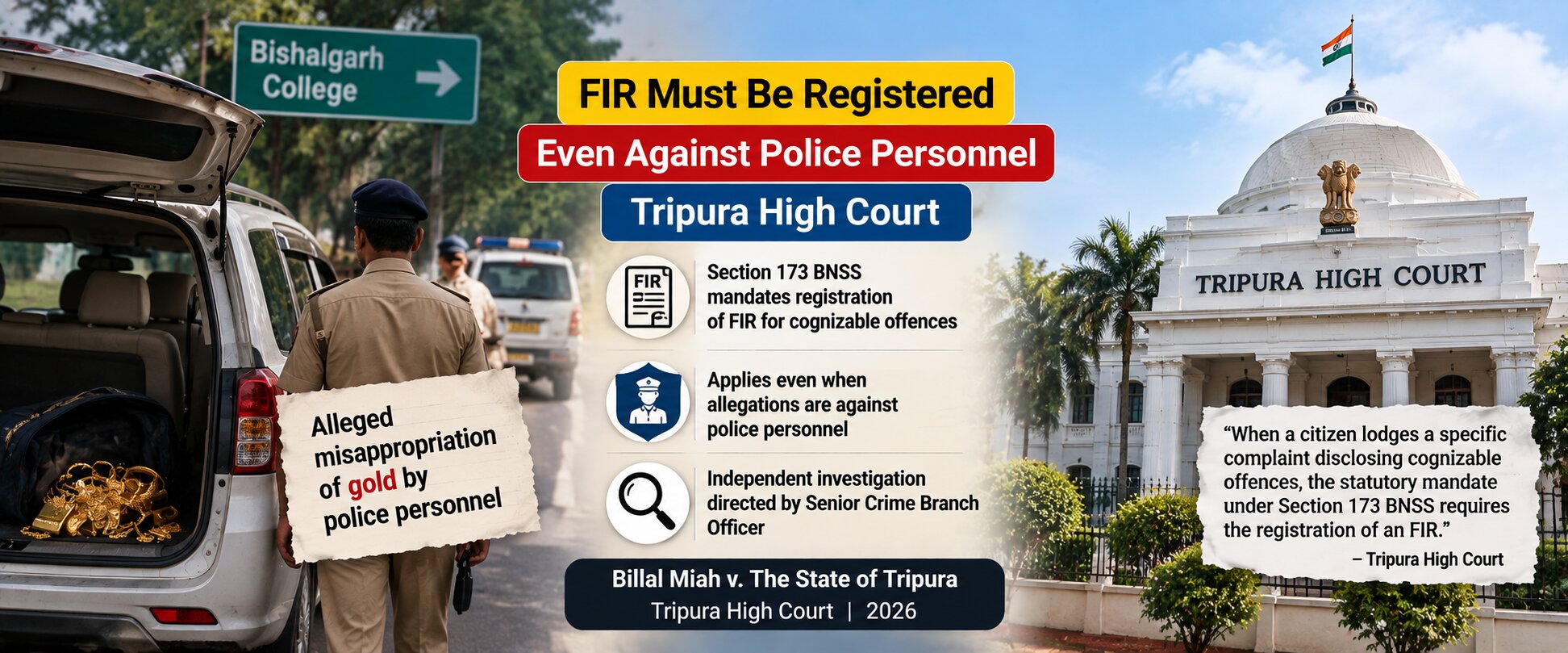
Section 173 BNSS mandates registration of an FIR where a complaint discloses cognizable offences.
Judgement Details
Court
High Court of Tripura
Date of Decision
21 September 2026
Judges
Justice Dr. T. Amarnath Goud and Justice S. Datta Purkayastha
Citation
Acts / Provisions
Facts of the Case
-
The petitioner, Billal Miah, was travelling to Agartala with his two brothers on 21 February 2026.
-
The purpose of the journey was allegedly to sell gold ornaments and gold bars to arrange funds for the medical treatment of one of his brothers.
-
While travelling, the petitioner and his brothers were intercepted by police personnel near Bishalgarh College.
-
According to the petitioner, the police took them and their vehicle first to an isolated tea garden and subsequently to Bishalgarh Police Station.
-
They remained detained for the day.
-
When they were eventually permitted to leave, the petitioner allegedly discovered that the back door of the vehicle was open.
-
He further alleged that the gold ornaments and gold bars kept in the vehicle were missing.
-
The petitioner attempted to lodge an FIR at Sonamura Police Station, but alleged that the police refused to register his complaint.
-
He subsequently approached the Superintendent of Police, but according to him, no FIR was registered even thereafter.
-
The petitioner then approached the Tripura High Court seeking directions for registration of his complaint and an independent investigation.
-
The State's conduct in taking the intercepted vehicle to an isolated tea garden attracted the Court's attention.
-
The Court noted that Bishalgarh Police Station was only approximately 2.5 kilometres away, raising concerns regarding why the vehicle had first been taken to the isolated location.
-
The allegations involved the alleged misappropriation of valuable property and high-handed conduct by police personnel.
-
The Court considered whether these allegations, if taken at face value, disclosed cognizable offences requiring registration of an FIR under Section 173 BNSS.
-
The Court also considered whether the investigation should be entrusted to an officer independent of the police personnel against whom the allegations had been made.
Issues
-
Whether Section 173 of the Bharatiya Nagarik Suraksha Sanhita, 2023 mandates registration of an FIR when a complaint discloses cognizable offences allegedly committed by police personnel?
-
Whether the allegations regarding disappearance or alleged misappropriation of gold ornaments and gold bars disclosed cognizable offences requiring registration of an FIR and investigation?
-
Whether the alleged refusal by the police to register the petitioner's complaint justified the intervention of the High Court in exercise of its writ jurisdiction?
-
Whether an independent investigation by a senior officer of the Crime Branch was necessary where the allegations of misappropriation and high-handedness were directed against police personnel?
-
Whether questions concerning ownership of the gold, validity of receipts and ultimate proof of misappropriation could be determined by the High Court at the stage of considering registration of the FIR?
Judgement
-
The Tripura High Court allowed the writ petition filed by Billal Miah.
-
The Court held that where a complaint discloses the commission of cognizable offences, Section 173 BNSS requires registration of an FIR.
-
The Court made clear that this statutory requirement applies even where the allegations are directed against police personnel.
-
The Bench found that the allegations concerning alleged misappropriation of gold ornaments and gold bars, coupled with allegations of high-handed conduct by police officials, required investigation.
-
The Court found the circumstances surrounding the interception of the vehicle significant.
-
In particular, the Court noted that the vehicle had allegedly been taken to an isolated tea garden, despite the Bishalgarh Police Station being only around 2.5 kilometres away.
-
The Court held that the circumstances raised concerns that could not simply be disregarded at the stage of registration of the FIR.
-
The Court held that questions concerning ownership of the gold, validity of receipts and whether the alleged misappropriation was ultimately proved were matters for investigation.
-
Such questions could not be conclusively determined by the High Court at the preliminary stage.
-
The Court therefore directed registration of the petitioner's written complaint as an FIR.
-
The State was directed to appoint a Senior Officer of the Crime Branch to conduct the investigation.
-
The investigation was directed to be independent, fair and expeditious.
-
The relevant records were directed to be transferred to the designated officer for investigation in accordance with law.
Held
-
The statutory obligation to register an FIR does not disappear merely because the alleged offenders are police personnel.
-
Allegations of police misconduct involving alleged misappropriation and high-handedness require impartial investigation where cognizable offences are disclosed.
-
The Court need not determine the ultimate truth of the allegations at the FIR-registration stage.
-
Questions relating to ownership of the gold, authenticity of receipts and proof of misappropriation require investigation and cannot ordinarily be conclusively determined at the preliminary stage.
-
The circumstances surrounding the police interception and subsequent handling of the vehicle warranted an independent investigation.
-
The High Court accordingly directed registration of the complaint and investigation by a Senior Crime Branch Officer.
Analysis
-
Mandatory FIR registration: The judgment reinforces the statutory character of Section 173 BNSS. Where information placed before the police discloses a cognizable offence, the registration of an FIR is not merely a matter of administrative discretion.
-
Police personnel are not an exception: An important aspect of the ruling is that the identity or position of the alleged offender does not, by itself, remove the statutory obligation to register an FIR. Allegations against police officials must be dealt with through the same legal framework governing cognizable offences.
-
Registration versus proof: The Court carefully distinguished between the threshold required for registration of an FIR and the evidence necessary to establish guilt. At the registration stage, the Court was concerned with whether the complaint disclosed cognizable offences—not whether the petitioner had already proved the allegations.
-
Need for investigation: Questions concerning who owned the gold, whether the receipts were genuine and whether the police personnel actually misappropriated the property were factual questions requiring evidence. These matters were therefore left to investigation.
-
Independent investigation: Because the allegations were directed against police personnel themselves, the Court considered an investigation by a Senior Officer of the Crime Branch appropriate to ensure impartiality and public confidence in the investigative process.
-
Significance of surrounding circumstances: The Court specifically considered the alleged decision to take the vehicle to an isolated tea garden even though a police station was nearby. The Court treated this circumstance as relevant to the need for investigation rather than treating it as proof of guilt.
-
High Court's writ jurisdiction: The decision illustrates the role of the High Court in ensuring that statutory investigative duties are performed when a complaint disclosing cognizable offences has allegedly not been registered.
-
BNSS framework: The judgment is significant because it applies the FIR-registration principle under the new Bharatiya Nagarik Suraksha Sanhita, 2023, rather than the corresponding provision of the repealed Code of Criminal Procedure.
-
Practical significance: The ruling indicates that a complainant alleging a cognizable offence cannot be denied registration merely because the allegations concern police officers. At the same time, registration of an FIR does not amount to a finding that the accused police personnel are guilty; the allegations remain subject to investigation and proof according to law.