
Bhikhubhai Govindbhai Patel & Anr. v. The State of Gujarat & Anr., 2026
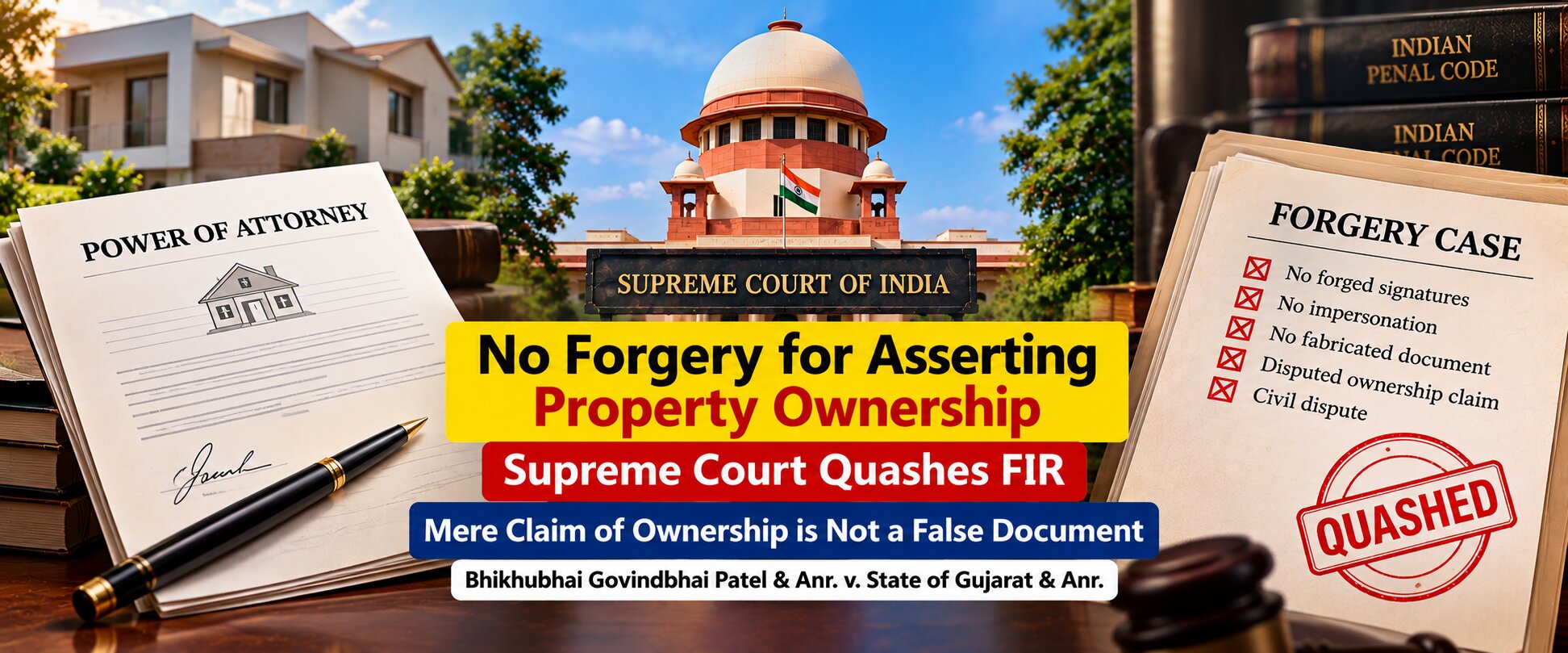
A person does not commit forgery merely by executing a document claiming ownership over property that ultimately turns out not to belong to him.
Judgement Details
Court
Supreme Court of India
Date of Decision
4 September 2026
Judges
Justice Sanjay Karol and Justice Vipul M. Pancholi
Citation
Acts / Provisions
Facts of the Case
-
The dispute arose out of a long-standing controversy concerning Survey No. 157 at Village Panas, Surat, measuring approximately 5.5 acres.
-
The property had originally been jointly purchased in 1957 by six children of Nemabhai Patel, including the father of the appellants and the father of Respondent No. 2.
-
The parties subsequently became involved in extensive civil litigation concerning their respective ownership and shares in the property.
-
Proceedings under the Urban Land Ceiling Act, 1976 subsequently recognised shares in favour of different branches of the family.
-
The appellants claimed that they continued to have a share in the ancestral property on the basis of the ULC proceedings and corresponding revenue entries.
-
A Power of Attorney dated 1 November 2001 was executed by accused Nos. 1 to 5 in favour of accused No. 6 in connection with the civil proceedings concerning the property.
-
The execution of the Power of Attorney itself was not disputed. There was no allegation that the signatures appearing on it had been forged or that the executants had been impersonated.
-
Civil litigation concerning the property continued for several years.
-
The appellants maintained that their claim of title was bona fide and based upon the ULC proceedings and revenue records.
-
In 2009, Respondent No. 2 initially lodged a complaint on 21 May 2009.
-
The initial complaint did not contain allegations of extortion or a monetary demand.
-
A subsequent complaint resulted in FIR No. I-CR No. 504/2009, registered on 31 December 2009 at Umra Police Station, Surat.
-
The FIR invoked several provisions of the IPC, including Sections 420, 465, 467, 468, 471, 504, 120-B, 384, 511 and 114.
-
The later FIR introduced an allegation that accused No. 6 had demanded ₹1.5 crore or a partnership in the property and had threatened Respondent No. 2.
-
The appellants approached the Gujarat High Court under Section 482 CrPC, seeking quashing of the criminal proceedings.
-
The Gujarat High Court declined to quash the proceedings and permitted the prosecution to proceed.
-
The appellants then approached the Supreme Court.
Issues
-
Whether execution of a Power of Attorney asserting ownership or an interest in disputed property constitutes making a “false document” merely because the executants are ultimately found not to have valid title?
-
Whether the essential ingredients of forgery under Sections 463 and 464 IPC are satisfied when there is no allegation of forged signatures, impersonation or fabrication of the document?
-
Whether a disputed claim of ownership over immovable property can, by itself, constitute cheating under Section 420 IPC?
-
Whether the allegations in the FIR disclosed the essential ingredients of extortion, criminal intimidation and criminal conspiracy?
-
Whether the substantial delay in lodging the FIR and the material improvements introduced in the subsequent complaint justified exercise of the High Court's jurisdiction under Section 482 CrPC?
-
Whether criminal antecedents of an accused can be relied upon as a basis for refusing to quash criminal proceedings when the essential ingredients of the alleged offences are otherwise absent?
-
Whether continuation of the criminal proceedings in the circumstances of the case amounted to an abuse of the process of law?
Judgement
-
The Supreme Court allowed the appeals filed by the appellants.
-
The Court set aside the Gujarat High Court's judgment dated 7 November 2023, by which the High Court had refused to quash the criminal proceedings.
-
The Supreme Court held that the High Court had proceeded on an incorrect legal premise by equating an unsuccessful claim of ownership with the making of a false document.
-
The Court emphasised that the essential ingredient of forgery under Section 463 IPC is the making of a “false document” within the meaning of Section 464 IPC.
-
In the present case, there was no allegation that the signatures on the Power of Attorney were forged.
-
There was also no allegation that the appellants had impersonated another person or fabricated a document by pretending to be someone else.
-
The execution of the Power of Attorney by the appellants was itself admitted.
-
The Court therefore held that the mere fact that the appellants' claim to the property was ultimately found to be legally unsustainable did not transform the document into a false document.
-
Relying upon Mohd. Ibrahim v. State of Bihar, (2009) 8 SCC 751, the Court reiterated that a person who executes a document claiming property as his own does not make a false document merely because the claim is subsequently found to be incorrect.
-
Consequently, the foundational requirement for the offences of forgery was absent.
-
The Court also found that the ingredients of Section 420 IPC were not established. There was no allegation that Respondent No. 2 had delivered property, money or valuable security to the appellants as a consequence of deception or fraudulent inducement.
-
The Court held that a disputed civil claim of ownership could not automatically be characterised as a fraudulent representation for the purpose of Section 420 IPC.
-
With regard to extortion, the Court noted that the alleged demand for ₹1.5 crore was not accompanied by sufficient particulars concerning the date, place or circumstances of the alleged demand.
-
The Court further noted the absence of an allegation that property or money was actually delivered pursuant to the alleged threat.
-
The allegations under Sections 504 and 506 were also found to be vague because the FIR did not provide adequate details regarding the words allegedly used, the nature of the threat or the circumstances constituting intimidation.
-
Since the substantive offences were not made out, the allegation of criminal conspiracy under Section 120-B IPC could not independently survive.
-
The Court also considered the fact that the criminal allegations had emerged after a long period of civil litigation.
-
The initial complaint of 21 May 2009 did not contain allegations of extortion or monetary demand, whereas the subsequent FIR introduced the allegation of a ₹1.5 crore demand.
-
The Court considered these material improvements, coupled with the substantial delay, while examining whether the criminal process was being misused.
-
The Court held that the case fell within the recognised categories in which the High Court may exercise its inherent jurisdiction under Section 482 CrPC.
-
The FIR and all consequential criminal proceedings, including any charge-sheet filed pursuant to the FIR, were quashed qua the appellants.
-
At the same time, the Supreme Court clarified that its observations were confined to the exercise of jurisdiction under Section 482 CrPC and would not affect the pending civil proceedings concerning title and ownership.
Held
-
An unsuccessful claim of title does not, by itself, amount to making a “false document” under Section 464 IPC.
-
Forgery requires the foundational ingredient of making a false document.
-
Where the document is genuinely executed by the persons whose signatures appear on it, and there is no allegation of impersonation or fabrication, the mere dispute over title does not ordinarily constitute forgery.
-
Sections 467 and 471 IPC cannot be attracted where the document itself does not qualify as a false document.
-
A disputed claim of ownership cannot automatically constitute cheating under Section 420 IPC.
-
For cheating, the necessary elements of deception, fraudulent inducement, dishonest intention and consequential delivery of property or valuable security must be present.
-
Vague allegations of an alleged monetary demand, without adequate particulars and supporting circumstances, may not satisfy the ingredients of extortion.
-
Where the substantive offences are not made out, the allegation of criminal conspiracy cannot survive independently.
-
Criminal antecedents cannot substitute for the essential ingredients of the offences alleged in the FIR.
-
A substantial and unexplained delay, coupled with material improvements in a later complaint, can be relevant while determining whether continuation of criminal proceedings would amount to abuse of process.
-
The High Court exercising Section 482 CrPC jurisdiction should not conduct a mini-trial or conclusively adjudicate disputed questions of title.
-
Criminal proceedings cannot be used as a mechanism to exert pressure in what is essentially a civil property dispute.
Analysis
-
Core distinction between false claim and false document: The most important aspect of the judgment is the distinction between a person making a legally incorrect claim and a person actually creating a false document. A false assertion of ownership does not automatically satisfy Section 464 IPC.
-
Mohd. Ibrahim principle reaffirmed: The Supreme Court expressly approved and applied the principle laid down in Mohd. Ibrahim. If a person executes a document in his own name claiming property as his own, he is not pretending to be somebody else. Therefore, the document is not necessarily a “false document” merely because his title claim ultimately fails.
-
Forgery requires more than lack of title: The judgment makes clear that absence of ownership and forgery are legally distinct concepts. A person may have no valid title and yet not be guilty of forging the document through which he asserts that title.
-
Impersonation and fabrication: The absence of allegations that the appellants impersonated someone else, fabricated the Power of Attorney or forged signatures was particularly significant. The Court therefore found the basic foundation of the forgery allegations missing.
-
Civil dispute cannot automatically become criminal: The underlying controversy concerned ownership and shares in immovable property and had been litigated before civil courts for years. The Supreme Court cautioned against giving such disputes a criminal character without the essential ingredients of a criminal offence being established.
-
Section 420 IPC: The Court separately examined cheating rather than assuming that the failure of the title claim itself constituted deception. There had to be fraudulent inducement and consequential delivery of property or valuable security. The FIR did not establish those ingredients.
-
Material improvement in second complaint: The initial complaint did not contain the allegation of a ₹1.5 crore extortion demand. The subsequent FIR introduced that allegation after several months. The Court considered this material improvement relevant to the question of abuse of criminal process.
-
Delay: The alleged events dated back to around 2001, whereas the impugned FIR was registered in December 2009. The Court considered the substantial delay particularly significant because the parties were already engaged in civil litigation during the intervening period.
-
Section 482 CrPC: The judgment reinforces that Section 482 is not merely a procedural power. Where the allegations, even if accepted at face value, fail to constitute the offences alleged, or where the criminal process is manifestly being abused, the High Court can intervene.
-
No mini-trial: The Supreme Court also made an important jurisdictional distinction. While exercising Section 482 jurisdiction, the Court is not expected to finally decide complicated questions of ownership or title. Those issues remain for the competent civil court.
-
Criminal antecedents: The Court rejected the use of alleged criminal antecedents as a substitute for examining whether the ingredients of the present FIR were established. The focus must remain on the allegations and material relating to the offences in the case before the Court.
-
Protection against criminalisation of title disputes: The judgment provides an important safeguard against converting a disputed ownership claim into allegations of forgery merely because one side ultimately loses the civil title dispute.
-
Important limitation: The ruling does not mean that a person can never commit forgery in a property dispute. If a person impersonates another, fabricates a document, forges signatures, creates a document purporting to have been executed by someone else, or otherwise satisfies the statutory definition of a false document, criminal liability may arise.