
Bhikhubhai Govindbhai Patel & Anr. v. State of Gujarat & Anr., 2026
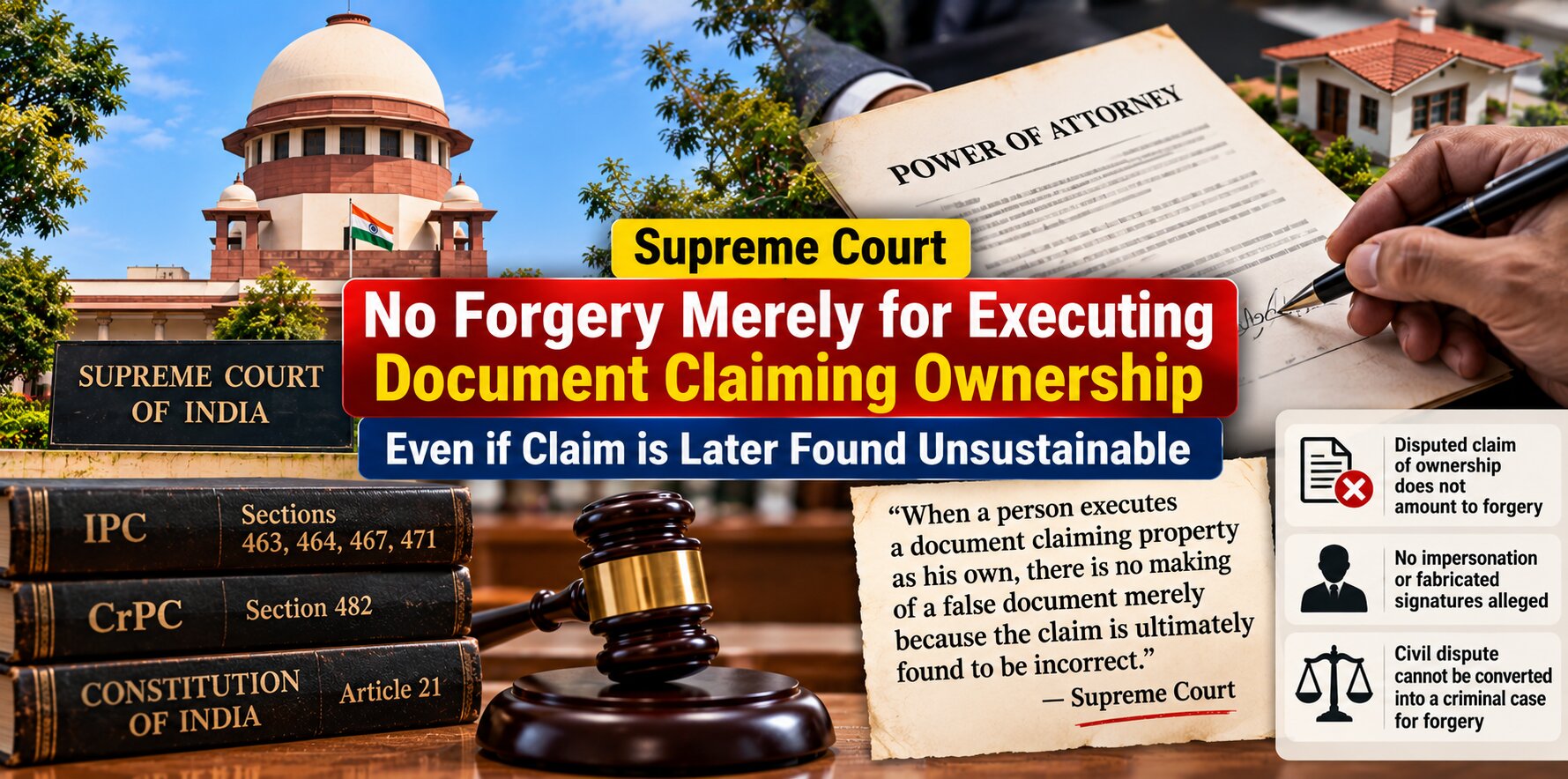
A disputed claim of ownership does not, by itself, amount to forgery.
Judgement Details
Court
Supreme Court of India
Date of Decision
5 September 2026
Judges
Justice Sanjay Karol and Justice Vipul M. Pancholi
Citation
Acts / Provisions
Facts of the Case
-
The dispute concerned Survey No. 157 at Village Panas, measuring approximately 5.5 acres, and arose from a longstanding controversy regarding ownership and shares in ancestral immovable property.
-
The property had originally been purchased in 1957 by six children of Nemabhai Patel, including the father of the appellants and the father of respondent No. 2.
-
Respondent No. 2 claimed exclusive ownership of the property on the basis of a 1987 settlement decree, whereas the appellants asserted that they had a share in the property.
-
The appellants relied, among other things, upon proceedings under the Urban Land Ceiling Act and revenue records recognising their interest in the property.
-
The appellants instituted civil proceedings in 2000 seeking declaration of their share in the property, and interim protection was granted during the civil litigation.
-
On 1 November 2001, accused Nos. 1 to 5 executed a Power of Attorney in favour of accused No. 6 for conducting the civil proceedings concerning the disputed property.
-
Respondent No. 2 subsequently alleged that the appellants had no valid title and that execution of the Power of Attorney amounted to forgery because they purported to exercise ownership rights over property that allegedly belonged exclusively to his branch.
-
The dispute remained before civil courts for several years. The Supreme Court noted that during the earlier civil litigation, respondent No. 2 had not alleged forgery, extortion, criminal intimidation or conspiracy against the appellants.
-
A complaint was eventually lodged in 2009, followed by FIR No. I-CR 504/2009, alleging offences including cheating, forgery, using forged documents, extortion, criminal intimidation and conspiracy.
-
The FIR was registered nearly nine years after the relevant events and introduced allegations that had not been raised during the earlier civil proceedings.
-
The appellants approached the Gujarat High Court under Section 482 CrPC seeking quashing of the criminal proceedings.
-
The Gujarat High Court declined to quash the proceedings, essentially treating the appellants' execution of documents asserting ownership rights, despite their disputed title, as sufficient to attract allegations of forgery.
-
The appellants thereafter approached the Supreme Court challenging the High Court's refusal to exercise its inherent jurisdiction.
Issues
-
Whether execution of a Power of Attorney asserting ownership or an interest in disputed property amounts to making a “false document” merely because the executants' claim of title is subsequently found to be legally unsustainable?
-
Whether the essential ingredients of forgery under Sections 463, 464, 465, 467, 468 and 471 of the IPC were disclosed when the signatures and execution of the Power of Attorney were not alleged to be forged or fabricated?
-
Whether a disputed claim of ownership over immovable property can, by itself, constitute forgery when there is no allegation of impersonation or fabrication of the document?
-
Whether the allegations in the FIR disclosed the essential ingredients of cheating, extortion, criminal intimidation and criminal conspiracy against the appellants?
-
Whether the belated second complaint containing material improvements and allegations not raised during earlier civil litigation justified exercise of the High Court's inherent jurisdiction under Section 482 CrPC?
-
Whether the Gujarat High Court erred in refusing to quash the FIR and consequential criminal proceedings against the appellants?
Judgement
-
The Supreme Court allowed the appeals and set aside the Gujarat High Court's judgment refusing to quash the criminal proceedings.
-
The Court held that the essential ingredient of forgery is the making of a “false document” within the meaning of Section 464 IPC.
-
The Court found that there was no allegation that the signatures on the Power of Attorney were forged or fabricated.
-
There was also no allegation that the appellants had impersonated another person or had fabricated a document by pretending to be someone else.
-
The execution of the Power of Attorney by the appellants was admitted.
-
The Supreme Court held that the High Court had proceeded on an erroneous legal premise by treating the absence of valid title as sufficient to convert the document into a forged document.
-
The Court relied upon the principle laid down in Mohd. Ibrahim v. State of Bihar, where it was held that a person who executes a document claiming property as his own does not make a false document merely because his claim of ownership is ultimately found to be incorrect.
-
The Court emphasised that whether the appellants' claim to the property was legally sustainable was a matter for determination by the competent civil court and could not, without more, constitute forgery.
-
The Court also considered the fact that the allegations of forgery, extortion, intimidation and conspiracy were raised after prolonged civil litigation in which such allegations had not previously been made.
-
The Court found the second complaint and FIR to contain material improvements, including allegations of extortion that had not formed part of the earlier complaint.
-
The Court concluded that the essential ingredients of the offences alleged against the appellants were not made out on the face of the FIR.
-
Consequently, the Court quashed FIR No. I-CR 504/2009 dated 31 December 2009 and all consequential proceedings arising from it, insofar as they concerned the appellants.
Held
-
Execution of a document asserting a person's own claim or interest in property does not become a “false document” merely because the claim is subsequently held to be legally incorrect.
-
Forgery requires the making of a false document within the meaning of Section 464 IPC.
-
Where the executants' signatures are genuine and there is no allegation of impersonation or fabrication, the mere absence of valid title does not satisfy the foundational requirement of forgery.
-
Consequently, offences dependent upon the existence of a forged document, including Sections 467 and 471 IPC, cannot be sustained merely on the basis of an unsuccessful property claim.
-
Criminal proceedings cannot be allowed to become a means of harassment or coercion in a dispute that is essentially concerned with title and ownership of immovable property.
-
Courts exercising Section 482 CrPC jurisdiction are required to examine whether the allegations, even if accepted at face value, actually satisfy the essential ingredients of the offences alleged.
-
Material improvements and unexplained delay in making serious criminal allegations can be relevant circumstances when determining whether continuation of criminal proceedings would amount to abuse of process.
-
The FIR and consequential proceedings were therefore quashed against the appellants.
Analysis
-
Distinction between a false claim and a false document: The central significance of the judgment lies in the distinction between making an incorrect legal claim and making a legally “false document.” A person may assert ownership of property and ultimately lose that claim in civil proceedings. That fact alone does not mean that the document through which the claim was asserted was fabricated.
-
Forgery requires the statutory ingredients: The Supreme Court correctly focused on Sections 463 and 464 IPC. The prosecution must first establish the making of a “false document.” Only after this foundational requirement is satisfied can offences such as Sections 465, 467, 468 or 471 become relevant.
-
Application of Mohd. Ibrahim: The Court reaffirmed the principle from Mohd. Ibrahim that executing a document in one's own name while claiming property that actually belongs to somebody else is fundamentally different from impersonating another person or fabricating another person's document.
-
Genuine execution is significant: In the present case, the Power of Attorney was admittedly executed by the persons whose signatures appeared on it. The absence of an allegation of impersonation or fabricated signatures therefore weakened the basic allegation of forgery.
-
Civil adjudication versus criminal prosecution: The Court recognised that the underlying controversy concerned competing claims of ownership and shares in immovable property. Such title questions ordinarily require adjudication in civil proceedings. The mere existence of an unsuccessful ownership claim does not automatically transform the dispute into a criminal case.
-
Section 482 CrPC: The judgment demonstrates that the High Court's inherent jurisdiction can be exercised where the allegations, even if accepted at face value, do not constitute the offences alleged or where continuation of the proceedings would amount to abuse of the criminal process.
-
Second complaint and material improvements: The Court also attached significance to the fact that serious allegations such as extortion and criminal intimidation appeared only later, after an earlier complaint and years of civil litigation. The circumstances surrounding such material improvements can be relevant in assessing whether the criminal process is being misused.
-
Forgery cannot be established merely through failure of title: The judgment makes clear that a civil court's finding that a person's ownership claim is unsustainable does not retrospectively transform every document executed by that person into a forged document.
-
Limits of the ruling: The decision does not mean that every document executed in connection with a property dispute is immune from criminal scrutiny. If the facts establish impersonation, fabrication, forged signatures, creation of a document in another person's name, or the other statutory ingredients of an offence, criminal liability may still arise.
-
Broader legal significance: The ruling reinforces the requirement that criminal courts and investigating agencies identify the specific statutory ingredients of an offence rather than treating an unsuccessful civil claim as proof of criminality.
-
The Supreme Court therefore quashed the FIR not merely because the dispute involved property, but because, on the allegations and circumstances before it, the essential ingredients of the offences were not disclosed and continuation of the prosecution amounted to an abuse of process.