
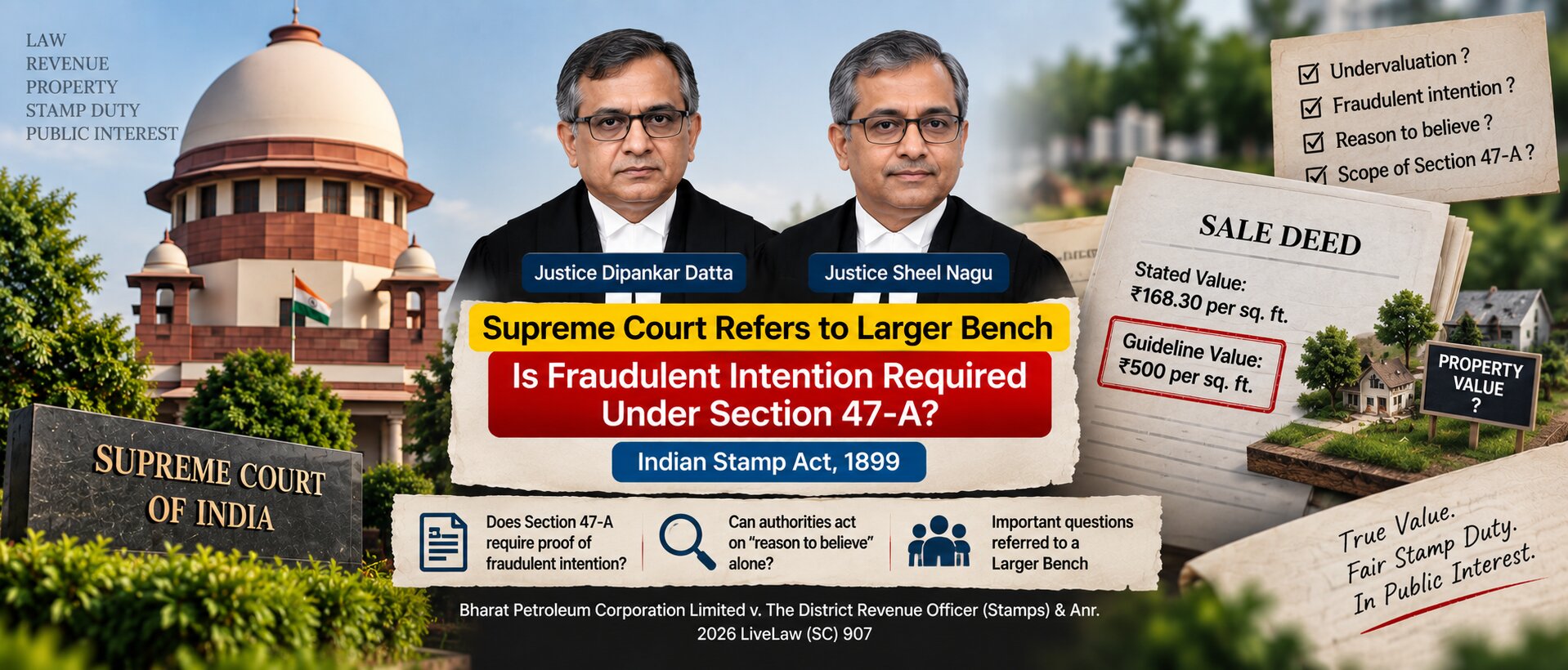
Bharat Petroleum Corporation Limited v. The District Revenue Officer (Stamps) & Anr., 2026
Section 47-A is concerned with determining whether the true market value or consideration has been correctly set forth in the instrument.
Judgement Details
Court
Supreme Court of India
Date of Decision
11 September 2026
Judges
Justice Dipankar Datta & Justice Sheel Nagu
Citation
Acts / Provisions
Facts of the Case
-
Bharat Petroleum Corporation Limited (BPCL) purchased a parcel of land from the Government of India, represented by the Deputy/Assistant Salt Commissioner.
-
The sale consideration was fixed and was fully paid through cheques in 2014.
-
Possession of the property was delivered to BPCL on 21 January 2014.
-
The sale deed was subsequently executed on 24 June 2016.
-
BPCL paid stamp duty on the full consideration mentioned in the sale deed.
-
The registering authority noticed a substantial difference between the value stated in the sale deed and the applicable guideline value.
-
The property was valued in the instrument at ₹168.30 per square foot, whereas the guideline value was ₹500 per square foot.
-
On this basis, the registering authority made a reference under Section 47-A of the Indian Stamp Act, 1899.
-
A show-cause notice dated 22 August 2016 was issued seeking determination of the correct market value and payment of additional stamp duty.
-
A Single Judge of the Madras High Court relied upon V.N. Devadoss v. Chief Revenue Control Officer-cum-Inspector of Stamps and quashed the notice.
-
The Single Judge held that Section 47-A could be invoked only where there was reason to believe that the property had been deliberately undervalued with fraudulent intention to evade stamp duty.
-
The Division Bench of the Madras High Court reversed the Single Judge's order and restored the Section 47-A proceedings.
-
BPCL thereafter approached the Supreme Court.
-
The Supreme Court, while considering the correctness of the earlier interpretation, expressed serious reservations about requiring proof of wilful undervaluation and fraudulent intention at the stage of invoking Section 47-A.
Issues
-
Whether the judgment in V.N. Devadoss v. Chief Revenue Control Officer-cum-Inspector of Stamps, subsequently followed in Registrar of Assurances v. ASL Vyapar (P) Ltd., correctly holds that wilful undervaluation with fraudulent intention to evade stamp duty is a prerequisite for exercising power under Section 47-A of the Indian Stamp Act, 1899?
-
Whether the power under Section 47-A can be exercised by the registering authority merely upon having reason to believe that the true market value or consideration has not been correctly stated in the instrument, irrespective of the culpable intention of the parties?
-
Whether the decisions in Ramesh Chand Bansal and Shanti Bhushan lay down the correct law?
Judgement
-
The Supreme Court expressed its disagreement with the interpretation adopted in V.N. Devadoss and subsequently followed in ASL Vyapar (P) Ltd.
-
The Court held that the words “wilful undervaluation” and “fraudulent intention” cannot be inserted into Section 47-A as additional jurisdictional requirements when those expressions are not found in the statutory provision.
-
Section 47-A specifically proceeds on the basis that the registering authority has “reason to believe” that the market value or consideration stated in the instrument does not represent the true value.
-
The Court emphasized that the statutory inquiry is primarily concerned with determining the true market value or consideration and the appropriate stamp duty.
-
According to the Court, importing a requirement of fraudulent intention into the provision would effectively amount to judicial legislation.
-
The Court observed that such an interpretation could unnecessarily convert a valuation inquiry into an inquiry concerning the culpable mental state of the parties.
-
The Bench illustrated the difficulty through two hypothetical situations.
-
In an honest transaction, a property may legitimately be sold below its guideline value because of tenancy restrictions, poor access, pending litigation or other circumstances affecting its actual market value.
-
In such a case, the Section 47-A inquiry should determine the property's genuine market value rather than require proof concerning fraudulent intention.
-
Conversely, in a fraudulent transaction, the parties may conceal the actual consideration by showing a lower amount in the instrument and paying the balance in cash.
-
If proof of fraudulent intention were required before an inquiry could even begin, the authority could be prevented from investigating precisely because evidence of the concealed arrangement may remain within the exclusive knowledge of the parties.
-
The Court therefore considered the earlier requirement of proving fraudulent intention at the threshold to be potentially too harsh in genuine cases and too lax in cases involving concealed transactions.
-
The Court referred the identified questions to a larger Bench for authoritative determination.
Held
-
Wilful undervaluation and fraudulent intention should not automatically be treated as independent jurisdictional conditions for initiating proceedings under Section 47-A.
-
The statutory expression “reason to believe” is the relevant threshold for the registering authority.
-
A requirement of fraudulent intention cannot be judicially inserted into a statutory provision when the legislature has not expressly provided such a requirement.
-
The correctness of the earlier decisions, particularly V.N. Devadoss and ASL Vyapar (P) Ltd., requires reconsideration by a larger Bench.
-
The questions concerning Ramesh Chand Bansal and Shanti Bhushan were also referred to the larger Bench.
Analysis
-
The judgment represents a significant shift in the interpretation of Section 47-A of the Indian Stamp Act by questioning the requirement that undervaluation must necessarily be accompanied by fraudulent intent.
-
The Court adopted a textual and statutory-scheme-based approach, focusing on the actual language used by the legislature.
-
The expression “reason to believe” indicates that the authority need not establish fraud conclusively before commencing a valuation inquiry.
-
The Court distinguished between initiating an inquiry and ultimately establishing wrongdoing. A preliminary valuation inquiry should not be made dependent upon proof of the parties' dishonest intention.
-
The reasoning prevents the valuation mechanism from becoming ineffective in situations where fraudulent arrangements are deliberately concealed.
-
At the same time, the approach does not mean that every transaction below the guideline value is automatically fraudulent or that additional stamp duty must always be imposed.
-
Genuine factors affecting the actual market value can still be examined during the Section 47-A proceedings.
-
The judgment therefore places greater emphasis on the true market value of the property rather than the subjective intention of the contracting parties.
-
The reference to a larger Bench is particularly important because V.N. Devadoss was a three-Judge Bench decision, and the present Bench has expressly disagreed with its interpretation.
-
The larger Bench's eventual ruling is likely to clarify the scope of Section 47-A and the extent of the registering authority's power to investigate undervaluation.
-
The decision may have substantial implications for property transactions, stamp-duty proceedings, registration authorities and revenue administration.