
BG v. VG, 2026
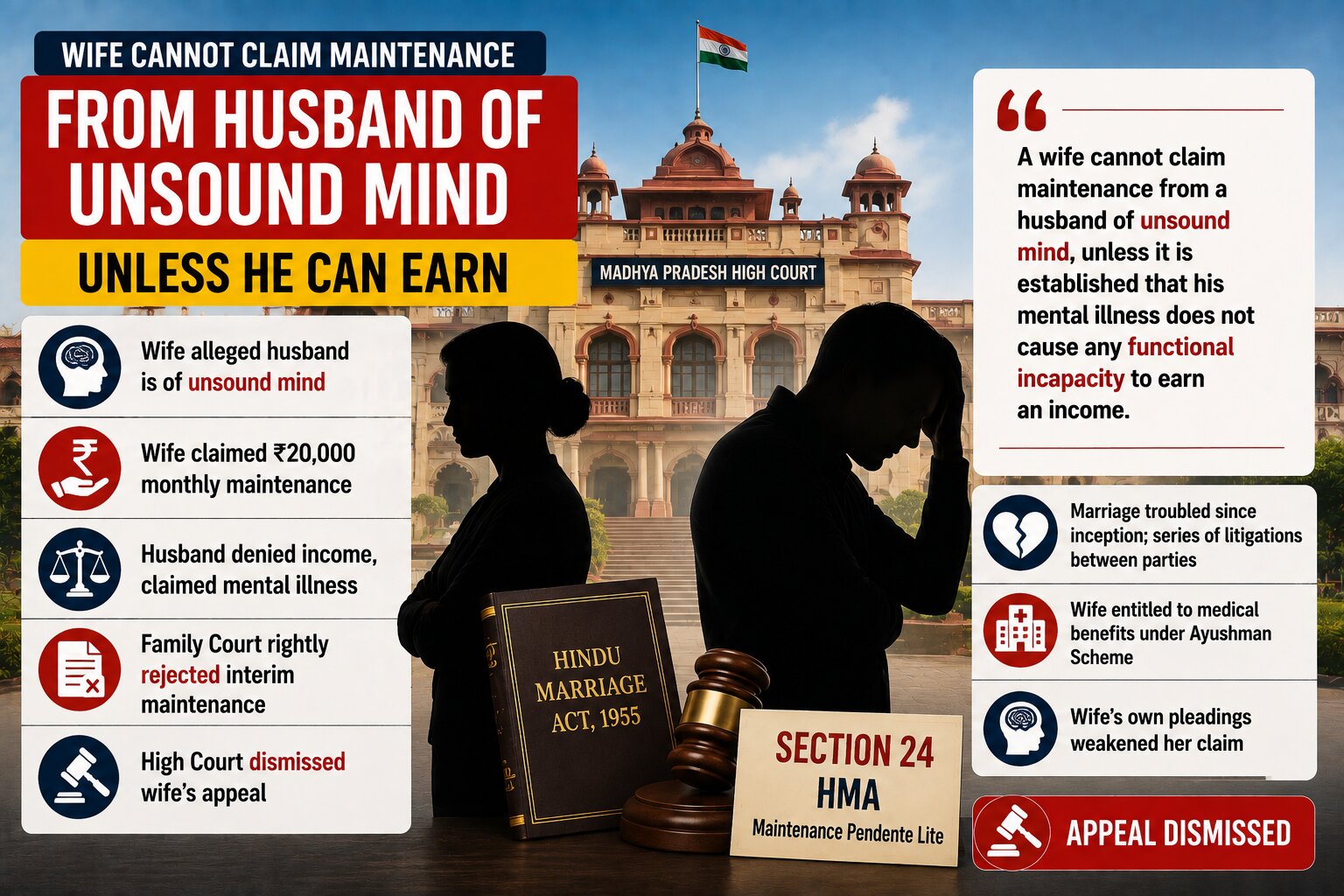
The judgment highlights that parties are bound by the consequences of their own pleadings during matrimonial litigation.
Judgement Details
Court
Madhya Pradesh High Court
Date of Decision
30 July 2026
Judges
Justice G.S. Ahluwalia & Justice Anuradha Shukla
Citation
Acts / Provisions
Facts of the Case
-
The parties were married in 2008, and matrimonial disputes arose soon thereafter.
-
In 2009, the husband filed a divorce petition, which was later withdrawn.
-
The parties subsequently filed a joint petition for divorce, but it was dismissed due to non-compliance with the agreed terms.
-
The husband filed another divorce petition in 2014, which was also withdrawn.
-
In 2016, the husband instituted a third divorce petition.
-
During the pendency of the third petition, the wife filed an application under Section 24 HMA seeking interim maintenance.
-
The wife alleged that she had been subjected to dowry harassment, was forced to leave the matrimonial home, and had no independent means of maintenance.
-
She claimed that the husband earned approximately ₹50,000 per month from a medical store and sought ₹20,000 per month as interim maintenance.
-
The husband denied these allegations, contending that he did not run any medical store, was responsible for maintaining his two daughters from his first marriage, and that the wife herself was earning by working as an Advocate and as a Court Commissioner.
-
During the proceedings, the wife amended her pleadings and alleged that the husband was of unsound mind.
-
She also sought an additional ₹15 lakh towards her medical treatment, claiming that she was undergoing treatment for cancer.
-
The Family Court dismissed the application for interim maintenance.
-
Aggrieved by the order, the wife preferred an appeal before the Madhya Pradesh High Court.
Issues
-
Whether the wife was entitled to interim maintenance under Section 24 of the Hindu Marriage Act, 1955?
-
Whether a wife can ordinarily claim maintenance from a husband whom she herself alleges to be of unsound mind?
-
Whether the wife's own pleadings alleging the husband's unsoundness of mind weakened her claim for interim maintenance?
-
Whether the Family Court was justified in rejecting the application for interim maintenance?
Judgement
-
The Madhya Pradesh High Court upheld the Family Court's order rejecting the wife's application for interim maintenance.
-
The Court observed that a wife cannot ordinarily claim maintenance from a husband whom she herself alleges is of unsound mind unless it is shown that his mental illness does not result in functional incapacity to earn an income.
-
The Bench held that the wife's own amendment alleging the husband's unsoundness of mind substantially weakened her claim for maintenance.
-
The Court noted that there had been continuous matrimonial litigation between the parties since shortly after their marriage.
-
It also observed that the wife admitted that the marriage had never been consummated.
-
The Court found that the wife had not succeeded in her earlier proceedings seeking maintenance or alleging domestic violence.
-
Regarding the wife's claim of ₹15 lakh towards medical treatment, the Court observed that she possessed an Ayushman Card, making her eligible for medical benefits under the Government scheme.
-
Consequently, the Court found no justification to interfere with the Family Court's order.
-
The appeal was dismissed.
Held
-
A wife cannot ordinarily seek maintenance from a husband whom she herself alleges to be of unsound mind unless it is established that the alleged mental illness does not render him functionally incapable of earning.
-
The wife's own pleadings can be relevant while determining entitlement to interim maintenance.
-
The Family Court's refusal to grant interim maintenance was upheld.
-
The appeal was dismissed.
Analysis
-
The Court emphasized that a plea alleging unsoundness of mind cannot be selectively relied upon while simultaneously claiming maintenance from the same person without establishing his earning capacity.
-
The decision clarifies that entitlement under Section 24 HMA depends not merely upon need but also upon the factual circumstances pleaded and proved by the parties.
-
The ruling underscores that interim maintenance is a discretionary relief and requires the Court to assess the financial capacity of both spouses.
-
By referring to the husband's alleged mental condition, the Court recognised that maintenance presupposes the respondent's ability to earn or possess sufficient means.
-
The judgment also reflects judicial scrutiny of claims for additional medical expenses where alternative statutory welfare benefits are available.
-
The ruling reinforces the principle that inconsistent or self-defeating pleadings may adversely affect a litigant's claim.
-
The decision provides guidance for Family Courts while considering interim maintenance applications involving allegations of mental incapacity.