
Bejla Oraon v. Kali Das Oraon & Others, 2026
An uncle-in-law cannot validly induct his niece's husband as a ghar damad under the recognized customary law of the Oraon tribe.
Judgement Details
Court
Supreme Court of India
Date of Decision
9 July 2026
Judges
Justice Sanjay Karol and Justice Nongmeikapam Kotiswar Singh
Citation
Acts / Provisions
Facts of the Case
-
The dispute concerned ancestral property belonging to Sukhu Oraon, who had three sons:
-
Dhungru Oraon,
-
Ledura Oraon, and
-
Bhoula Oraon.
-
-
Ledura died issueless.
-
Bhoula also died, leaving behind only one daughter, Budhain.
-
The plaintiff, Bejla Oraon, son of Dhungru, claimed that as the nearest male agnate, he inherited the properties after the deaths of Ledura and Bhoula.
-
The defendants contended that Budhain's husband, Punai, had been inducted as a ghar damad (resident son-in-law) by Ledura and therefore became entitled to inherit the property.
-
They also relied upon a document dated 27 February 1975, described during the proceedings as a partition deed.
-
The Trial Court accepted the defendants' plea regarding the validity of the alleged ghar damad arrangement and dismissed the suit.
-
The First Appellate Court affirmed the judgment.
-
The Jharkhand High Court dismissed the second appeal despite framing a substantial question of law regarding whether an uncle-in-law could induct his niece's husband as a ghar damad under Oraon customary law.
-
Aggrieved, the plaintiff approached the Supreme Court.
Issues
-
Whether an uncle-in-law can validly induct his niece's husband as a ghar damad under the customary law of the Oraon tribe?
-
Whether the defendants successfully proved the existence of a customary practice permitting such induction?
-
Whether the nearest male agnate succeeds to the property of an issueless Oraon male in the absence of a validly inducted ghar damad?
-
Whether the High Court erred in failing to decide the substantial question of law framed under Section 100 CPC?
Judgement
-
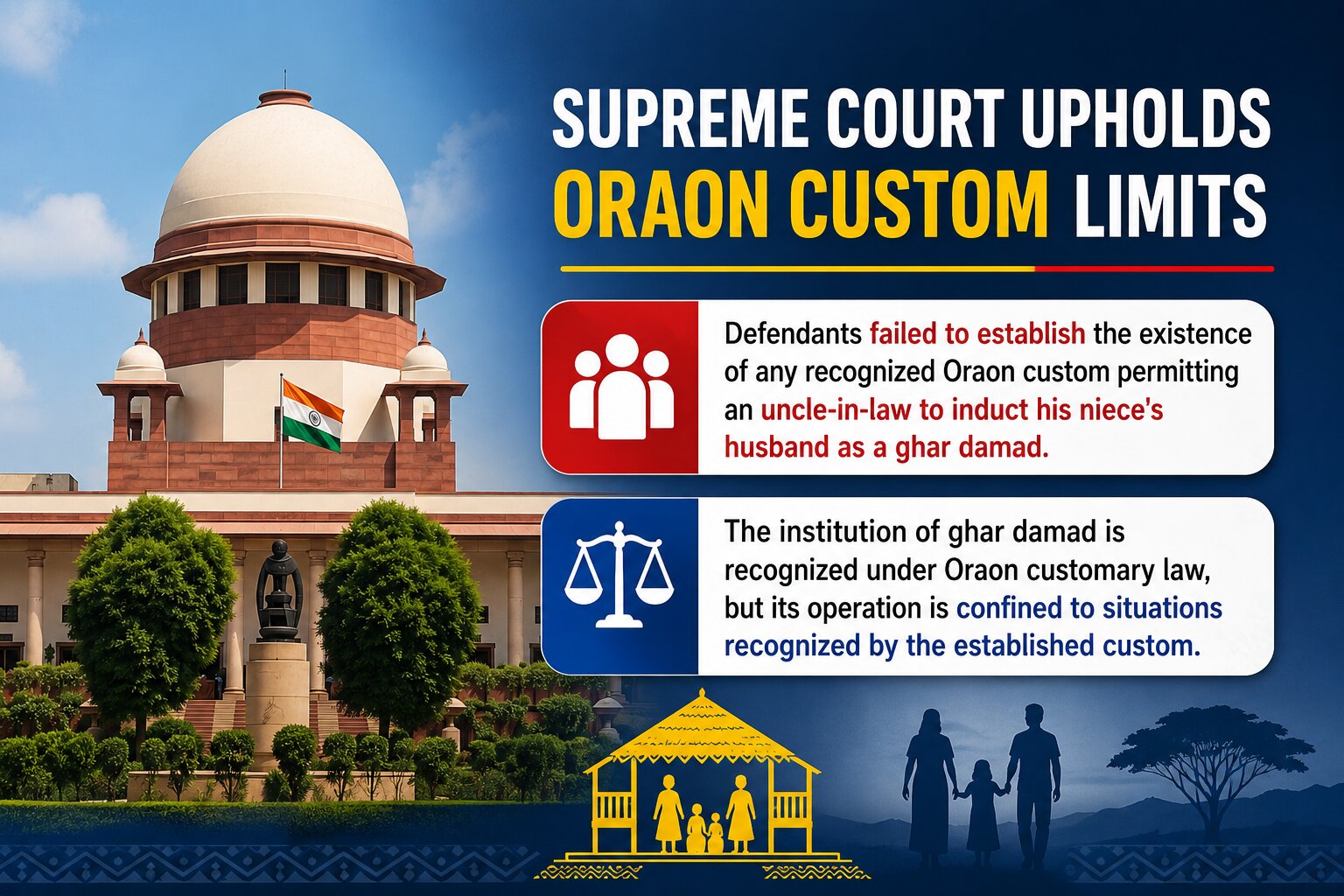
The Supreme Court held that the defendants failed to establish the existence of any recognized Oraon custom permitting an uncle-in-law to induct his niece's husband as a ghar damad.
-
The Court observed that although the institution of ghar damad is recognized under Oraon customary law, its operation is confined to situations recognized by the established custom.
-
Relying upon S.C. Roy's authoritative work, The Oraons of Chotanagpur, the Court held that succession rights accrue to a ghar damad only when he is adopted into the household by:
-
the last male owner, or
-
his widow.
-
-
In the present case, Punai was allegedly inducted by Ledura, who was merely the maternal uncle of Budhain and not her father.
-
Consequently, the Court held that the alleged ghar damad arrangement did not satisfy the requirements of the recognized custom.
-
The Supreme Court reiterated that the party relying upon a custom bears the burden of proving its existence, certainty, antiquity, continuity, and reasonableness.
-
The Court observed that no evidence establishing such a custom had been produced by the defendants.
-
It further held that, under the prevailing Oraon customary law, where there is no son, no validly adopted ghar damad, and no other direct male heir, succession devolves upon the nearest male agnate.
-
The Court also held that the partition deed relied upon by the defendants was ineffective to confer title.
-
The Court found that the High Court committed an error by merely relying upon concurrent findings without answering the substantial question of law framed under Section 100 CPC.
-
Accordingly, the Supreme Court allowed the appeal, set aside the judgments of the Trial Court, First Appellate Court, and High Court, and decreed the plaintiff's suit.
Held
-
The party asserting a custom must strictly prove its existence under Section 48 of the Evidence Act.
-
In the absence of a validly adopted ghar damad or other direct male heir, the nearest male agnate inherits the property of an issueless Oraon male.
-
The High Court erred by failing to properly answer the substantial question of law under Section 100 CPC.
-
The plaintiff, being the nearest male agnate, was declared entitled to succeed to the disputed property.
Analysis
-
The judgment reaffirms the principle that customary law constitutes an exception to the general law and must therefore be strictly proved, rather than assumed on the basis of general assertions.
-
By relying upon the scholarly work of S.C. Roy, the Supreme Court emphasized that recognized customary practices must be established through authoritative evidence and long-standing usage.
-
The decision clarifies the limited scope of the ghar damad institution under Oraon customary law, holding that succession rights arise only where induction is made by the last male owner or his widow.
-
The Court also reiterated that concurrent findings of fact are not immune from interference where they are founded upon an erroneous understanding of customary law or where material legal questions remain unanswered.
-
The judgment strengthens the obligation of High Courts exercising jurisdiction under Section 100 CPC to actually decide the substantial questions of law framed, rather than merely affirm concurrent findings.
-
The ruling further underscores that burden of proof rests entirely upon the party asserting a custom, especially where such custom alters the normal rules of succession.
-
Overall, the decision provides important guidance on the judicial approach to tribal customary law by balancing respect for indigenous customs with the requirement that such customs be proved through reliable legal evidence before they are enforced.