
Bassanna Since Deceased by LRs. & Ors. v. Bhimanna & Ors., 2026
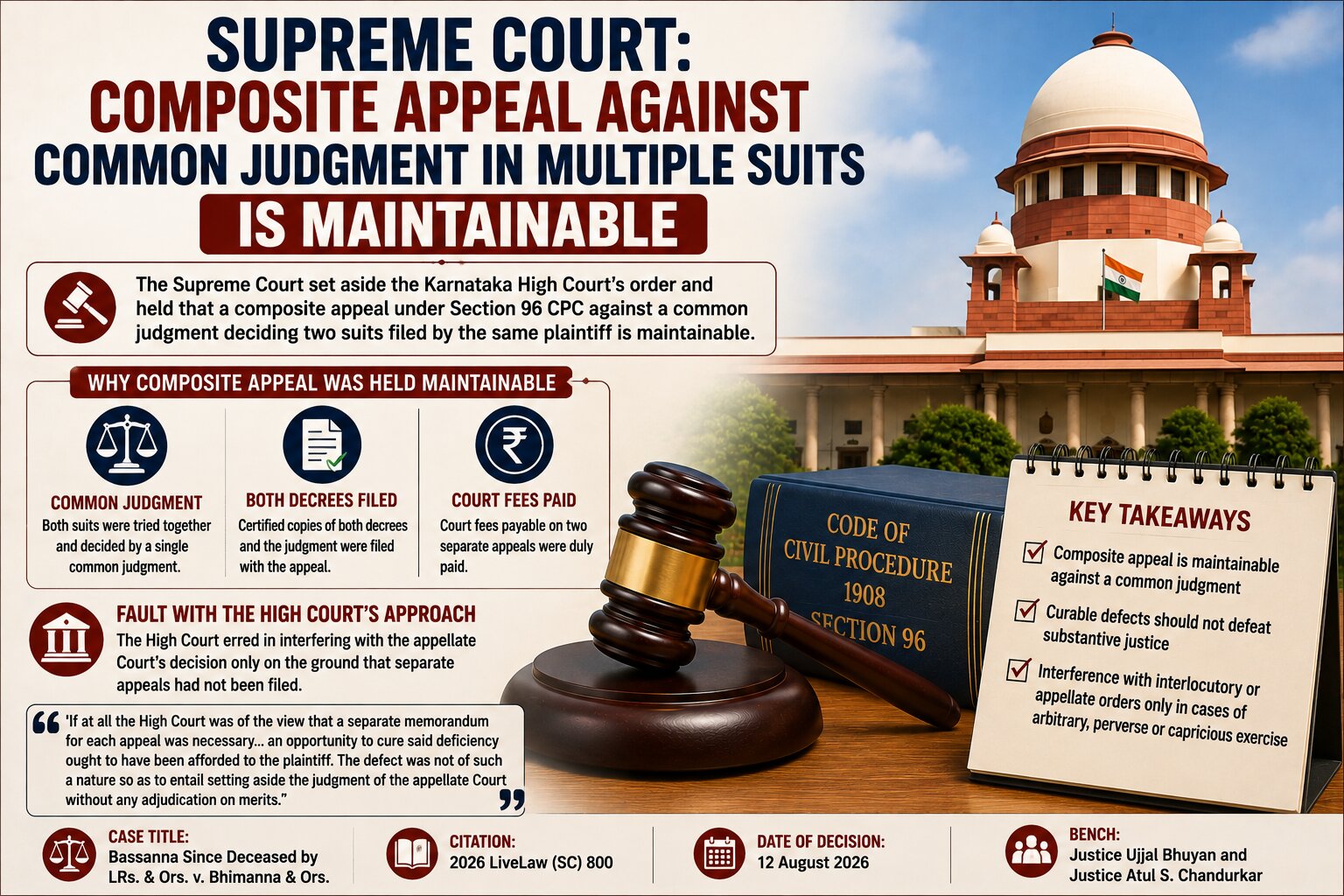
A composite appeal is maintainable against a common judgment deciding two suits filed by the same plaintiff, in appropriate circumstances.
Judgement Details
Court
Supreme Court of India
Date of Decision
13 August 2026
Judges
Justice Ujjal Bhuyan and Justice Atul S. Chandurkar
Citation
Acts / Provisions
Facts of the Case
-
The dispute originated from two civil suits filed by the same plaintiff.
-
In the first suit, the plaintiff sought a declaration that a registered sale deed executed by one defendant in favour of another was null and void.
-
In the second suit, the plaintiff sought a permanent injunction restraining the defendants from interfering with the plaintiff's alleged joint possession of the property.
-
Both suits involved substantially connected questions and were therefore clubbed together.
-
A common trial was conducted in respect of both suits.
-
The parties led evidence in the consolidated proceedings.
-
By a common judgment dated 7 December 1990, the trial court dismissed both suits.
-
The plaintiff challenged the common judgment by filing one composite appeal under Section 96 CPC.
-
The appellant filed certified copies of the judgment and both decrees along with the memorandum of appeal.
-
The appellant also paid court fees applicable to two separate appeals.
-
The composite appeal specifically challenged the common judgment dismissing both suits.
-
The First Appellate Court entertained the composite appeal and adjudicated the matter on merits.
-
The respondents subsequently challenged the appellate decision before the High Court.
-
The Karnataka High Court interfered with the First Appellate Court's decision on the ground that separate appeals had not been filed against the two decrees.
-
According to the High Court, separate memoranda of appeal were required because two decrees had been passed.
-
The aggrieved appellants approached the Supreme Court.
-
The Supreme Court considered whether a composite appeal is maintainable against a common judgment deciding two suits instituted by the same plaintiff.
-
The Court also considered whether failure to file separate memoranda constituted a fatal defect or merely a curable procedural irregularity.
Issues
-
Whether a composite appeal under Section 96 of the Code of Civil Procedure is maintainable against a common judgment adjudicating two suits filed by the same plaintiff?
-
Whether the mere existence of two separate decrees arising from a common judgment requires the plaintiff to file two separate appeals?
-
Whether a composite appeal can be entertained where the appellant challenges the common judgment disposing of both suits and files the decrees relating to both suits along with the memorandum of appeal?
-
Whether failure to file separate memoranda of appeal against two decrees arising from a common judgment constitutes a fatal defect?
-
Whether the omission to file separate appeals, if considered a procedural defect, is curable by providing the appellant an opportunity to rectify the defect?
-
Whether the High Court was justified in setting aside the First Appellate Court's decision solely on the ground that separate appeals had not been filed?
Judgement
-
The Supreme Court allowed the appeal.
-
The Court set aside the judgment of the Karnataka High Court.
-
The Supreme Court held that the composite appeal filed by the plaintiff was maintainable in the circumstances of the case.
-
The First Appellate Court was correct in entertaining and adjudicating the composite appeal on merits.
-
The Court rejected the proposition that the mere existence of two decrees necessarily required two separate appeals in the circumstances presented.
-
The Supreme Court noted that the two suits had been decided through a single common judgment.
-
The plaintiff had challenged that common judgment through one composite appeal.
-
Importantly, the appellant had filed certified copies of both decrees along with the appeal.
-
The appellant had also paid the court fees applicable to two appeals.
-
The Supreme Court held that the absence of a separate memorandum of appeal was, at most, a curable procedural defect.
-
Such a defect could not justify setting aside the appellate court's decision without examining the substantive dispute.
-
The High Court should have provided an opportunity to cure the procedural deficiency if it considered separate memoranda necessary.
-
The Supreme Court emphasised that procedural requirements should not unnecessarily prevent adjudication of a dispute on its merits.
-
The matter was consequently restored for fresh adjudication on merits before the High Court.
-
The second appeals preferred by the respondents were restored before the High Court for consideration in accordance with law.
Held
-
The filing of two separate decrees does not automatically make a composite appeal invalid.
-
Where the appellant challenges a common judgment and places both decrees on record, the appellate court can entertain the composite appeal.
-
Payment of court fees corresponding to both appeals is an important factor supporting maintainability.
-
Failure to file separate memoranda, where otherwise required, may constitute a curable procedural defect rather than a fatal defect.
-
A litigant should ordinarily be given an opportunity to cure such a procedural deficiency.
-
An appellate decision should not be set aside merely because of such a curable procedural omission without consideration of the merits.
-
The High Court therefore erred in interfering with the First Appellate Court's decision solely because separate appeals had not been filed.
-
The composite appeal was properly entertained by the First Appellate Court.
Analysis
-
Central legal principle: The Supreme Court adopted a pragmatic approach to appellate procedure. The focus was on whether the opposing party and the court were adequately informed of the challenge to both decrees rather than treating the number of memoranda as an inflexible technical requirement.
-
Common judgment: The fact that both suits were decided by one common judgment was significant. The plaintiff's grievance arose from the same adjudicatory exercise, making a composite challenge procedurally understandable.
-
Two decrees versus one appeal: The Court recognised that two decrees may technically arise from a common judgment, but this does not necessarily mean that two separate memoranda must always be treated as indispensable.
-
Court fees: The appellant had paid court fees applicable to both appeals. This demonstrated that there was no attempt to avoid the financial or procedural requirements attached to the two appellate challenges.
-
Both decrees filed: The appellant had also placed certified copies of both decrees before the appellate court. Therefore, the court had the necessary material to understand the scope of the challenge.
-
Curable defect: Even assuming that separate memoranda were technically required, the Supreme Court considered the omission curable. The appropriate response would have been to permit rectification rather than terminate the appellate adjudication.
-
Procedural law and substantive justice: The judgment reinforces the principle that procedural rules exist to facilitate the administration of justice and should not ordinarily become an obstacle to deciding substantive rights.
-
No prejudice: The circumstances indicated that the respondents were aware that the plaintiff was challenging the common judgment concerning both suits. There was therefore no apparent procedural surprise that justified nullifying the appellate decision.
-
Role of Section 96 CPC: Section 96 provides the substantive right of appeal from an original decree. The Supreme Court's approach ensures that the procedural format of exercising that right does not unnecessarily defeat the right itself.
-
Importance of opportunity to cure: Where a court identifies a procedural defect that does not go to the root of jurisdiction or substantive validity, the preferable course is generally to give the affected party an opportunity to correct it.
-
Distinction from incurable defects: The judgment does not mean that every failure in an appeal is automatically curable. The Court's reasoning depends heavily on the common judgment, common factual background, filing of both decrees and payment of appropriate court fees.
-
Appellate efficiency: Permitting a composite appeal in appropriate cases can reduce unnecessary duplication and prevent multiple proceedings concerning substantially connected disputes.
-
Protection against technical dismissal: The decision prevents a party from losing a merits-based appellate remedy merely because the appeal was presented in a composite format when the substantive challenge to both decrees was clearly identifiable.
-
Impact on civil litigation: The judgment provides guidance for cases where multiple suits involving the same plaintiff are tried together and disposed of through a common judgment.
-
Practical lesson for advocates: Where a common judgment decides multiple suits, counsel should clearly identify every decree being challenged, include the relevant decrees, state the grounds concerning each matter distinctly and pay the applicable court fees.
-
Judicial discretion: The judgment reinforces the responsibility of appellate courts to distinguish between defects affecting the very maintainability of proceedings and procedural deficiencies that can reasonably be corrected.
-
Overall significance: The decision promotes a merits-oriented approach to civil appeals and discourages dismissal of substantive appellate proceedings solely because of a curable procedural irregularity.