
Balveer Singh v. State of Uttar Pradesh and Others, 2026
Section 23(1) presupposes a valid transfer by the senior citizen.
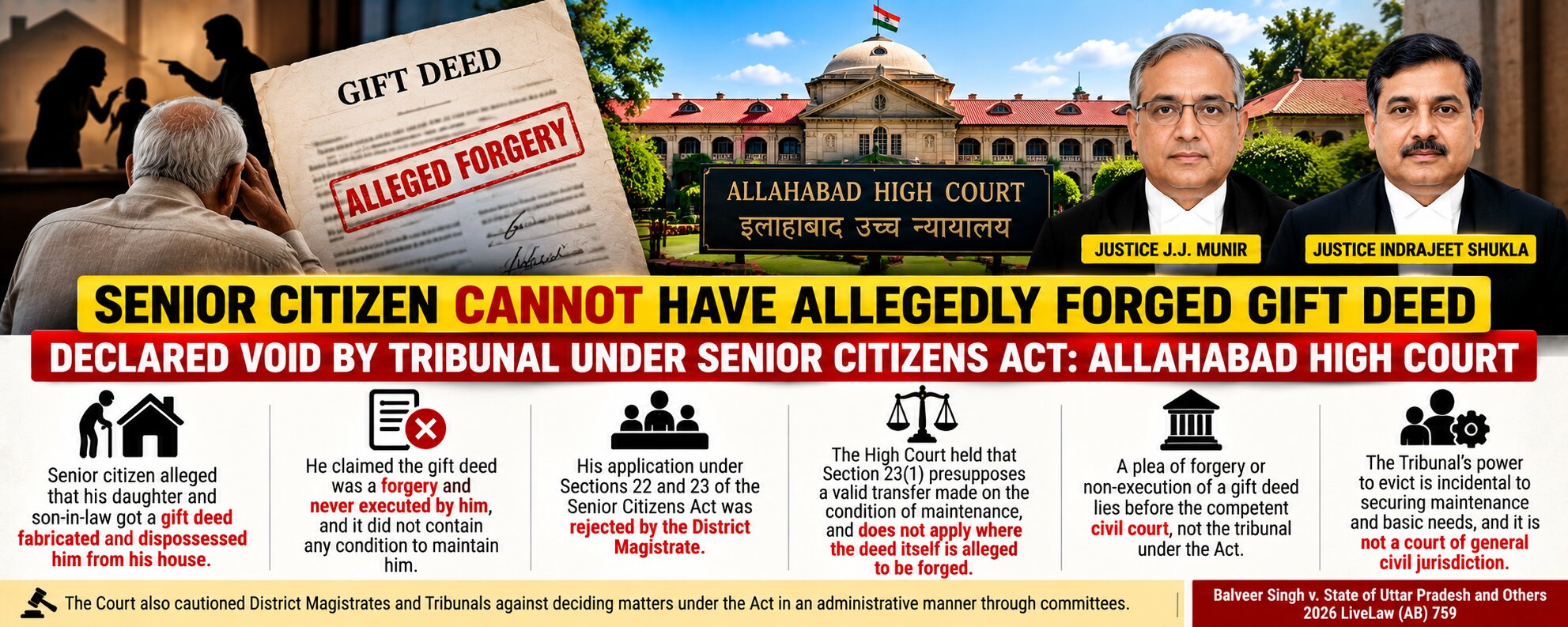
Judgement Details
Court
Allahabad High Court
Date of Decision
30 September 2026
Judges
Justice J.J. Munir and Justice Indrajeet Shukla
Citation
Acts / Provisions
Facts of the Case
-
The petitioner, Balveer Singh, aged 68 years, was a senior citizen residing in Lalitpur.
-
He alleged that his daughter and son-in-law had procured a registered gift deed dated 18 November 2023 concerning his residential house.
-
According to the petitioner, the gift deed was forged and fabricated, as it did not bear his genuine signatures and, according to him, he had never executed the document.
-
The property was alleged to be the petitioner's only shelter.
-
He further alleged that the respondents relied upon the disputed gift deed and assaulted him before dispossessing him from the property.
-
Significantly, the petitioner asserted that the gift deed contained no condition requiring his daughter to maintain him or provide him with basic amenities and physical needs.
-
The petitioner invoked the statutory mechanism under Sections 22 and 23 of the Maintenance and Welfare of Parents and Senior Citizens Act, 2007, seeking protection and eviction of the alleged transferees.
-
His representations were not acted upon initially, and the District Magistrate, Lalitpur rejected his application for eviction on 23 June 2026.
-
During the proceedings, the District Magistrate had also constituted committees to inquire into the allegation that the gift deed was forged.
-
Aggrieved, the petitioner approached the Allahabad High Court under its writ jurisdiction.
Issues
-
Whether a senior citizen can invoke Section 23(1) of the Maintenance and Welfare of Parents and Senior Citizens Act, 2007 to have a gift deed declared void on the ground that the deed itself is forged or was never executed by him?
-
Whether the Tribunal exercising jurisdiction under the 2007 Act possesses the plenary jurisdiction of a civil court to adjudicate the validity, execution, title and genuineness of a registered gift deed?
-
Whether the statutory power under Section 23(1) is attracted in the absence of a condition in the transfer requiring the transferee to provide basic amenities and physical needs to the senior citizen?
-
Whether the District Magistrate or Tribunal can constitute administrative committees to inquire into allegations of forgery while exercising judicial or quasi-judicial jurisdiction under the Act?
Judgement
-
The Allahabad High Court dismissed the writ petition, holding that the petitioner's challenge to the gift deed on the ground of forgery fell outside the jurisdiction of the Tribunal under the Maintenance and Welfare of Parents and Senior Citizens Act, 2007.
-
The Court held that Section 23(1) operates on the assumption that there has been a valid transfer of property by the senior citizen.
-
The provision becomes relevant where the transfer was subject to a condition that the transferee would provide the senior citizen with basic amenities and basic physical needs, and the transferee subsequently fails to fulfil that obligation.
-
In such circumstances, the statute creates a legal fiction under which the transfer may be treated as having been made by fraud, coercion or undue influence and may, at the election of the transferor, be declared void.
-
The Court emphasised that this statutory fiction does not confer a general power upon the Tribunal to examine every allegation of fraud, coercion, undue influence or forgery concerning the validity of a document.
-
Where the senior citizen's case is that the document was never executed by him at all, or that his signature was forged, the dispute concerns the very existence and validity of the conveyance.
-
Such a dispute must be adjudicated by the competent civil court having ordinary original civil jurisdiction.
-
The civil court can grant the appropriate relief concerning cancellation of the disputed gift deed and, where necessary, also adjudicate questions relating to title, possession and consequential reliefs.
-
The Court held that the Tribunal's power to order eviction is incidental to the statutory objective of securing maintenance, basic needs and protection of the life and property of senior citizens.
-
It is not a general jurisdiction to adjudicate complicated questions of title or determine whether a registered conveyance is genuine or forged.
-
Applying the principle from its earlier decision in Shyamji Shukla v. State of U.P., the Court reiterated that the Tribunal under the Act does not possess plenary jurisdiction equivalent to that of a civil court.
-
The Court illustrated the jurisdictional limitation by asking whether the petitioner could have sought cancellation of the gift deed before the Tribunal if the alleged transferee had not been his daughter. It answered the question in the negative.
-
The Court also criticised the administrative manner in which the forgery allegations were investigated through committees.
-
It cautioned District Magistrates and Sub-Divisional Magistrates that when exercising judicial or quasi-judicial powers, they must follow the procedure prescribed by law rather than adopting an administrative method of inquiry.
-
The Court therefore left the petitioner free to pursue his rights and appropriate remedies before the competent civil court.
Held
-
The provision is attracted where the transfer was made subject to an obligation upon the transferee to provide basic amenities and basic physical needs and that obligation is subsequently breached.
-
A plea that a gift deed is forged, fabricated or never executed is fundamentally different from a claim that a valid transfer has subsequently resulted in neglect or failure of maintenance.
-
The Senior Citizens Tribunal cannot exercise general civil jurisdiction to adjudicate the genuineness or validity of a registered conveyance.
-
Allegations of forgery concerning the execution of a gift deed must be adjudicated by the competent civil court.
-
The Tribunal's power to evict a transferee is incidental to its statutory jurisdiction relating to maintenance, protection of life and property, and enforcement of the statutory rights of senior citizens.
-
Section 23(1) does not create a general statutory mechanism for cancelling every allegedly fraudulent property transaction involving a senior citizen.
-
Administrative committees cannot be used as a substitute for the legally prescribed adjudicatory process when a Tribunal is exercising judicial or quasi-judicial powers.
-
The petitioner was therefore required to pursue the appropriate civil remedy for cancellation of the allegedly forged gift deed and consequential relief concerning title and possession.
Analysis
-
The central principle of the judgment is the distinction between a valid transfer followed by breach of a maintenance condition and a dispute over whether the transfer itself ever took place.
-
Section 23(1) presupposes that the senior citizen actually transferred the property to the transferee.
-
The provision applies where the transfer was made subject to a condition that the transferee would provide the senior citizen with basic amenities and basic physical needs.
-
Where the transferee fails to fulfil that maintenance obligation, Section 23(1) permits the transfer to be treated as void at the election of the senior citizen.
-
The statutory mechanism under Section 23(1) cannot be extended to a case where the senior citizen alleges that he never executed the document at all.
-
An allegation of forgery or fabrication requires determination of issues relating to execution, signatures, authenticity of documents, evidence and title.
-
Such questions fall within the jurisdiction of the competent civil court, rather than the Senior Citizens Tribunal.
-
The High Court therefore drew a clear jurisdictional boundary between the special statutory jurisdiction of the Senior Citizens Tribunal and the ordinary jurisdiction of a civil court.
-
The Tribunal can protect the statutory rights and interests of senior citizens, but it cannot exercise the plenary jurisdiction of a civil court merely because the dispute concerns property belonging to a senior citizen.
-
Although Section 23(1) uses the expressions fraud, coercion and undue influence, those concepts operate within the specific statutory framework created by the provision.
-
The statutory fiction under Section 23(1) arises when a senior citizen has made a transfer subject to a maintenance obligation and the transferee subsequently fails to fulfil that obligation.
-
The statutory reference to fraud, coercion or undue influence does not confer a general power on the Tribunal to adjudicate every allegation of fraud or forgery concerning a property document.
-
The fact that the alleged transferee was the petitioner's daughter and another respondent was his son-in-law did not enlarge the Tribunal's statutory jurisdiction.
-
Jurisdiction must be determined from the ingredients and scope of Section 23, and not merely from the relationship between the senior citizen and the transferee.
-
The judgment reiterates that statutory tribunals possess only the jurisdiction conferred upon them by the legislation under which they are constituted.
-
The Senior Citizens Act provides a specialised mechanism for protecting senior citizens, but it does not convert the Tribunal into a court of general civil jurisdiction.
-
The decision therefore distinguishes between a senior citizen's claim of neglect or breach of a maintenance condition and a claim that a property document itself is forged or was never executed.
-
Where the grievance concerns neglect or breach of a maintenance obligation, the statutory remedy under the Senior Citizens Act may be available if its requirements are satisfied.
-
Where the grievance concerns the validity, execution or genuineness of a gift deed, the senior citizen must approach the competent civil court.
-
The judgment does not remove the statutory protection available to senior citizens; rather, it clarifies the proper forum and remedy for different categories of disputes.
-
The Court also criticised the use of administrative committees to investigate allegations of forgery while exercising judicial or quasi-judicial powers under the Act.
-
Once an authority exercises judicial or quasi-judicial jurisdiction affecting the rights of parties, it must follow the procedure prescribed by law.
-
The Court cautioned District Magistrates, Sub-Divisional Magistrates and Tribunals against adopting an administrative method of adjudication in proceedings under the Senior Citizens Act.
-
The judgment emphasises that committees and administrative inquiries cannot be used as a substitute for the adjudicatory process prescribed by the statute.
-
Overall, the decision reinforces the principle that Section 23(1) is a specific statutory remedy for breach of a maintenance condition and not a general mechanism for cancelling allegedly forged property documents.