
Bala v. U.T. Chandigarh and Others, 2026
Preventive Detention Quashed for Violation of Article 22(5)
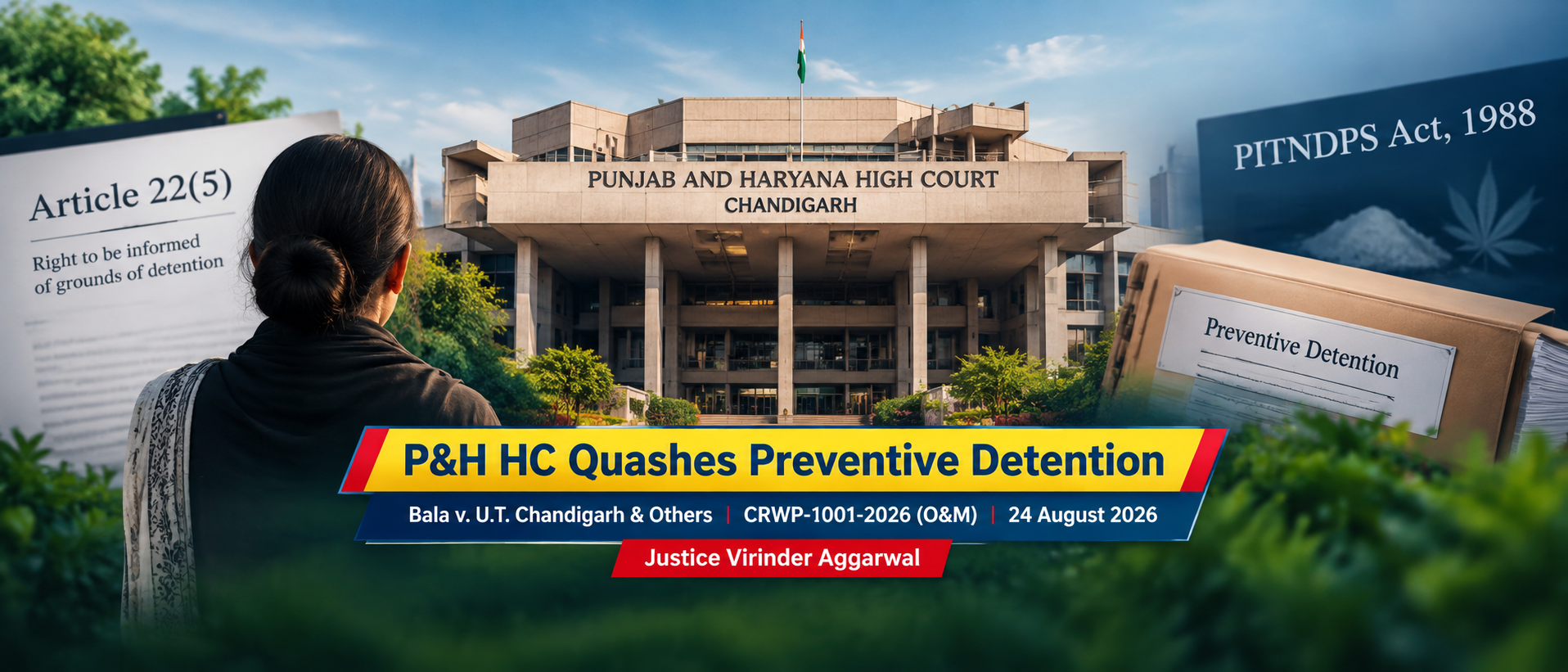
Judgement Details
Court
Punjab and Haryana High Court
Date of Decision
4 September 2026
Judges
Justice Virinder Aggarwal.
Citation
Acts / Provisions
Facts of the Case
-
The petitioner, Bala, was subjected to preventive detention under the PITNDPS Act, 1988 pursuant to a detention order dated 1 November 2025, passed by the Home Secretary, Chandigarh Administration.
-
An earlier detention order against her had been set aside by the Advisory Board on 8 July 2025, following which she was released.
-
Thereafter, FIR No. 103 dated 4 August 2025 was registered against her and 21 others under Section 21 of the NDPS Act at Police Station Sector 39, Chandigarh. The allegations concerned narcotics, although the petitioner contended that no search was conducted, no contraband was recovered and no accused was arrested.
-
A fresh preventive-detention order was subsequently passed on 1 November 2025.
-
She was initially informed of her right to make representations to certain authorities, but was not informed of her separate right to make a representation to the Central Government until 16 December 2025.
-
Her Central Government representation was submitted on 24 December 2025, but substantial delays occurred in forwarding, obtaining comments and deciding it.
-
The High Court therefore examined whether these delays violated the constitutional safeguard under Article 22(5).
Issues
-
Whether the petitioner was informed of her constitutional right to make a representation to the Central Government at the earliest opportunity, as required by Article 22(5).
-
Whether the approximately 45-day delay in informing her of this right violated Article 22(5).
-
Whether the subsequent delays in forwarding, processing and deciding her representation rendered the continued preventive detention unconstitutional.
-
Whether the cumulative effect of the procedural delays justified quashing the detention order and directing the petitioner's release.
Judgement
The Punjab and Haryana High Court allowed the habeas corpus petition and quashed the preventive-detention order dated 1 November 2025, together with the consequential continued detention. The Court directed that the petitioner be set at liberty forthwith, if she was not required in any other case.
Justice Virinder Aggarwal emphasised that the constitutional protection under Article 22(5) is not satisfied merely by formally permitting a detenue to make a representation. The detenue must be promptly informed of the right and the authorities to whom the representation can be made, and the representation must thereafter be dealt with expeditiously.
The Court found delays at multiple stages:
-
delay in informing the petitioner about her right to approach the Central Government;
-
delay in forwarding her representation;
-
delay in obtaining the necessary comments/material; and
-
delay in deciding the representation.
The Central Government representation was ultimately rejected on 2 June 2026, after the relevant process had extended for several months.
Held
-
The Court held that the unexplained and cumulative delays in informing the detenue of her right to represent to the Central Government and in processing her representation amounted to a violation of Article 22(5).
-
Consequently, the detention order dated 1 November 2025 and the petitioner's continued detention were quashed.
Analysis
-
Preventive detention permits detention without a prior finding of guilt, making constitutional safeguards particularly important. The Court therefore treated the procedural requirements under Article 22(5) as substantive protections rather than technical formalities.
-
Article 22(5) requires that the detenue receive an effective and timely opportunity to challenge detention. Delayed communication of the right to approach the Central Government can materially reduce the effectiveness of that safeguard.
-
The Court found no satisfactory justification for the approximately 45-day delay between the initial communication concerning representation and the subsequent communication regarding the Central Government.
-
The Court also examined what happened after the representation was made. The representation submitted on 24 December 2025 underwent substantial delays before reaching the relevant Central Government division and before the necessary comments were supplied.
-
Importantly, the Court considered the combined effect of the delays rather than treating each delay as an isolated procedural defect. The Court characterised the sequence as delay "at every step"—communication of rights, forwarding, comments and decision.
-
Because the statutory preventive-detention power operates subject to constitutional limitations, failure to comply meaningfully with Article 22(5) undermines the legality of continued detention.
-
The judgment reinforces the established principle that authorities dealing with preventive detention must act with promptness and expedition when a detenue seeks to exercise the constitutional right of representation. The Court relied, among other authorities, on Supreme Court decisions including Alfiya A. v. State of Kerala, Jaseela Shaji v. Union of India, and Sarabjeet Singh Mokha v. District Magistrate, Jabalpur.
-
The ruling does not determine whether the underlying narcotics allegations were true or false. Its basis was the failure to comply with the constitutional safeguards governing preventive detention.