
B v. N, 2026
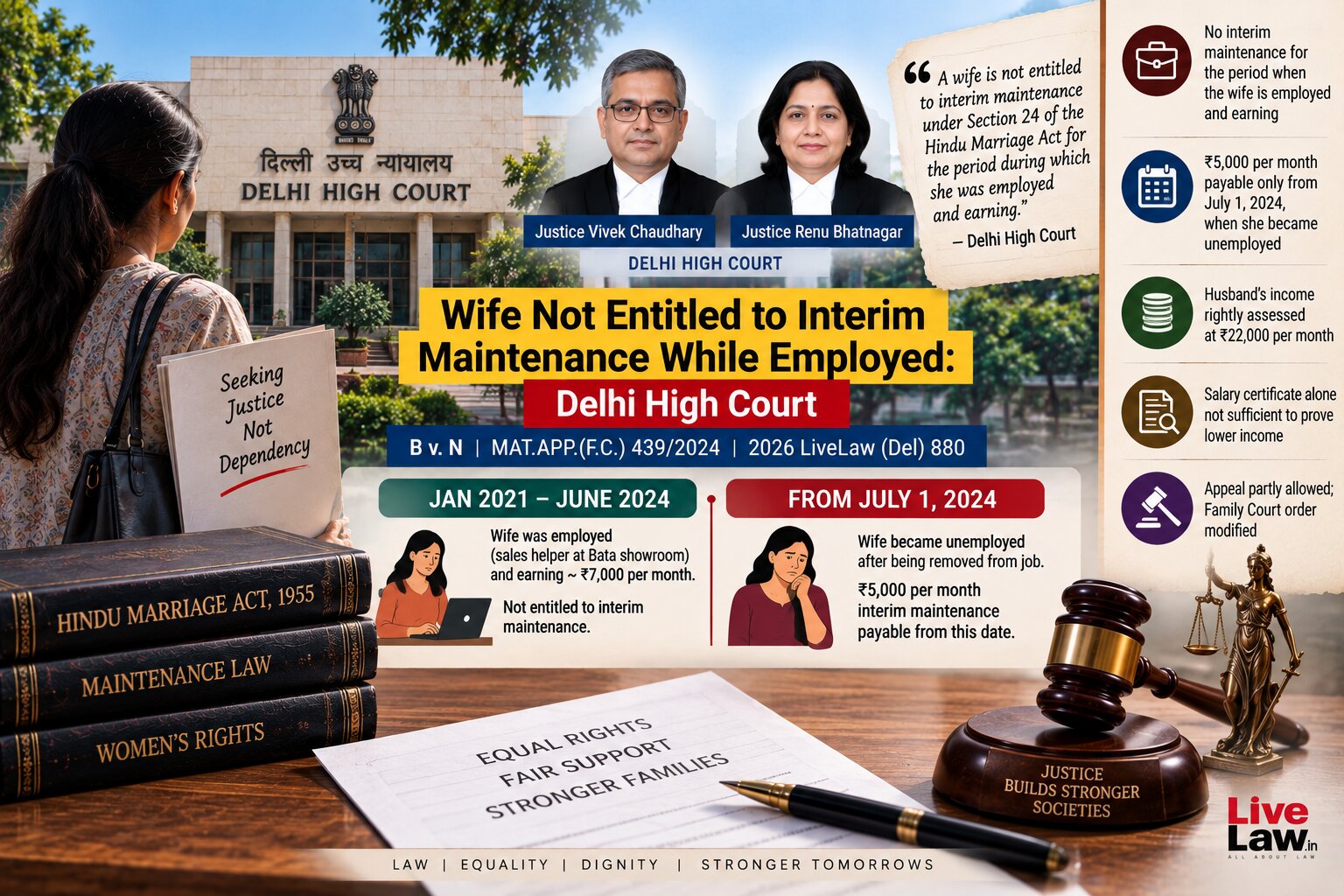
A wife who is employed and earning is not entitled to interim maintenance under Section 24 of the Hindu Marriage Act for the period during which she is earning sufficient income.
Judgement Details
Court
Delhi High Court
Date of Decision
21 September 2026
Judges
Justice Vivek Chaudhary & Justice Renu Bhatnagar
Citation
Acts / Provisions
Facts of the Case
-
The parties were married on 25.10.2015.
-
They began living separately in November 2020.
-
The wife subsequently instituted divorce proceedings on the ground of cruelty.
-
Along with the divorce proceedings, she sought interim maintenance under Section 24 of the Hindu Marriage Act, 1955.
-
The wife filed her maintenance application on 08.01.2021.
-
The Family Court directed the husband to pay ₹5,000 per month as pendente lite maintenance from the date of filing of the maintenance application until disposal of the divorce petition.
-
The husband challenged the Family Court's order before the Delhi High Court.
-
The husband contended that the wife was financially independent and had admitted that she was working at a Bata showroom.
-
The wife had stated in an application under the Guardians and Wards Act that she was financially independent and capable of securing a future for her daughter.
-
In her affidavit before the Family Court, the wife stated that she worked as a sales helper at a Bata showroom on Saturdays and Sundays and earned approximately ₹7,000 per month.
-
She continued working until June 2024, when she was removed because the owner no longer required additional staff.
-
The husband also disputed the Family Court's assessment of his monthly income at ₹22,000.
-
He claimed that he earned only ₹16,500 per month while working as an operator at his father's photostat shop.
-
He argued that the Family Court should not have relied upon the Delhi Government's minimum-wage notification, as he was residing and working in Haryana.
-
The High Court considered the applicable minimum wages in Haryana and found them to be broadly similar to those in Delhi.
-
The husband did not produce sufficient credible documentary evidence establishing that his actual income-earning capacity was lower than the amount assessed by the Family Court.
-
The High Court therefore considered the assessment of the husband's monthly income at ₹22,000 to be justified.
-
The Court also considered the salary certificate issued by the husband's father showing an income of ₹16,500 per month.
-
The Court found that the salary certificate, standing alone and unsupported by other cogent documentary evidence, could not conclusively establish the husband's actual income.
-
The principal question before the High Court concerned the wife's entitlement to interim maintenance during the period in which she was employed and earning.
Issues
-
Whether a wife who was employed and earning when she filed an application under Section 24 of the Hindu Marriage Act is entitled to interim maintenance for that period?
-
Whether the wife's financial independence and actual earnings are relevant while determining her entitlement to pendente lite maintenance under Section 24 of the Hindu Marriage Act?
-
Whether the Family Court was justified in awarding ₹5,000 per month from the date of filing of the maintenance application despite the wife's employment during that period?
-
Whether the wife's entitlement to interim maintenance could arise from the date on which she ceased employment and became unemployed?
-
Whether the Family Court was justified in assessing the husband's monthly income at ₹22,000 despite his claim that he earned only ₹16,500 per month?
Judgement
-
The Delhi High Court modified the Family Court's order.
-
The Court held that the wife was not entitled to interim maintenance for the period during which she was employed and earning.
-
The wife was employed when she filed the maintenance application on 08.01.2021.
-
She continued working until June 2024.
-
Accordingly, the Court held that she was not entitled to the monthly maintenance of ₹5,000 for the period from 08.01.2021 to June 2024.
-
The Court directed that the amount of ₹5,000 per month would be payable from 01.07.2024, when the wife became unemployed.
-
The Court considered the wife's own statements regarding her financial independence and employment while determining her entitlement.
-
The Court did not interfere with the Family Court's assessment of the husband's monthly income at ₹22,000.
-
The Court found that the husband had not produced sufficient credible evidence to establish that his earning capacity was limited to ₹16,500 per month.
-
The salary certificate issued by the husband's father was not considered sufficient by itself to establish the husband's actual income.
-
The appeal was therefore partly allowed, with the Family Court's maintenance order modified accordingly.
Held
-
In the present case, the wife was not entitled to ₹5,000 per month for the period from 08.01.2021 to June 2024.
-
The wife's entitlement to the interim maintenance arose from 01.07.2024, after she ceased employment.
-
The husband's monthly income was properly assessed at ₹22,000 in the absence of sufficient credible evidence supporting his claimed income of ₹16,500.
-
The Family Court's order was therefore modified to restrict the maintenance period.
Analysis
-
Employment and maintenance: The Court treated the wife's actual employment and earnings as material circumstances in determining her entitlement to interim maintenance.
-
Period-specific entitlement: The judgment demonstrates that entitlement to interim maintenance may depend upon the financial circumstances existing during the particular period for which maintenance is claimed.
-
Change in circumstances: The wife's position changed when her employment ended in June 2024. The Court therefore fixed 01.07.2024 as the commencement date for payment of the ₹5,000 monthly amount.
-
Financial independence: The wife's own statements regarding her financial independence and employment were relevant to assessing whether she required interim financial support during the earlier period.
-
Husband's income: The Court also examined the husband's earning capacity rather than accepting his claimed income solely on the basis of a salary certificate.
-
Salary certificate: Since the certificate had been issued by the husband's father and was unsupported by other cogent documentary evidence, the Court did not treat it as conclusive proof of his actual income.
-
Minimum-wage assessment: The Court found that the applicable minimum wages in Haryana were broadly comparable with those in Delhi and therefore did not find sufficient reason to interfere with the income assessment of ₹22,000.
-
Section 24: The decision illustrates the relevance of the parties' respective financial circumstances when determining pendente lite maintenance under Section 24 of the Hindu Marriage Act.
-
Modification rather than complete rejection: The Court did not deny maintenance altogether. Instead, it modified the period for which the ₹5,000 monthly amount was payable based on the wife's change in employment status.