
Ayushi Ginoria (Agrawal) (Wrongly Typed as Ginodia) v. Sumit Agrawal, 2026
Refusal to Resume Cohabitation & ₹2 Crore Demand: Mental Cruelty
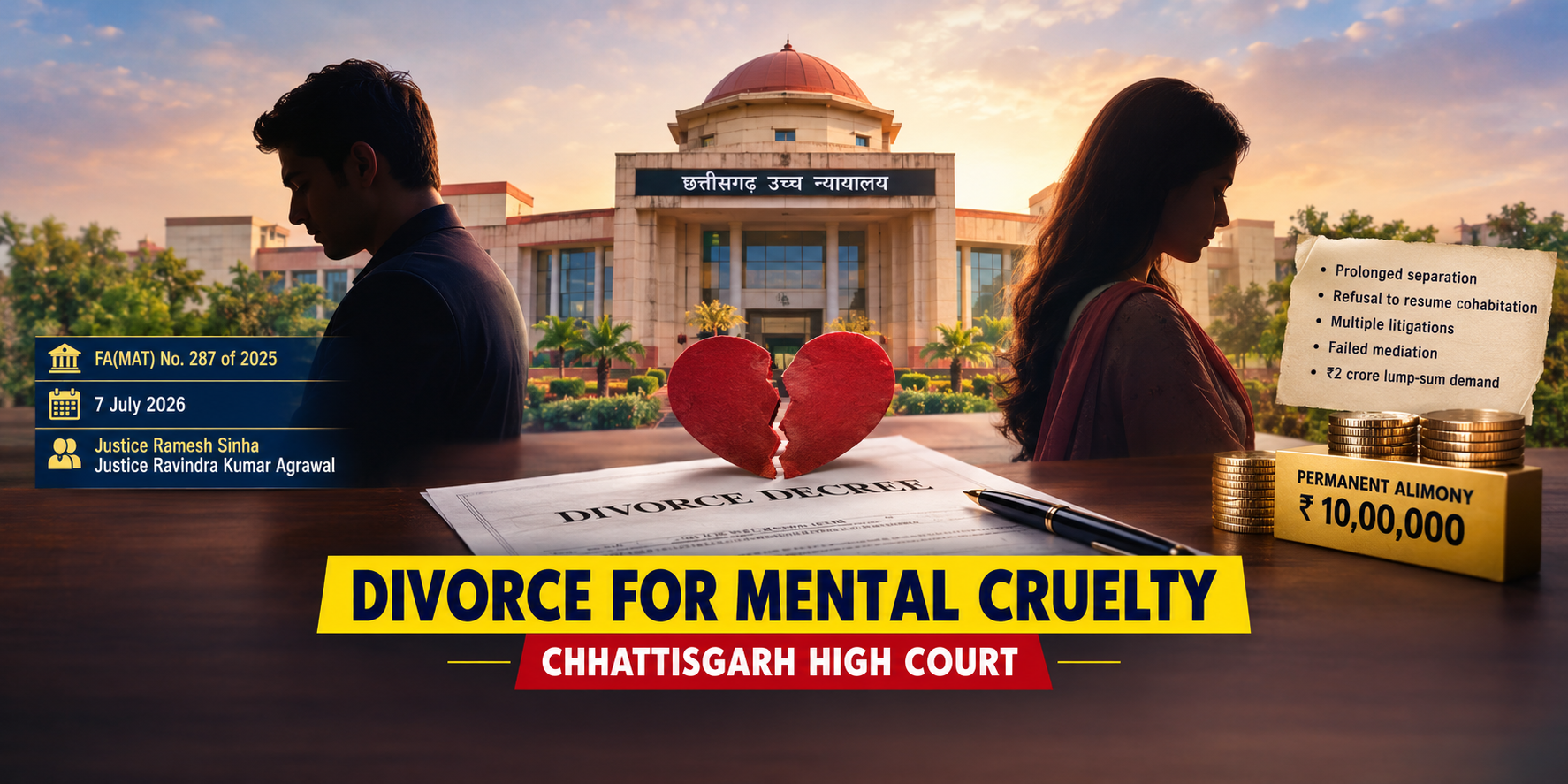
Judgement Details
Court
High Court of Chhattisgarh
Date of Decision
23 September 2026
Judges
Justice Ramesh Sinha and Justice Ravindra Kumar Agrawal
Citation
Acts / Provisions
Facts of the Case
-
The parties married on 29 June 2020 according to Hindu rites and customs. No child was born from the marriage.
-
According to the husband, matrimonial disputes arose between the wife and his family, including an incident involving his grandmother on 5 February 2022.
-
The wife left the matrimonial home on 7 February 2022 and thereafter the parties lived separately.
-
The husband alleged that despite repeated requests and counselling efforts through the Mahila Thana, Raipur and One-Stop Sakhi Centre, the wife did not resume cohabitation.
-
The wife denied the allegations and asserted that she had herself been subjected to harassment and ill-treatment and remained willing to continue the matrimonial relationship.
-
She also alleged that the husband had created a matrimonial profile describing himself as “Awaiting Divorce” and that a fake matrimonial profile had been created in her name.
-
The dispute resulted in multiple proceedings, including proceedings under the Protection of Women from Domestic Violence Act, 2005 and criminal proceedings concerning the alleged fake profile.
-
The Family Court, Dhamtari, by judgment dated 22 July 2025, granted the husband divorce on the grounds of cruelty and desertion and awarded the wife ₹10 lakh as permanent alimony.
-
During cross-examination, the wife acknowledged that she had proposed consenting to divorce if she received a lump-sum amount of ₹2 crore.
-
The High Court subsequently attempted mediation, particularly concerning dissolution of marriage and alimony, but the mediation did not result in a settlement.
Issues
-
Whether the Family Court was justified in granting divorce on the ground of cruelty under Section 13(1)(ia) of the Hindu Marriage Act, 1955?
-
Whether the prolonged separation and refusal to resume matrimonial cohabitation, considered with the other circumstances, constituted mental cruelty?
-
Whether the husband had sufficiently established the grounds of cruelty and desertion alleged in the divorce petition?
-
Whether the Family Court's appreciation of the oral and documentary evidence suffered from perversity, illegality or material irregularity?
-
Whether the award of ₹10 lakh as permanent alimony under Section 25 of the Hindu Marriage Act required appellate interference?
-
Whether the matrimonial relationship had reached a stage where reconciliation or restoration of matrimonial life was no longer realistically possible?
Judgement
-
The High Court dismissed the wife's appeal and affirmed the Family Court's decree of divorce.
-
The Bench held that the evidence demonstrated prolonged matrimonial discord, separation since 7 February 2022, unsuccessful efforts at counselling and mediation, multiple litigations between the parties, and the wife's continued refusal to resume matrimonial cohabitation. The cumulative circumstances were found to constitute mental cruelty within the meaning of Section 13(1)(ia) of the Hindu Marriage Act.
-
The Court also found no sufficient basis to interfere with the Family Court's award of ₹10 lakh permanent alimony.
-
Accordingly, the High Court directed the husband to deposit the ₹10 lakh permanent alimony before the concerned Family Court within four weeks, with liberty to the wife to withdraw the amount. There was no order as to costs.
Held
-
The cumulative conduct and circumstances established mental cruelty under Section 13(1)(ia) of the Hindu Marriage Act, 1955. The prolonged separation, refusal to resume matrimonial life, unsuccessful reconciliation/mediation efforts and the overall matrimonial circumstances demonstrated that the relationship had reached a stage where restoration of cohabitation was not realistically possible.
-
The High Court therefore affirmed the divorce decree and ₹10 lakh permanent alimony and dismissed the appeal.
Analysis
-
The Court did not treat one isolated incident as determinative. It considered the parties' conduct, prolonged separation, matrimonial discord, multiple proceedings and failed attempts at reconciliation together.
-
The Court considered the wife's continued refusal to return to the matrimonial home, despite repeated efforts and counselling, as an important circumstance contributing to the finding of mental cruelty.
-
The judgment emphasises that persistent deprivation of matrimonial companionship, when considered alongside the surrounding facts, may contribute to a finding of mental cruelty.
-
The Court took note of the numerous proceedings between the spouses as evidence of the depth of the matrimonial breakdown, rather than treating the mere filing of a legal proceeding as automatically constituting cruelty.
-
The Court specifically considered the wife's admission that she would consent to divorce if paid ₹2 crore. The failed mediation was also considered in assessing whether reconciliation remained possible.
-
The High Court observed that the parties' relationship had reached a stage of irretrievable breakdown, with no realistic prospect of restoration of conjugal life. This formed part of the Court's overall assessment of the matrimonial circumstances.
-
The High Court emphasised that the appellant had not demonstrated that the Family Court's findings were perverse, illegal or materially irregular so as to justify appellate interference.
-
The Court declined to interfere with the ₹10 lakh award, finding no sufficient basis to establish that the Family Court's determination was arbitrary or contrary to applicable principles.
-
The ruling is fact-specific. It should not be read as establishing that every refusal to cohabit, every matrimonial complaint, or every demand for settlement automatically amounts to mental cruelty. The Court relied on the cumulative circumstances and evidence in this particular matrimonial dispute.