
Ashwini Anantrao Deshpande v. State of Maharashtra, 2026
Supreme Court Quashes FIR Against Ashwini Anantrao Deshpande: Resisting Own Medical Examination Not Obstruction Under Section 186 IPC
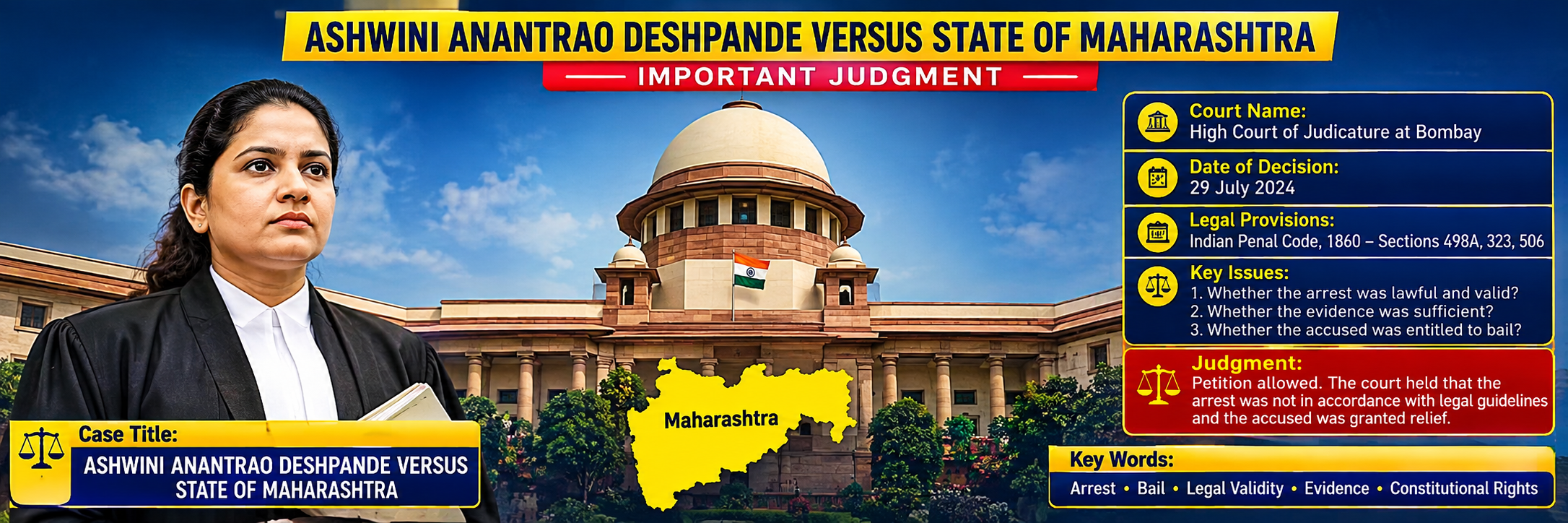
Judgement Details
Court
Supreme Court of India
Date of Decision
31 August 2026
Judges
Justice K. V. Viswanathan and Justice Arun Palli
Citation
Acts / Provisions
Facts of the Case
-
Ashwini Anantrao Deshpande was working as a Lekhapal/employee at the Forest Range Office, Paratwada, Maharashtra.
-
On 4 May 2021, the Forest Range Officer informed the police that Deshpande was allegedly in an intoxicated condition and was creating a disturbance. Police personnel accompanied her to the Sub-District Hospital, Achalpur, for a medical examination.
-
According to the FIR, Deshpande initially resisted the medical examination and was allegedly creating a scene. However, she was subsequently persuaded and underwent the medical examination, during which her blood sample was collected.
-
An FIR was registered for offences under Sections 186 and 189 IPC and provisions of the Maharashtra Police Act. A chargesheet/final report was subsequently filed.
-
Deshpande approached the Bombay High Court seeking quashing of the proceedings. The High Court declined to quash them on 19 November 2025. She then approached the Supreme Court.
Issues
-
Whether initially resisting one's own medical examination amounts to voluntarily obstructing a public servant in the discharge of public functions under Section 186 IPC.
-
xWhether the allegations in the FIR disclosed the essential ingredients of Section 189 IPC, particularly a threat of injury to a public servant intended to influence the exercise of public functions.
-
Whether Sections 110, 112 and 117 of the Maharashtra Police Act, 1951 were attracted on the facts alleged against the appellant.
- Whether the criminal proceedings should be quashed when the allegations, even if accepted at face value, did not constitute the alleged offences.
Judgement
-
The Supreme Court allowed the appeal and set aside the judgment of the Bombay High Court.
-
The Court held that the appellant's initial resistance to her own medical examination, particularly since she ultimately underwent the examination, did not constitute voluntary obstruction of a public servant within the meaning of Section 186 IPC.
-
The Court also found that the ingredients of Section 189 IPC were not present because there was no factual basis showing that the appellant had threatened a public servant with injury for the purpose contemplated by that provision.
-
The Court similarly found that the relevant provisions of the Maharashtra Police Act were not attracted.
-
Consequently, the Supreme Court quashed the FIR and the consequential criminal proceedings/chargesheet against the appellant.
Held
-
Merely resisting one's own medical examination, followed by eventual compliance, does not amount to voluntarily obstructing a public servant in the discharge of public functions under Section 186 IPC.
-
The requirements of Section 189 IPC were not established because there was no allegation of the requisite threat of injury.
-
The provisions of the Maharashtra Police Act invoked against the appellant were also not attracted.
-
Continuing the criminal proceedings when the basic ingredients of the alleged offences were absent would amount to an improper use of the criminal process.
-
Result: The appeal was allowed, the Bombay High Court's order was set aside, and the FIR and consequential proceedings were quashed.
Analysis
-
The most important principle is that criminal liability cannot be imposed merely because conduct appears undesirable, disorderly or inconvenient.
-
The prosecution must establish facts which, even if taken at their highest, satisfy the precise ingredients of the offence charged.
-
Section 186 requires voluntary obstruction of a public servant while the public servant is performing a public function.
-
The Supreme Court distinguished between obstructing a public servant's official function and resisting an act directed at the person herself.
-
Here, the medical examination concerned Deshpande herself. More importantly, she ultimately underwent the examination. Therefore, the alleged conduct did not satisfy the statutory requirement of voluntary obstruction contemplated by Section 186.
-
Section 189 is not attracted merely because a person behaves aggressively or refuses to cooperate.
-
There must be a threat of injury to a public servant, made for the purpose of inducing the public servant to do, omit or delay an act connected with the exercise of public functions.
-
The Supreme Court found no factual foundation for this ingredient in the prosecution's case.
-
The Court also questioned the application of Sections 110, 112 and 117 of the Maharashtra Police Act.
-
Section 110 concerns, among other things, indecent language or disorderly behaviour in specified public places; Section 112 deals with threatening, abusive or insulting behaviour intended to provoke a breach of peace; and Section 117 provides the penalty for contraventions of specified provisions.
-
The allegations against Deshpande did not satisfy these statutory requirements.
-
The decision reinforces the Supreme Court's established approach to quashing of criminal proceedings: where the allegations, even if accepted as true, do not disclose the ingredients of the offences alleged, continuation of prosecution can constitute an abuse of the process of law.
-
Resistance is not automatically obstruction.
-
The precise ingredients of an offence must be established.
-
A criminal charge cannot be sustained merely by attaching a penal provision to undesirable conduct.
-
Courts must prevent criminal proceedings from continuing where the allegations themselves fail to constitute an offence.
-
Personal resistance to a medical examination must be distinguished from interference with a public servant's independent public function.
-
The judgment therefore strengthens the principle of strict construction of penal provisions and protection against unwarranted criminal prosecution.