
Ashwini Anantrao Deshpande v. State of Maharashtra, 2026
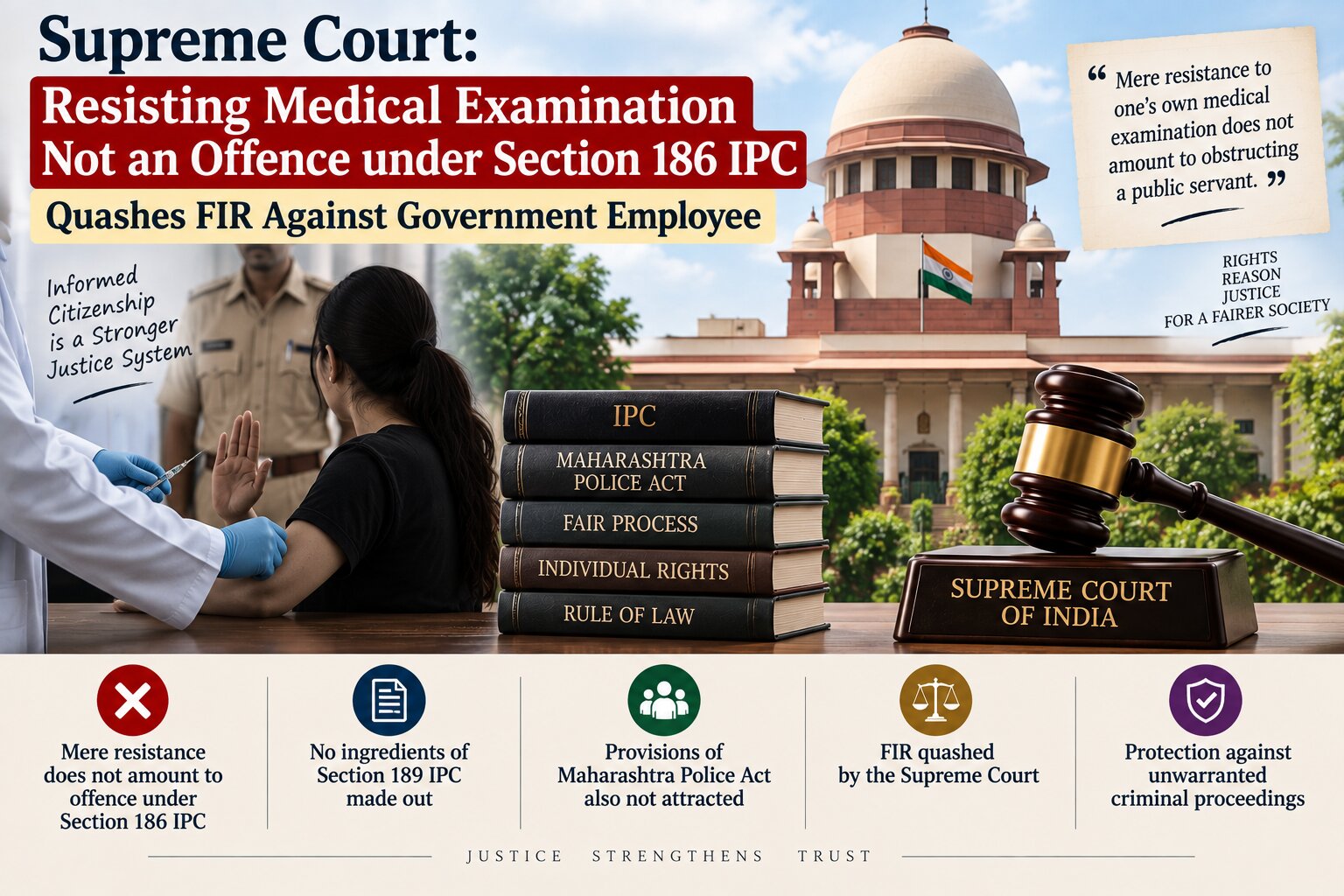
Mere initial resistance to one's own medical examination does not constitute an offence under Section 186 IPC where the examination is ultimately completed.
Judgement Details
Court
Supreme Court of India
Date of Decision
12 August 2026
Judges
Justice K.V. Viswanathan and Justice Arun Palli
Citation
Acts / Provisions
Facts of the Case
-
The appellant was working as a Lekhapal at the Forest Range Office, Paratwada.
-
On 4 May 2021, she was allegedly found in an intoxicated condition and creating a disturbance.
-
She was taken to the Sub-District Hospital, Achalpur for medical examination.
-
She initially resisted the examination and allegedly created a disturbance, but was subsequently persuaded and underwent the examination, including blood collection.
-
An FIR was registered under Sections 186 and 189 IPC and Sections 110 and 117 of the Maharashtra Police Act.
-
The Bombay High Court, Nagpur Bench, declined to quash the FIR and consequential proceedings.
-
The appellant approached the Supreme Court under its appellate jurisdiction.
Issues
-
Whether resisting one's own medical examination amounts to voluntarily obstructing a public servant under Section 186 IPC?
-
Whether the alleged conduct of the appellant constituted a threat of injury to a public servant so as to attract Section 189 IPC?
-
Whether the allegations disclosed the ingredients of offences under Sections 110, 112 and 117 of the Maharashtra Police Act?
-
Whether the criminal proceedings were liable to be quashed under Section 528 BNSS when the allegations, even if accepted at their highest, did not constitute the offences alleged?
Judgement
-
The Supreme Court allowed the appeal and set aside the Bombay High Court's order dated 19 November 2025.
-
It held that the appellant's initial resistance to her own medical examination did not amount to voluntary obstruction of a public servant under Section 186 IPC.
-
The Court emphasised that the medical examination was ultimately conducted and the blood sample was collected.
-
Section 189 IPC was also held to be inapplicable because there was no allegation satisfying the requirement of a threat of injury intended to influence the public servant's official action.
-
The Court found the provisions of the Maharashtra Police Act invoked against the appellant to be equally inapplicable.
-
FIR No. 0131/2021 and the consequential chargesheet/final report were quashed.
Held
-
Section 186 requires voluntary obstruction of a public servant in the discharge of a public function; the alleged conduct in the present case did not satisfy that requirement.
-
Section 189 IPC requires a threat of injury to a public servant or a person in whom the public servant is interested, coupled with the requisite intention.
-
The allegations did not disclose the ingredients of Sections 110, 112 and 117 of the Maharashtra Police Act.
-
Section 117 is a penal provision for contraventions of the substantive provisions of the Act and could not independently sustain the prosecution.
-
For exercising quashing jurisdiction, the Court may examine whether, taking the prosecution case at its highest, the alleged facts constitute the offences charged.
-
Where the basic ingredients of the offences are absent, continuation of the criminal proceedings is unwarranted.
Analysis
-
The judgment reinforces that Section 186 IPC cannot be invoked merely because a person is reluctant or initially resists an official procedure.
-
The decisive circumstance was that the appellant ultimately underwent the medical examination. Therefore, the alleged resistance did not prevent the public servants from performing the function they had undertaken.
-
The Court carefully distinguished between resistance and legally punishable obstruction. Every act of non-cooperation does not automatically become criminal obstruction.
-
Section 189 IPC was even less sustainable because the prosecution allegations did not establish the essential element of a threat of injury made for the statutory purpose contemplated by the provision.
-
The Court also scrutinised the Maharashtra Police Act provisions instead of allowing broadly worded allegations of disturbance to sustain criminal charges without establishing their statutory ingredients.
-
Importantly, the Court applied the “prosecution case at its highest” test. Even assuming the prosecution allegations to be completely true, the ingredients of the offences were still absent.
-
The decision therefore protects against the continuation of criminal proceedings where the factual allegations, on their own terms, do not constitute the alleged offences.
-
The ruling is particularly significant for Section 186 IPC because it prevents the provision from being converted into a general offence for non-compliance, reluctance or disagreement with public officials.