
Ashok Upadhyay & Anr. v. State of Bihar, 2026
An accused cannot be convicted where the prosecution evidence reasonably permits a hypothesis consistent with innocence.
Judgement Details
Court
Supreme Court of India
Date of Decision
14 September 2026
Judges
Justice J. B. Pardiwala and Justice Vinod K. Chandran
Citation
Acts / Provisions
Facts of the Case
-
The case arose out of a dispute between two families, which subsequently resulted in a violent confrontation.
-
During the altercation, one person was allegedly shot dead, while another accused allegedly fired at other members of the opposing family.
-
Five persons were chargesheeted in connection with the incident.
-
The Trial Court acquitted three accused persons but convicted the present two appellants.
-
The appellants were convicted under Sections 302 read with 34 IPC and Section 27 of the Arms Act.
-
The Patna High Court subsequently affirmed their conviction.
-
Aggrieved by the High Court's decision, the two convicted persons approached the Supreme Court.
-
The prosecution relied substantially upon the testimony of eyewitnesses, several of whom were close relatives of the deceased.
-
The Supreme Court noticed contradictions between the accounts of different eyewitnesses concerning what happened immediately after the shooting.
-
A significant discrepancy concerned the place to which the deceased's body was taken.
-
Some prosecution witnesses stated that the body was taken to the hospital, whereas other witnesses stated that it was taken to the police station.
-
The inquest report and the Investigating Officer's evidence indicated that the body had in fact been taken to the police station.
-
The Court found this circumstance significant because, in ordinary circumstances, a seriously injured person would ordinarily be expected to be taken to a hospital.
-
The postmortem doctor stated that the injury was not necessarily immediately fatal and that the deceased could have survived for approximately three to six hours.
-
One prosecution witness also indicated that the deceased had not died instantaneously and that she could feel his pulse while he was being taken away from the scene.
-
The Court therefore found the prosecution's own evidence regarding the deceased's condition and the subsequent handling of the body to be significant.
-
The investigation contained several additional deficiencies.
-
Nothing was recovered from the alleged scene of occurrence.
-
The blood-stained clothes of the deceased's relatives were not seized.
-
Despite the Investigating Officer visiting the site on the same night, no site map was prepared.
-
The alleged murder weapons were also never recovered.
-
The Court noted that substantial portions of the evidence of two eyewitnesses were contradicted by their earlier statements recorded under Section 161 CrPC.
-
These contradictions cast doubt upon the presence of those witnesses at the scene.
-
Other eyewitness accounts also contained contradictions concerning material aspects of the incident.
-
The defence produced a witness who described an altercation involving lathis and gunshots at a different time, accompanied by slogans of “inquilab zindabad.”
-
The Supreme Court held that this defence evidence could not simply be ignored in view of the inconsistencies already emerging from the prosecution evidence.
-
The Court clarified that witnesses cannot be treated as unreliable merely because they are related to the deceased.
-
However, where the surrounding circumstances reveal substantial inconsistencies or a “ring of falsity”, their evidence requires closer scrutiny.
-
The Supreme Court considered the principles laid down in Sharad Birdhichand Sarda v. State of Maharashtra concerning the requirement that the prosecution case must exclude a reasonable hypothesis of innocence.
-
On an overall assessment, the Court found that the prosecution evidence did not inspire sufficient confidence to sustain the convictions.
Issues
-
Whether the prosecution eyewitness testimony was sufficiently consistent and reliable to sustain the appellants' conviction for murder?
-
Whether the contradictions concerning the place to which the deceased was taken after the incident created a reasonable doubt regarding the prosecution version?
-
Whether the investigation suffered from material deficiencies, including non-recovery of weapons, non-seizure of blood-stained clothes and failure to prepare a site map, which weakened the prosecution case?
-
Whether contradictions between the eyewitness testimony and their earlier statements recorded under Section 161 CrPC rendered their presence at the scene doubtful?
-
Whether the relationship of the eyewitnesses with the deceased required their evidence to be subjected to closer scrutiny in the circumstances of the case?
-
Whether the defence evidence could be considered when significant inconsistencies had already emerged from the prosecution's own evidence?
-
Whether the circumstances established by the prosecution excluded every reasonable hypothesis of innocence in accordance with the principles laid down in Sharad Birdhichand Sarda v. State of Maharashtra?
-
Whether the appellants were entitled to the benefit of doubt and acquittal when the prosecution evidence did not inspire confidence beyond reasonable doubt?
Judgement
-
The Supreme Court allowed the appeals and acquitted both appellants.
-
The Court held that the prosecution evidence contained significant discrepancies and inconsistencies which created a reasonable doubt regarding the appellants' involvement.
-
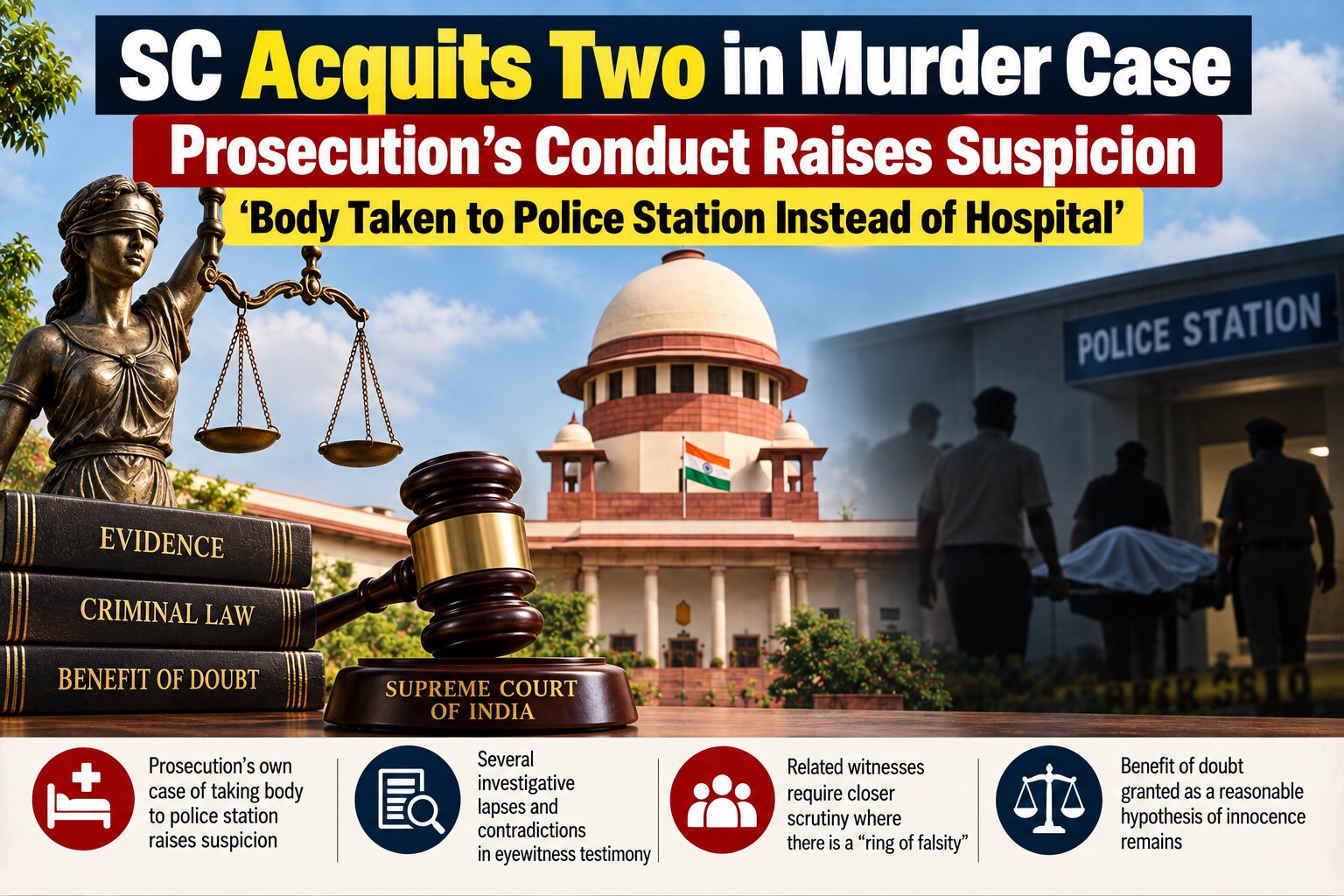
The Court attached particular importance to the fact that the prosecution's own evidence indicated that the deceased was taken to the police station rather than the hospital.
-
The postmortem evidence indicated that the injury was not necessarily instantly fatal and that the deceased could have survived for several hours.
-
This circumstance made the manner in which the body was handled after the incident a significant unexplained feature of the prosecution case.
-
The Court also identified multiple investigative lapses, including failure to recover the alleged weapons.
-
The blood-stained clothes of the deceased's relatives were not seized.
-
No site map of the occurrence was prepared despite the Investigating Officer visiting the location.
-
The Court found material contradictions between the eyewitness testimony and their earlier statements recorded under Section 161 CrPC.
-
These contradictions created doubt regarding the presence and reliability of some of the eyewitnesses.
-
The Court also considered contradictions among the eyewitnesses regarding basic facts, including the destination to which the deceased was taken.
-
The Court held that although related witnesses cannot automatically be treated as interested witnesses, their evidence requires closer scrutiny where surrounding circumstances disclose substantial inconsistencies.
-
The defence evidence concerning a different altercation was also considered relevant in the overall assessment of the prosecution case.
-
Applying the principle in Sharad Birdhichand Sarda, the Court held that the circumstances did not lead exclusively to the hypothesis of guilt.
-
A reasonable hypothesis of innocence remained available on the evidence produced by the prosecution itself.
-
The Court therefore extended the benefit of doubt to the appellants.
-
The convictions under Section 302 read with Section 34 IPC and Section 27 of the Arms Act were consequently set aside.
-
The appellants were acquitted.
Held
-
A conviction for murder cannot be sustained where material contradictions and investigative deficiencies create a reasonable hypothesis of innocence.
-
The prosecution's own evidence concerning the deceased being taken to the police station rather than the hospital was a significant circumstance requiring explanation.
-
Where medical evidence indicates that the deceased could have survived for several hours, the circumstances surrounding the treatment and movement of the injured person become relevant.
-
Non-recovery of the alleged murder weapons can constitute a significant investigative deficiency when considered along with other weaknesses in the prosecution case.
-
Failure to seize relevant blood-stained clothes and failure to prepare a site map can further weaken the prosecution's version.
-
Contradictions between eyewitness testimony and their earlier statements under Section 161 CrPC can affect the credibility of the prosecution witnesses and, depending upon their nature, may cast doubt on their presence.
-
A witness does not become an “interested witness” merely because the witness is related to the deceased.
-
However, where the circumstances disclose a “ring of falsity”, the testimony of related witnesses must be subjected to closer scrutiny.
-
The defence evidence cannot be disregarded merely because it originates from the defence when the prosecution evidence itself contains material inconsistencies.
-
The prosecution must establish circumstances that lead to the hypothesis of guilt and exclude a reasonable hypothesis of innocence.
-
Where a reasonable hypothesis of innocence remains, the accused is entitled to the benefit of doubt.
-
The Supreme Court therefore acquitted the appellants.
Analysis
-
Benefit of doubt: The central principle applied by the Supreme Court was that criminal conviction requires proof beyond reasonable doubt. The Court found that the prosecution's own evidence left a reasonable possibility consistent with innocence.
-
Prosecution case examined as a whole: The Court did not consider the eyewitness evidence in isolation. It examined the testimony alongside medical evidence, the investigation, documentary material and defence evidence.
-
Body taken to police station: This was one of the most important circumstances. The prosecution witnesses gave conflicting versions about whether the body was taken to the hospital or police station. The official inquest material and Investigating Officer's evidence supported the latter version.
-
Medical evidence: The postmortem doctor's evidence that the injury could permit survival for three to six hours was important because it weakened any assumption that the deceased necessarily died instantaneously.
-
Investigative lapses: The failure to recover the alleged weapons, seize blood-stained clothing and prepare a site map were individually and collectively relevant to assessing whether the investigation reliably established the prosecution version.
-
Eyewitness contradictions: The Court found that significant portions of the testimony of certain eyewitnesses were inconsistent with their earlier police statements. Such contradictions were material because they affected the credibility and presence of those witnesses.
-
Related witnesses: The judgment carefully avoided adopting a rule that relatives are inherently unreliable. Instead, it held that relationship alone is insufficient to discard evidence, but circumstances revealing a “ring of falsity” justify heightened scrutiny.
-
Defence evidence: The Court considered the defence version in the context of weaknesses already apparent in the prosecution case. The defence does not necessarily have to establish an alternative story beyond reasonable doubt; it is sufficient for the prosecution case to remain doubtful.
-
Sharad Birdhichand Sarda principle: The Court reiterated the established principle that when the evidence permits a reasonable hypothesis of innocence, the court must refrain from recording a conviction.
-
Acquittal of co-accused: The fact that three other accused persons had already been acquitted by the Trial Court was also considered while examining the allegations and specific overt acts attributed to the appellants.
-
Standard of criminal proof: The judgment reinforces that suspicion, inconsistencies or an incomplete investigation cannot substitute for proof beyond reasonable doubt.
-
Overall significance: The decision demonstrates that even where an incident involving a death is established, the prosecution must independently and reliably establish the identity and culpable participation of the accused. Material contradictions and investigative failures can entitle an accused to acquittal where they create a reasonable hypothesis of innocence.