
Arth Micro Finance Private Ltd. & Ors. v. Shivalik Small Finance Bank Ltd., 2026
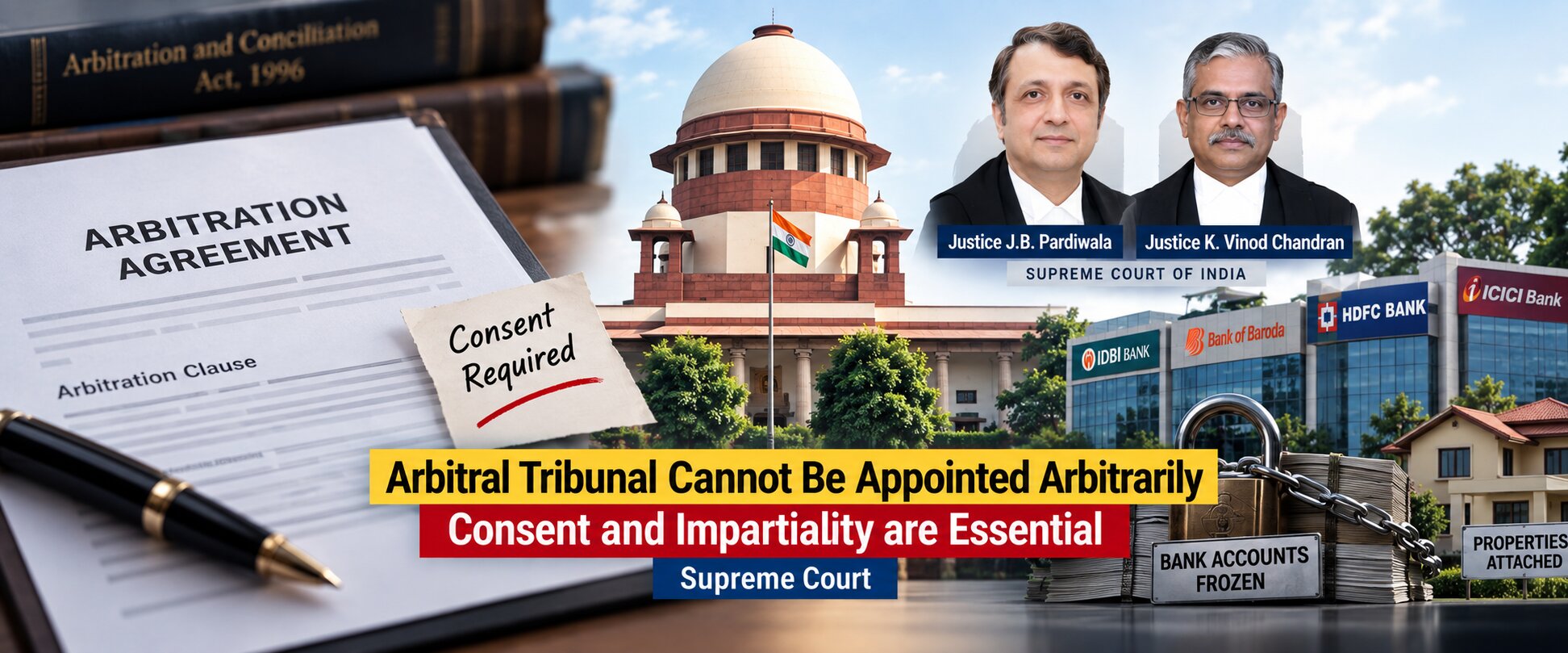
An arbitral tribunal cannot be treated as validly constituted merely by asserting that it was appointed by consent.
Judgement Details
Court
Supreme Court of India
Date of Decision
17 September 2026
Judges
Justice J.B. Pardiwala and Justice K. Vinod Chandran
Citation
Acts / Provisions
Facts of the Case
-
The appellants, Arth Micro Finance Private Ltd. and others, and the respondent, Shivalik Small Finance Bank Ltd., had entered into an agreement containing an arbitration clause.
-
The respondent claimed that an Arbitral Tribunal had been appointed by consent in connection with the disputes between the parties.
-
The appellants disputed this assertion and contended that their consent had never been obtained for the appointment of the tribunal.
-
The appellants also raised allegations of bias, contending that the members of the tribunal had close links with the respondent bank.
-
Despite the objection, the arbitral proceedings continued.
-
The Arbitral Tribunal passed three interim orders under Section 17 of the Arbitration and Conciliation Act, 1996.
-
One order directed the freezing of bank accounts of the appellants maintained with IDBI Bank, Bank of Baroda, HDFC Bank and ICICI Bank.
-
Another order permitted the respondent bank to take possession of the appellants' movable and immovable properties.
-
A further order directed that amounts lying in the appellants' bank accounts be transferred to the respondent bank.
-
The appellants challenged the interim orders before the Allahabad High Court under Section 37 of the Arbitration and Conciliation Act.
-
The High Court dismissed the appeal on the ground of limitation, including the absence of an application seeking condonation of delay.
-
The appellants approached the Supreme Court challenging the High Court's decision as well as the validity of the arbitral proceedings.
-
The Supreme Court examined whether the arbitration itself could validly proceed when the alleged consent for appointment of the tribunal was not established and the appointment had been specifically objected to on grounds of bias.
Issues
-
Whether the appointment of an Arbitral Tribunal without establishing the consent of the appellants renders the initiation of arbitration legally invalid?
-
Whether arbitration, being a consensual dispute-resolution mechanism, can be initiated and an arbitral tribunal appointed unilaterally when the other party has specifically objected to the appointment?
-
Whether an allegation of bias against the proposed Arbitral Tribunal, coupled with absence of demonstrated consent, invalidates the appointment of the tribunal?
-
Whether the interim orders under Section 17 passed by an Arbitral Tribunal whose appointment is legally invalid can be sustained?
-
Whether the High Court was justified in dismissing the appellants' challenge to the arbitral orders on the ground of limitation when the very initiation of arbitration was alleged to be non est in law?
-
Whether amounts transferred and properties taken over pursuant to the interim orders of the Arbitral Tribunal are required to be restored when the tribunal's appointment is found to be invalid?
Judgement
-
The Supreme Court held that arbitration cannot become an arbitrary measure, particularly in relation to the appointment of an Arbitral Tribunal.
-
The Court observed that although the agreement between the parties contained an arbitration clause, there was nothing on record demonstrating that the appellants had actually consented to the appointment of the tribunal.
-
This was particularly significant because the appellants had expressly objected to the appointment and had raised allegations of bias.
-
The Court therefore found the initiation of the arbitration to be non est in law.
-
The Supreme Court set aside the impugned order of the Allahabad High Court.
-
It also set aside all three interim orders passed by the Arbitral Tribunal.
-
If any amounts had already been transferred from the appellants' accounts to the respondent's account pursuant to the interim orders, the respondent was directed to return those amounts within one week.
-
Any attachment or takeover of the appellants' movable or immovable properties pursuant to the interim orders was also set aside.
-
The properties were directed to be restored to the appellants.
-
The Court provided a stringent consequence for failure to return the transferred amounts within the stipulated period.
-
Such amounts would carry compound interest at 18% per annum with monthly rests, calculated from the date on which the amounts were debited.
-
The question of interest and the ultimate claims between the parties were left open for determination in the subsequent arbitration.
-
The Court appointed Ms. Mayuri Raghuwanshi, Advocate, as the Arbitrator to facilitate resolution of the underlying disputes.
-
The Court clarified that it had expressed no opinion on the merits of the underlying dispute, leaving those questions open before the newly appointed arbitrator.
-
The appeal was ultimately disposed of with the above directions.
Held
-
The Supreme Court held that arbitration cannot be initiated arbitrarily by one party where the appointment of the Arbitral Tribunal is specifically disputed.
-
Where an appointment is claimed to have been made by consent, there must be material demonstrating that the necessary consent was actually obtained.
-
The absence of demonstrated consent, particularly in the face of an express bias objection, rendered the appointment of the tribunal and the initiation of arbitration non est in law.
-
Consequently, the interim orders passed by that tribunal could not be sustained.
-
Amounts transferred pursuant to those orders had to be returned, and attached or taken-over properties had to be restored.
-
The Supreme Court appointed a fresh arbitrator to resolve the parties' underlying disputes.
-
The Court expressly left the merits of the dispute open for consideration by the newly appointed arbitrator.
Analysis
-
Consent is fundamental: The judgment emphasizes that the consensual character of arbitration cannot be reduced to a mere reference to an arbitration clause. The appointment process must comply with the parties' legally enforceable agreement and applicable procedural requirements.
-
Arbitration cannot be arbitrary: The Court's central observation is that arbitration, despite its similarity in wording to "arbitrary," cannot operate arbitrarily. The dispute-resolution mechanism must remain subject to legal safeguards.
-
Importance of actual consent: Merely stating that an arbitral tribunal was appointed "by consent" is insufficient where the record does not demonstrate that consent was actually obtained.
-
Bias objection: The appellants had specifically objected to the tribunal and alleged links between the tribunal and the respondent. The Court considered the absence of demonstrated consent particularly significant in that context.
-
Effect on interim orders: Once the tribunal's appointment was found to be non est in law, the interim measures flowing from that tribunal could not remain operative.
-
Protection of property and funds: The directions for restoration of transferred amounts and properties demonstrate the Court's effort to reverse the practical consequences of the invalid interim orders.
-
18% compound interest: The Court imposed a specific financial consequence for non-compliance with its direction to return the transferred amounts within one week.
-
Fresh arbitration: Rather than ending the parties' underlying dispute, the Court appointed Ms. Mayuri Raghuwanshi as arbitrator so that the substantive dispute could proceed through a properly constituted arbitral process.
-
Merits left open: The Court expressly stated that it had not adjudicated the merits of the underlying dispute, preserving the parties' opportunity to present their substantive claims and defences before the newly appointed arbitrator.
-
Significance for arbitration law: The decision reinforces the importance of party consent, impartiality, proper constitution of the tribunal, and procedural fairness in arbitration proceedings.