
Archana Singh v. Anand Kumar, 2026
WhatsApp messages produced before a Family Court cannot automatically be discarded merely because they do not strictly satisfy every evidentiary requirement applicable in ordinary civil proceedings.
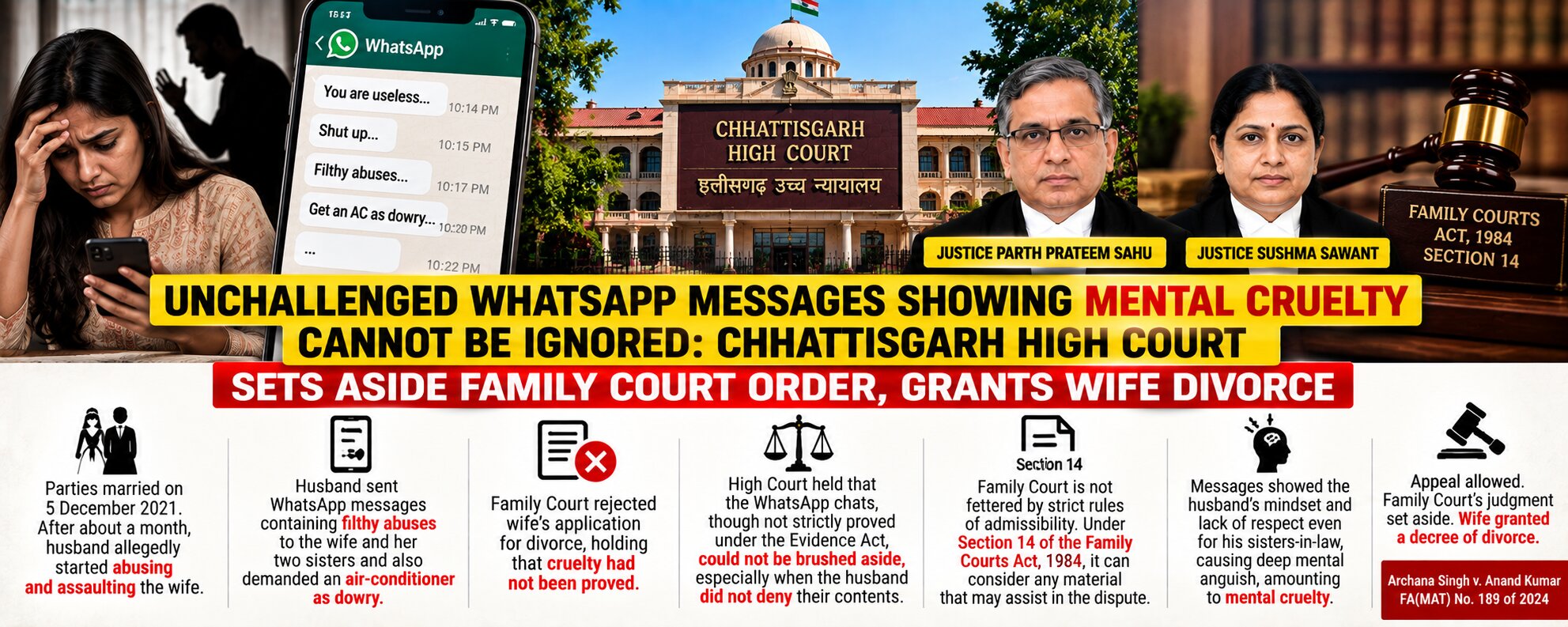
Judgement Details
Court
Chhattisgarh High Court
Date of Decision
28 September 2026
Judges
Justice Parth Prateem Sahu and Justice Sushma Sawant
Citation
Acts / Provisions
Facts of the Case
-
The parties were married on 5 December 2021.
-
According to the wife, after living together for approximately one month, the husband began subjecting her to abuse and physical assault.
-
The wife alleged that the husband sent filthy and abusive WhatsApp messages to her and also to her two sisters.
-
She further alleged that the husband and his family demanded an air-conditioner as dowry.
-
The wife relied upon WhatsApp conversations, marked as Exhibits P.2 and P.3, to substantiate her allegations.
-
The wife instituted proceedings seeking divorce on the ground of cruelty.
-
The Family Court rejected her application, holding that the alleged cruelty had not been sufficiently established.
-
While considering the WhatsApp conversations, the Family Court expressed concerns regarding the absence of evidence establishing the identity of the person holding the relevant mobile phone and the fact that the chats were incomplete.
-
The wife challenged the Family Court's decision before the Chhattisgarh High Court.
-
The High Court examined the WhatsApp chats in the context of the other material available on record.
-
The Court noted that although the wife had not strictly complied with the evidentiary requirements applicable to electronic records, the husband had not specifically denied or controverted the contents of the messages.
-
The High Court therefore considered whether the messages could nevertheless be taken into account under Section 14 of the Family Courts Act, 1984.
Issues
-
Whether unchallenged WhatsApp messages produced by a wife can be considered by a Family Court despite non-compliance with the strict evidentiary requirements applicable to electronic records?
-
Whether the WhatsApp messages in question disclosed conduct amounting to mental cruelty within the meaning of the Hindu Marriage Act, 1955?
-
Whether Section 14 of the Family Courts Act, 1984 gives a Family Court wider discretion to receive material that may assist it in effectively adjudicating a matrimonial dispute?
-
Whether the Family Court erred in completely disregarding the WhatsApp chats merely because their authenticity and completeness were not established in accordance with the strict rules of evidence?
-
Whether the wife was entitled to a decree of divorce on the ground of cruelty on the basis of the WhatsApp messages and the surrounding circumstances?
Judgement
-
The Chhattisgarh High Court allowed the wife's appeal.
-
The Court set aside the judgment and decree of the Family Court which had rejected the wife's application for divorce.
-
The High Court held that the WhatsApp conversations, when viewed in their proper context, disclosed conduct falling within the ambit of mental cruelty.
-
The Court noted that the husband had not specifically denied or controverted the contents of the WhatsApp messages.
-
Although the wife had not complied with the strict evidentiary requirements applicable to electronic records, the Court held that the material could not therefore be completely brushed aside or ignored.
-
The Court relied upon Section 14 of the Family Courts Act, 1984, which gives Family Courts a wider discretion to receive reports, statements, documents, information or other material that may assist in effectively resolving matrimonial disputes.
-
The Court distinguished the evidentiary approach applicable to an ordinary civil court from the more flexible approach permitted to a Family Court under Section 14.
-
The WhatsApp messages were considered significant in assessing the conduct and mindset of the husband.
-
The Court found that the messages reflected a lack of respect towards the wife's sisters and that such conduct could cause deep mental anguish to the wife.
-
The Court treated such conduct, particularly when directed towards members of the wife's family, as capable of constituting grave mental cruelty.
-
The High Court concluded that the Family Court had erred in its appreciation of the material on record.
-
The Family Court's judgment was accordingly set aside.
-
The High Court granted the wife a decree of divorce.
Held
-
Section 14 of the Family Courts Act, 1984 gives Family Courts wider discretion to receive material that may assist them in effectively adjudicating matrimonial disputes.
-
The absence of strict compliance with the Evidence Act does not necessarily mean that relevant material must be completely ignored by a Family Court.
-
The evidentiary value of electronic communications must be assessed in the context of the entire matrimonial dispute and the circumstances of the case.
-
The fact that the husband did not specifically deny or controvert the contents of the WhatsApp chats was a material circumstance.
-
The WhatsApp messages in the present case reflected conduct capable of causing serious mental anguish to the wife.
-
Abusive and disrespectful communications directed towards the wife's family members may constitute mental cruelty towards the wife.
-
The Family Court's approach of completely discarding the WhatsApp material resulted in an error in appreciation of evidence.
-
The High Court therefore interfered with the Family Court's judgment.
-
The wife was granted a decree of divorce on the ground of cruelty.
Analysis
-
The central principle of the judgment is that Family Courts are not necessarily confined by the strict technical rules of evidence applicable to ordinary civil proceedings.
-
Section 14 of the Family Courts Act was enacted to enable Family Courts to adopt a more flexible approach while resolving sensitive matrimonial disputes.
-
The purpose of this provision is to allow the court to consider material that may assist it in reaching a proper conclusion, even where the material may not satisfy every technical requirement of admissibility under ordinary evidentiary rules.
-
The Court therefore refused to treat the absence of strict compliance with electronic-evidence requirements as an automatic reason to completely disregard the WhatsApp conversations.
-
An important factor was that the husband did not specifically deny the contents of the messages.
-
The absence of a specific denial did not necessarily establish every aspect of the wife's case, but it made it inappropriate to simply ignore the material without examining its significance in the overall factual context.
-
The Court examined the WhatsApp messages together with the allegations of abuse, assault and dowry demand.
-
The messages were particularly significant because they reflected the husband's conduct towards the wife and her sisters.
-
The Court considered the nature of the language used and concluded that the communications demonstrated a lack of respect and appropriate regard towards the wife's family members.
-
The judgment recognizes that mental cruelty is not confined to physical violence or direct acts committed against the spouse.
-
Conduct directed towards close family members may also have a significant impact upon the mental well-being of the spouse and, depending upon the circumstances, may contribute to a finding of mental cruelty.
-
The decision therefore adopts a contextual approach to mental cruelty, requiring the court to consider the cumulative effect of the conduct rather than examining each incident in isolation.
-
The judgment also highlights the importance of electronic communications in modern matrimonial disputes.
-
WhatsApp messages, text messages and other digital communications may provide important evidence of conduct within a marriage.
-
At the same time, the judgment does not establish that every WhatsApp message is automatically admissible or sufficient to prove cruelty. The material must still be evaluated by the Family Court in accordance with the statutory framework and the facts of the particular case.
-
Section 14 gives the Family Court flexibility to receive relevant material, but the court must still determine the weight and reliability of that material.
-
The decision also demonstrates that a Family Court should not allow technical evidentiary objections to completely obscure material that may assist in understanding the actual matrimonial relationship.
-
The High Court ultimately found that the Family Court's approach resulted in an erroneous appreciation of the evidence, warranting appellate interference.
-
The judgment reinforces the wider evidentiary discretion of Family Courts under Section 14 of the Family Courts Act, 1984.
-
It recognizes that electronic communications can play an important role in establishing mental cruelty in matrimonial proceedings.
-
It clarifies that failure to strictly satisfy ordinary evidentiary requirements does not necessarily require a Family Court to completely disregard potentially relevant material.
-
The decision emphasizes that unchallenged or insufficiently controverted digital communications may acquire significance when considered along with the surrounding evidence.
-
The judgment also reinforces the principle that mental cruelty must be assessed from the overall conduct and cumulative matrimonial circumstances.
-
Conduct involving humiliation, abuse or serious disrespect towards the spouse's close family members may, depending upon the facts, contribute to a finding of mental cruelty.