
Appellant/Wife v. Respondent/Husband, 2026
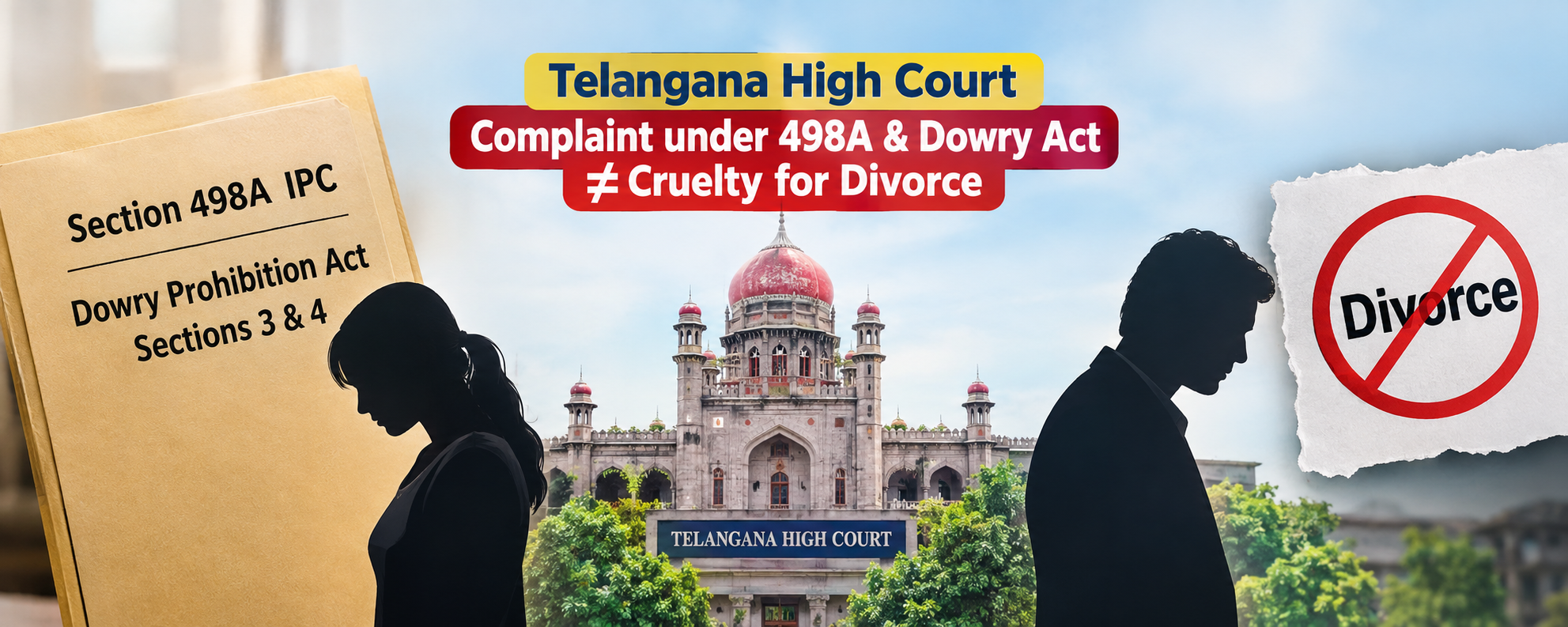
498A Complaint Alone Is Not Cruelty for Divorce
Judgement Details
Court
Telangana High Court
Date of Decision
18 September 2026
Judges
Justice K. Lakshman and Justice K. Sujana
Citation
Acts / Provisions
Facts of the Case
-
The respondent/husband filed a matrimonial proceeding seeking dissolution of marriage on the ground of cruelty against the appellant/wife.
-
The husband relied, among other circumstances, upon the fact that the wife had lodged a criminal complaint against him and his family members alleging offences under Section 498A IPC and Sections 3 and 4 of the Dowry Prohibition Act.
-
The husband examined himself in support of his allegations but did not examine any other witness to substantiate the alleged acts of cruelty.
-
The matter ultimately came before the Telangana High Court, which examined whether the husband's allegations and the filing of the criminal complaint were sufficient to establish matrimonial cruelty.
Issues
-
Whether mere lodging of a complaint under Section 498A IPC and Sections 3 & 4 of the Dowry Prohibition Act against the husband and his family members amounts to matrimonial cruelty.
-
Whether a spouse seeking divorce on the ground of cruelty must specifically plead and prove the alleged acts through cogent evidence.
-
Whether the Family Court or High Court can dissolve a marriage solely on the ground of irretrievable breakdown of marriage.
-
Whether the evidence produced by the husband was sufficient to establish the alleged cruelty committed by the wife.
Judgement
-
The Telangana High Court held that the husband, being the party who sought dissolution of the marriage on the ground of cruelty, was required to plead and prove the alleged cruelty by cogent evidence.
-
The Court noted that, apart from examining himself, the husband had not examined any other witness to substantiate his allegations.
-
The Division Bench further held that the mere lodging of a criminal complaint by the wife against her husband and his family members under Section 498A IPC and Sections 3 & 4 of the Dowry Prohibition Act does not, by itself, constitute matrimonial cruelty.
-
The Court also held that irretrievable breakdown of marriage, by itself, could not be treated as a statutory ground for dissolution of marriage by the Family Court or High Court.
Held
The Court held that:
-
Mere lodging of a complaint under Section 498A IPC and Sections 3 & 4 of the Dowry Prohibition Act does not amount to cruelty.
-
A spouse seeking divorce on the ground of cruelty must plead and establish the alleged conduct through cogent evidence.
-
Since the husband failed to produce sufficient evidence establishing cruelty, he could not obtain dissolution of marriage merely on the basis of the wife's criminal complaint.
-
The Court further held that the Family Court and High Court cannot dissolve a marriage merely on the ground of irretrievable breakdown of marriage when such ground is not available as a statutory ground before them.
Analysis
-
The judgment emphasizes the fundamental principle that an allegation of matrimonial cruelty must be established through evidence rather than being presumed from the existence of matrimonial or criminal litigation.
-
First, the burden rested upon the husband because he was the party seeking divorce on the ground of cruelty. The Court therefore required him to establish the alleged conduct through cogent evidence.
-
Second, the Court distinguished between the filing of a criminal complaint and the commission of matrimonial cruelty. The fact that a wife invokes Section 498A IPC or provisions of the Dowry Prohibition Act does not automatically establish that she has subjected her husband to cruelty. The circumstances and evidence surrounding the alleged conduct must be examined.
-
Third, the judgment reinforces the importance of pleadings and proof in matrimonial proceedings. A party cannot obtain divorce merely by making allegations; the allegations must be supported by reliable evidence.
-
Fourth, the Court addressed irretrievable breakdown of marriage. The High Court clarified that it cannot simply dissolve a marriage on that basis when the statutory framework does not provide it as an independent ground for divorce. This also reflects the distinction between the powers of constitutional courts and those available to ordinary matrimonial courts.
-
Overall, the judgment highlights that criminal proceedings between spouses do not automatically translate into matrimonial cruelty. Each allegation must be assessed on its own facts and established according to the applicable legal standard.