
AP v. NK, 2026
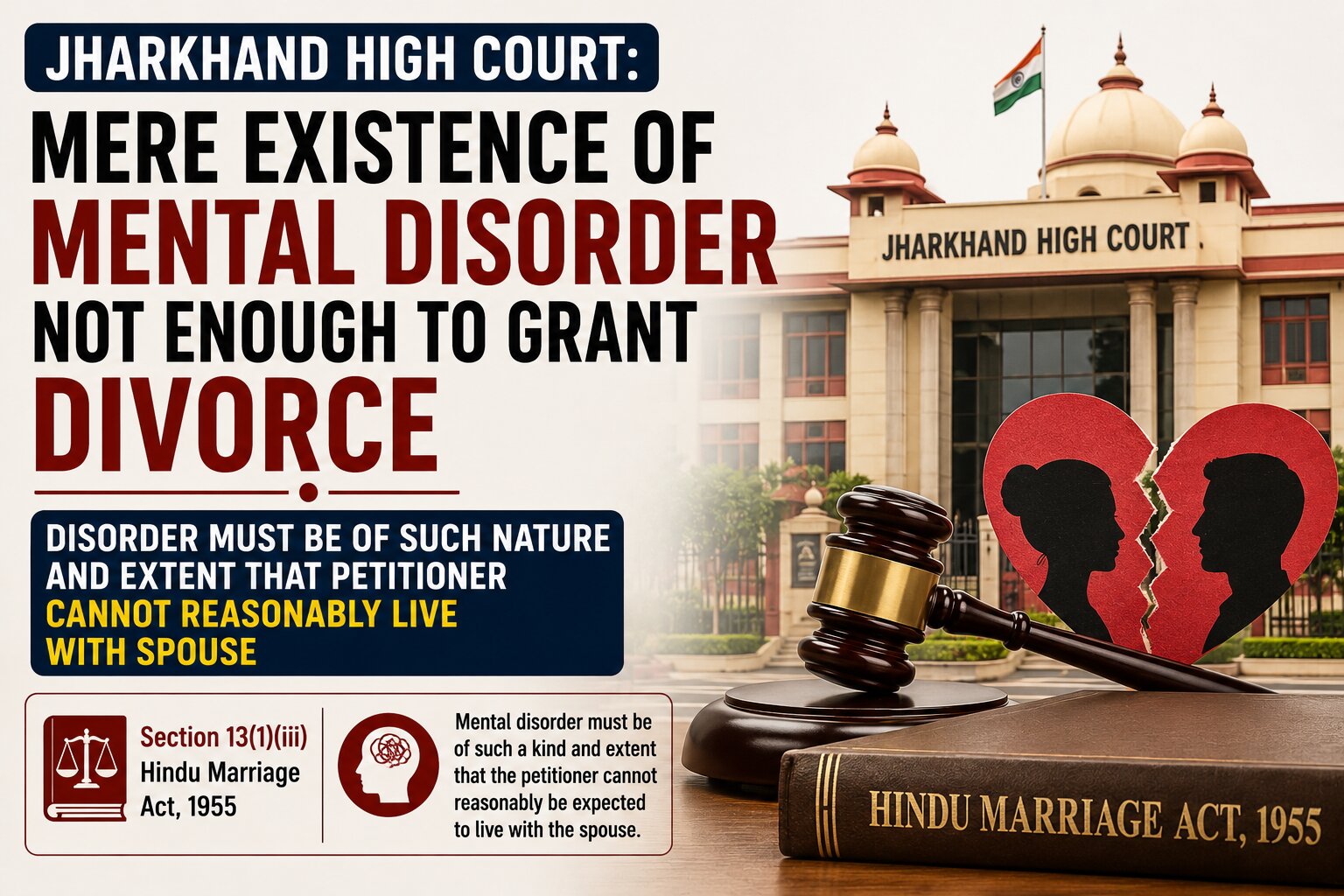
Mere existence of a mental disorder is not sufficient to obtain divorce under Section 13(1)(iii) of the Hindu Marriage Act.
Judgement Details
Court
High Court of Jharkhand
Date of Decision
4 August 2026
Judges
Justice Sujit Narayan Prasad and Justice Pradeep Kumar Srivastava
Citation
Acts / Provisions
Facts of the Case
-
The parties were married on 22 June 2017.
-
According to the husband, he discovered on the first night of marriage that the wife allegedly suffered from a chronic and incurable mental disorder.
-
He alleged that because of the wife's alleged mental condition, the marriage could not be consummated.
-
The husband claimed that the wife's family had concealed her alleged mental condition before the marriage.
-
He sought dissolution of the marriage on the grounds of cruelty and mental disorder.
-
The husband filed a petition under Sections 13(1)(i-a) and 13(1)(iii) of the Hindu Marriage Act, 1955.
-
The wife denied suffering from any mental illness or disorder.
-
She alleged that instead she had been subjected to cruelty and harassment by the husband and his family.
-
The wife alleged that the harassment was connected with demands for a four-wheeler.
-
She maintained that she was willing to continue the marital relationship.
-
The Family Court rejected the husband's petition for divorce.
-
The husband thereafter filed an appeal before the Jharkhand High Court.
-
With respect to cruelty, the husband did not allege that the wife had physically assaulted or abused him or his family members after the marriage.
-
His principal allegation was that the marriage was not consummated because of the wife's alleged mental disorder.
-
The High Court found that the husband had not produced cogent or reliable evidence establishing cruelty.
-
With respect to Section 13(1)(iii), the Court examined whether the alleged mental condition satisfied the statutory threshold required for dissolution of marriage.
-
The Court emphasized that the mere existence of some degree of mental abnormality or disorder is not sufficient.
-
The relevant mental condition must be of such a nature and degree that the petitioner cannot reasonably be expected to live with the respondent.
-
The Court further observed that the burden of proving the alleged mental disorder rests upon the spouse seeking divorce.
-
The Court emphasized the importance of expert medical evidence, while clarifying that psychiatric evidence must itself be evaluated along with the medical records, symptoms, treatment history, follow-up and actual behaviour of the spouse.
-
Finding that the husband had failed to establish either statutory cruelty or a qualifying mental disorder, the High Court upheld the Family Court's decision.
Issues
-
Whether the mere existence of a mental disorder or mental abnormality, irrespective of its degree, is sufficient to dissolve a marriage under Section 13(1)(iii) of the Hindu Marriage Act, 1955?
-
Whether the husband established that the wife's alleged mental disorder was of such a nature and extent that he could not reasonably be expected to live with her?
-
Whether the husband proved the allegation of mental cruelty against the wife so as to obtain dissolution of marriage under Section 13(1)(i-a) of the Hindu Marriage Act, 1955?
-
Whether the absence of cogent medical and expert evidence regarding the wife's alleged mental disorder was sufficient to reject the husband's claim for divorce?
-
Whether the Family Court was justified in dismissing the husband's petition for divorce when the allegations of cruelty and mental disorder were not proved by reliable evidence?
Judgement
-
The Jharkhand High Court dismissed the husband's appeal.
-
The Court upheld the Family Court's refusal to grant divorce.
-
The Court held that cruelty under the Hindu Marriage Act is not limited to physical violence and may include conduct causing such mental pain or anguish that continued matrimonial cohabitation becomes unreasonable.
-
However, the Court emphasized that cruelty must be established from the facts and circumstances of the particular case.
-
The Court found that the husband had not alleged that the wife abused or assaulted him or his family members after the marriage.
-
The husband's principal allegation concerned alleged non-consummation of the marriage due to the wife's mental condition.
-
The Court found no cogent or reliable evidence establishing that the wife had committed matrimonial cruelty.
-
Regarding Section 13(1)(iii), the Court held that the provision recognizes distinct grounds relating to incurable unsoundness of mind and qualifying mental disorder.
-
The Court emphasized that the statutory provision requires consideration of the nature and degree of the mental disorder.
-
The disorder must be sufficiently serious that the petitioner cannot reasonably be expected to live with the respondent.
-
The Court held that the mere existence of a mental abnormality does not automatically satisfy this requirement.
-
The spouse seeking divorce bears the burden of proving the relevant mental condition.
-
The Court stated that such an allegation ordinarily requires reliable expert medical evidence.
-
Even psychiatric evidence, however, is not conclusive by itself and must be considered along with medical records, symptoms, treatment history, follow-up and behavioural evidence.
-
The Court found that the husband had failed to establish the wife's alleged mental disorder at the level required by Section 13(1)(iii).
-
The Court therefore found no reason to interfere with the Family Court's judgment.
-
The appeal was accordingly dismissed.
Held
- The mental disorder must be of such a nature and degree that the petitioner cannot reasonably be expected to live with the respondent.
-
The spouse seeking divorce bears the burden of proving the alleged mental disorder.
-
Such allegations ordinarily require reliable medical and expert evidence.
-
Psychiatric evidence is not automatically conclusive and must be examined alongside medical records, symptoms, treatment history and the spouse's actual behaviour.
-
The husband failed to establish that the wife suffered from a mental disorder satisfying the statutory threshold.
-
The husband also failed to establish cruelty under Section 13(1)(i-a).
-
The High Court therefore upheld the Family Court's dismissal of the divorce petition.
-
The appeal was dismissed.
Analysis
-
Degree of mental disorder is crucial: The most important principle is that Section 13(1)(iii) does not make every form of mental abnormality a ground for divorce. The condition must reach the statutory threshold specified by the provision.
-
Mental disorder versus statutory incapacity: The Court distinguished between the existence of a psychological or psychiatric condition and a condition so serious that continued matrimonial life cannot reasonably be expected.
-
No automatic divorce for mental illness: The judgment makes clear that the existence of a mental disorder does not automatically entitle the other spouse to dissolution of marriage.
-
Burden of proof: The spouse alleging mental disorder must establish it through reliable evidence. Mere allegations, suspicion or marital difficulties cannot substitute for proof.
-
Importance of expert evidence: Mental disorders are medical conditions requiring appropriate assessment. The Court therefore emphasized the importance of psychiatric or other expert evidence.
-
Expert opinion is not conclusive: Even where a psychiatrist gives an opinion, the court must independently examine the medical records, symptoms, treatment history, follow-up and actual conduct of the spouse.
-
Behavioural evidence: The Court's approach recognizes that the legal question is not simply whether a diagnosis exists. The court must examine how the alleged condition affects the matrimonial relationship and whether cohabitation has become legally unreasonable.
-
Cruelty is fact-specific: The Court reiterated that cruelty may be physical or mental, but its existence must be determined according to the facts and circumstances of each matrimonial relationship.
-
No evidence of post-marriage cruelty: In the present case, the husband did not establish that the wife had assaulted, abused or otherwise subjected him or his family to conduct amounting to cruelty.
-
Non-consummation allegation: The husband's allegation that the marriage had not been consummated because of the wife's alleged mental disorder was not supported by sufficient evidence to establish either the alleged disorder or statutory cruelty.
-
Concealment allegation: The husband's claim that the wife's family had concealed a mental condition before marriage also required proof. The Court did not find sufficient evidence to establish the allegation to the standard required for matrimonial relief.
-
Protection against stigmatization: The judgment is significant because it prevents mental-health allegations from becoming an automatic mechanism for terminating a marriage. A diagnosis or alleged abnormality cannot, by itself, be treated as proof that a spouse is incapable of matrimonial life.
-
Reasonable expectation of cohabitation: The statutory test focuses on whether the petitioner can reasonably be expected to live with the respondent, making the effect and severity of the condition legally important.
-
Individual assessment: The Court's approach reinforces the principle that matrimonial cases involving mental disorders must be decided on their own evidence rather than by applying a blanket rule to a particular diagnosis.
-
Relationship between medical and legal findings: A medical diagnosis and a legal finding under Section 13(1)(iii) are not identical. The court must determine whether the medical condition satisfies the specific legal threshold prescribed by the statute.
-
Impact on matrimonial law: The judgment reinforces the narrow and fact-sensitive interpretation of Section 13(1)(iii), ensuring that the provision is not invoked merely because one spouse alleges that the other has some psychological or psychiatric difficulty.
-
Overall significance: The judgment establishes that mental disorder becomes a ground for divorce only when its nature and degree satisfy the statutory requirement. Mere existence of mental abnormality, without proof of its serious impact on matrimonial cohabitation, is insufficient.