
Anup Vikal v. State of Maharashtra, 2026
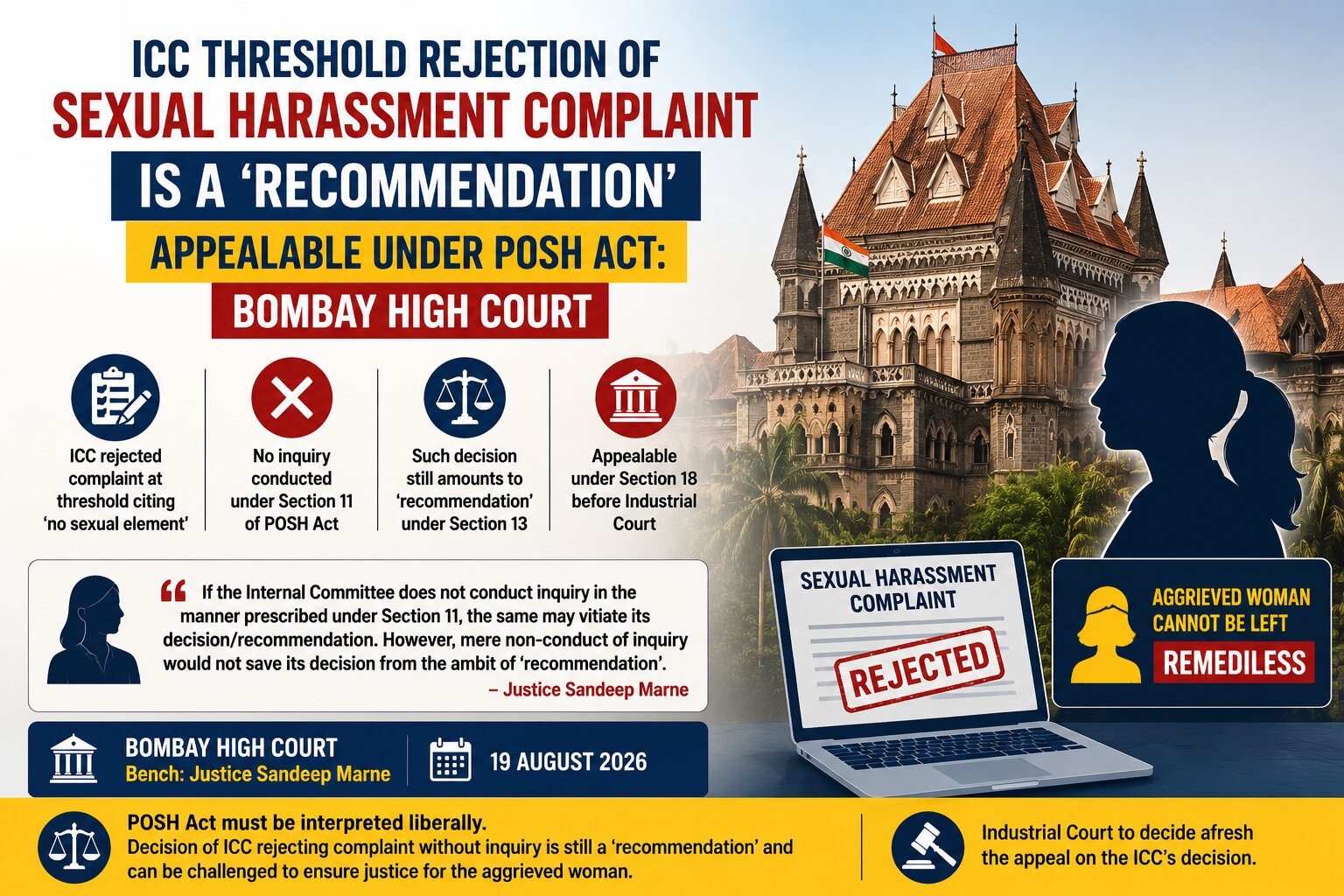
An ICC's threshold rejection of a sexual-harassment complaint can amount to a recommendation under Section 13 of the POSH Act.
Judgement Details
Court
Bombay High Court
Date of Decision
22 August 2026
Judges
Justice Sandeep Marne
Citation
Acts / Provisions
Facts of the Case
-
A female employee submitted a complaint alleging sexual harassment in the workplace.
-
The complaint was referred by the employer to the Internal Complaints Committee (ICC).
-
Because of a conflict involving one ICC member, an external member headed the committee proceedings.
-
The ICC rejected the complaint at the threshold, concluding that it did not contain any “sexual element.”
-
The ICC did so without conducting the inquiry contemplated under Section 11 of the POSH Act.
-
The complainant challenged the ICC's decision before the Industrial Court under Section 18.
-
The Industrial Court held that the ICC's decision was appealable and directed reconsideration of the complaint.
-
The employees challenged the Industrial Court's decision before the Bombay High Court.
Issues
-
Whether a decision of the Internal Complaints Committee rejecting a sexual-harassment complaint at the threshold without conducting an inquiry under Section 11 constitutes a “recommendation” under Section 13 of the POSH Act?
-
Whether such a decision of the Internal Complaints Committee is appealable under Section 18 of the POSH Act?
-
Whether failure by the Internal Complaints Committee to conduct the prescribed inquiry removes its decision from the scope of an appeal under Section 18?
Judgement
-
The Bombay High Court held that an ICC decision rejecting a complaint at the threshold can constitute a “recommendation” under Section 13, even where no inquiry was conducted.
-
The Court rejected the argument that absence of an inquiry automatically makes the decision non-appealable.
-
Justice Sandeep Marne held that treating such a decision as non-appealable would leave the aggrieved woman without an effective remedy.
-
The Court held that failure to conduct an inquiry may vitiate the ICC's decision, but it does not prevent that decision from being treated as a recommendation.
-
The Court emphasized that the POSH Act must be interpreted liberally to advance the protection intended for women under the legislation.
-
The Industrial Court was directed to reconsider the complainant's appeal afresh.
-
The High Court clarified that while deciding maintainability, the Industrial Court should not prematurely decide the merits of the complaint.
Held
-
Such a decision can be challenged in appeal under Section 18.
-
Failure to conduct the Section 11 inquiry does not make the ICC decision immune from challenge.
-
The remedy under the POSH Act cannot be denied merely because the ICC itself failed to follow the statutory inquiry procedure.
Analysis
-
Protection against a remediless situation: The Court's primary concern was that a strict interpretation would allow an ICC to defeat the complainant's statutory right of appeal simply by failing to conduct an inquiry.
-
Violation of Section 11 does not create immunity: The Court distinguished between the validity of the ICC's procedure and the character of its decision. An improperly reached decision may be legally defective, but it can still constitute a recommendation capable of being challenged.
-
Purpose-oriented interpretation: The judgment adopts a beneficial interpretation of the POSH Act, emphasizing that legislation enacted to protect women from workplace sexual harassment should not be interpreted in a manner that deprives the complainant of a remedy.
-
Right of appeal preserved: Section 18 becomes meaningful only if an affected employee can challenge an ICC decision that effectively disposes of the complaint.
-
Industrial Court's limited role at maintainability stage: The High Court cautioned that the Industrial Court should first determine whether the appeal is maintainable and should not decide the substantive merits while deciding that preliminary question.
-
Important procedural safeguard: The ruling prevents an ICC from effectively making its threshold rejection final merely because it failed to conduct the inquiry required by Section 11.