
Antonetto J D'Souza v. Aldila Braganza & Others, 2026
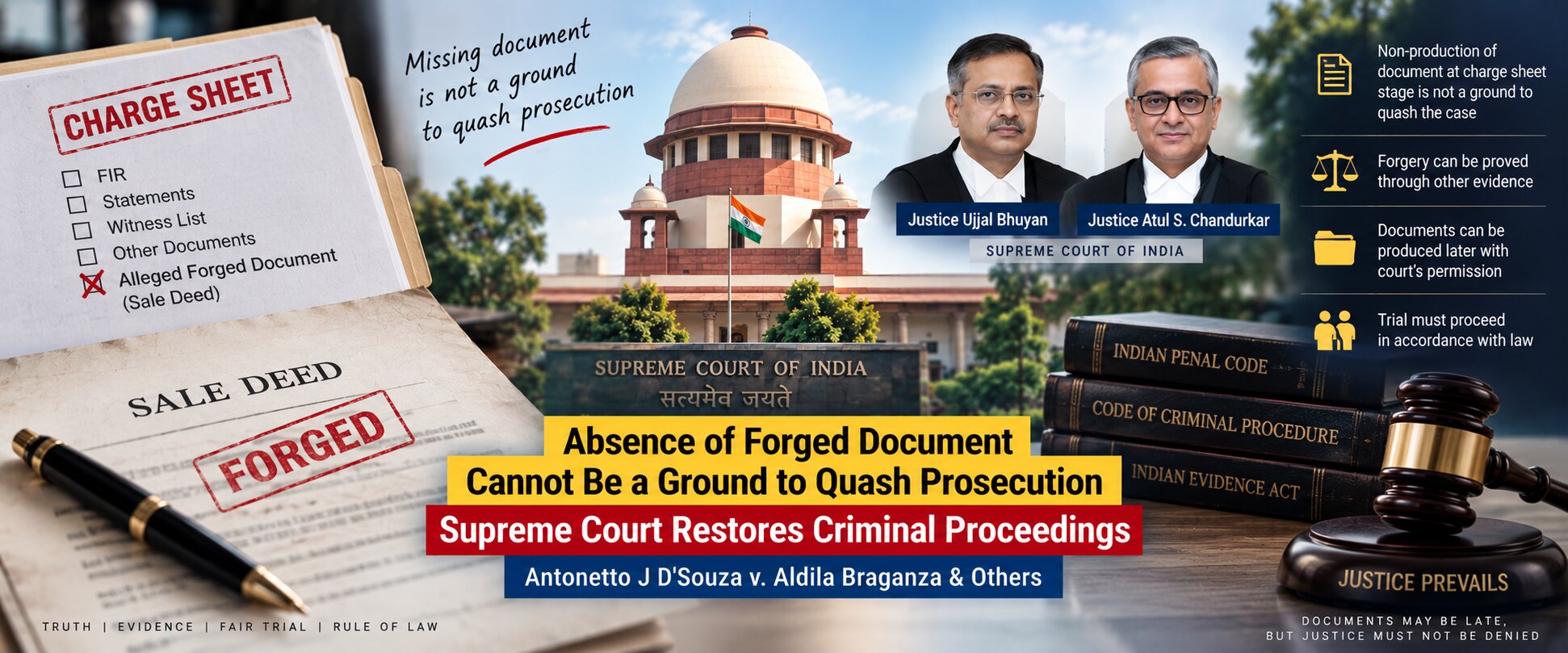
The mere absence of the original forged document at the time of filing the charge sheet does not justify quashing the prosecution.
Judgement Details
Court
Supreme Court of India
Date of Decision
22 September 2026
Judges
Justice Ujjal Bhuyan & Justice Atul S. Chandurkar
Citation
Acts / Provisions
Facts of the Case
-
The case concerned allegations of forgery involving a sale deed.
-
The prosecution alleged that the accused persons were involved in an offence relating to a forged sale deed.
-
The investigating agency submitted a charge sheet before the Magistrate.
-
However, the original document alleged to have been forged was not produced along with the charge sheet.
-
The accused persons relied upon the non-production of the original sale deed and sought to challenge the continuation of the criminal proceedings.
-
The Magistrate had refused to discharge the accused and proceeded with the criminal case.
-
The accused thereafter approached the Bombay High Court, Goa Bench, seeking discharge.
-
A Single Judge of the High Court interfered with the Magistrate's order and discharged the accused, primarily relying upon the absence of the alleged forged document.
-
The High Court had earlier considered the issue before a Division Bench, which had declined to interfere with the order framing charges against the accused.
-
The Supreme Court examined whether the absence of the original allegedly forged document at the stage of filing the charge sheet could justify quashing the prosecution or discharging the accused.
-
The Court also considered whether a document omitted from the charge sheet could subsequently be produced before the trial court with its permission.
Issues
-
Whether the non-production of the original forged document along with the charge sheet can, by itself, constitute a ground for quashing the prosecution?
-
Whether the absence of the alleged forged sale deed at the pre-trial stage prevents the prosecution from establishing the offence of forgery through other evidence?
-
Whether a document omitted from the charge sheet can be produced subsequently with the permission of the Court?
-
Whether the Single Judge of the High Court was justified in reconsidering an issue that had already been considered by the Division Bench?
-
Whether the High Court's order discharging the accused was contrary to the principles of judicial comity and issue estoppel?
-
Whether the prosecution should be permitted to establish the charge of forgery through circumstantial and other evidence at trial despite the absence of the original document at the stage of filing the charge sheet?
Judgement
-
The Supreme Court allowed the appeal and set aside the order of the Bombay High Court, Goa Bench.
-
The Court held that the mere absence of the original forged document at the time of filing the charge sheet could not be a ground for quashing the entire prosecution.
-
The Court held that whether the offence of forgery could ultimately be established was a matter to be determined at trial after evaluating the entire evidence.
-
The prosecution could seek to establish the charge through circumstantial evidence and other material available on record.
-
The Court relied upon the decision in Rama Shanker Lal v. State of U.P. (1971), which recognized that forgery may, in an appropriate case, be established even without production of the document alleged to have been forged.
-
The Court clarified that the absence of the original document does not automatically result in the failure of the prosecution case.
-
The Court also relied upon Central Bureau of Investigation v. R.S. Pai (2002).
-
The Court held that although relevant documents are ordinarily required to be produced along with the charge sheet, an omission to produce a document does not create an absolute bar against its subsequent production.
-
The Investigating Officer may subsequently produce such documents with the permission of the Court.
-
The Supreme Court found that the Single Judge had exceeded the permissible scope of judicial inquiry by reconsidering material that had already been considered by the Division Bench.
-
The Court restored the criminal proceedings before the trial court.
-
The Magistrate was directed to proceed with the trial in accordance with law.
Held
-
The prosecution may attempt to establish forgery through other evidence and circumstantial evidence.
-
Whether forgery has actually been proved is a matter to be determined at the conclusion of the trial.
-
An omission to file a relevant document along with the charge sheet does not permanently prevent its subsequent production with the Court's permission.
-
The Single Judge was not justified in reconsidering an issue that had already been considered by the Division Bench.
-
The High Court's order discharging the accused was therefore set aside.
-
The criminal proceedings were restored before the trial court.
Analysis
-
Pre-trial stage: The Court emphasized that the question at the pre-trial stage is not whether the prosecution will ultimately succeed, but whether there is sufficient material for the case to proceed to trial.
-
Forgery without original document: The judgment recognizes that the prosecution may, depending on the circumstances, establish forgery through evidence other than the physical original of the allegedly forged document.
-
Proof beyond reasonable doubt: The absence of the original document may ultimately affect the prosecution's ability to prove its case, but that is a matter for assessment during trial rather than an automatic ground for terminating the proceedings beforehand.
-
Subsequent production of documents: The Court reaffirmed that an investigating officer's failure to submit a relevant document along with the charge sheet does not necessarily make subsequent production impermissible.
-
Court's permission: Additional documents may be produced subsequently with the permission of the trial court.
-
Judicial comity: The Supreme Court emphasized that a Single Judge should respect an earlier decision of a Division Bench dealing with the same issue.
-
Issue estoppel: The Court applied the principle that an issue already determined between the parties should not ordinarily be reopened in subsequent proceedings in the same matter.
-
Limited pre-trial scrutiny: The judgment reinforces that courts should avoid conducting an extensive evaluation of the prosecution evidence at a stage where the matter is required to proceed to trial.
-
Trial remains decisive: Ultimately, the prosecution must prove the allegation of forgery beyond reasonable doubt. The fact that the prosecution is permitted to proceed does not mean that the accused has been found guilty.
-
Balance between prosecution and accused: The judgment preserves the accused's right to challenge the prosecution evidence at trial while preventing the entire prosecution from being terminated merely because one relevant document was not initially filed with the charge sheet.