
Anil Singh @ Anil Kumar Singh v. The State of Bihar & Ors., 2026
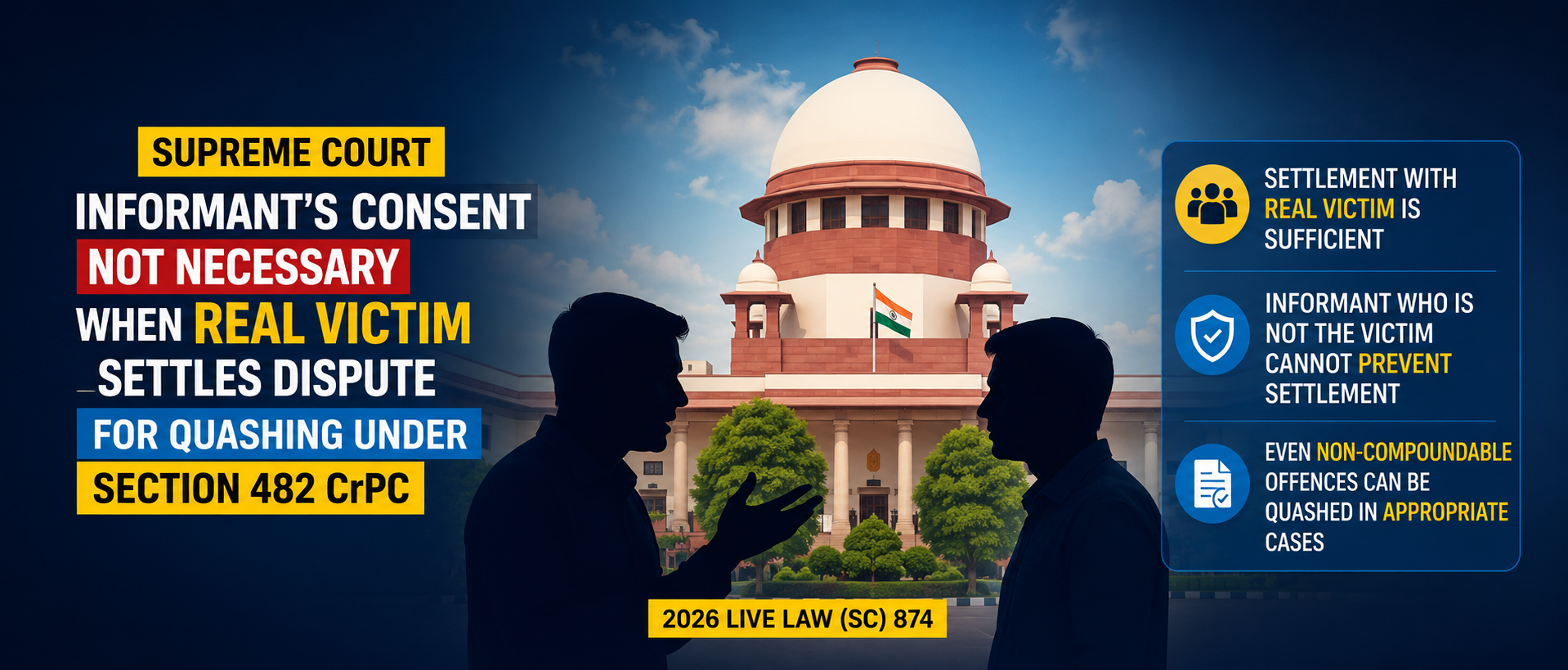
Informant’s Consent Not Needed for Quashing After Victim’s Settlement
Judgement Details
Court
Supreme Court of India
Date of Decision
31 August 2026
Judges
Justice J.B. Pardiwala and Justice K. Vinod Chandran
Citation
Acts / Provisions
Facts of the Case
The case arose out of an altercation in which the appellant and his father sustained injuries.
According to the prosecution:
-
Accused No. 1 allegedly attacked the appellant's father with a spear.
-
Accused Nos. 3 and 4 allegedly assaulted him with an iron rod.
-
Accused No. 2 allegedly struck the appellant on the head with a sword.
After investigation, charges were framed only against Accused Nos. 1 and 2, while the charges against Accused Nos. 3 and 4 were dropped.
The trial began in 2017 and had reached an advanced stage. During the proceedings, the appellant/de-facto complainant filed an application under Section 311 CrPC seeking examination of crucial witnesses, particularly:
-
His injured father;
-
The Medical Officer/Doctor who had examined the injured persons; and
-
The Investigating Officer.
The Trial Court rejected the application, considering it an attempt to delay the trial and fill lacunae in the prosecution evidence. The Patna High Court upheld the Trial Court's decision.
The appellant consequently approached the Supreme Court.
Issues
-
Whether the application under Section 311 CrPC for examination of the injured witness, Medical Officer and Investigating Officer was rightly rejected by the courts below?
-
Whether examination of these witnesses was essential for the just decision of the case?
-
Whether the Trial Court can reject examination of crucial witnesses merely on the ground that the application may fill a lacuna in the prosecution case or cause delay in the trial?
-
Whether the failure of the prosecution to examine crucial witnesses can justify the intervention of the Court to ensure a fair trial?
-
Whether the accused's examination under Section 313 CrPC should be recommenced after the newly summoned witnesses give evidence containing incriminating circumstances?
Judgement
- The Supreme Court allowed the appeal and set aside the orders of the Trial Court and the Patna High Court.
- The Court found that the courts below had adopted an erroneous approach by treating the Section 311 application primarily as an attempt to fill lacunae or delay the proceedings.
- The Supreme Court noted that the witnesses sought to be examined were not ordinary or peripheral witnesses. The appellant and his father were injured in the incident, and the injured father, Medical Officer and Investigating Officer were all crucial to the proper adjudication of the case.
- The Court stressed that a Trial Court is not a “moot spectator” when there is a serious failure by the prosecution to conduct the trial properly.
- Accordingly, the Court directed the Trial Court to permit examination of the relevant witnesses.
- It further directed that the Section 313 CrPC examination of the accused should recommence from the stage where it had stopped, so that any incriminating circumstances emerging from the newly recorded evidence could be put to the accused.
Held
-
The Supreme Court held that the application under Section 311 CrPC ought to have been allowed because the witnesses sought to be examined were crucial witnesses whose evidence could have a direct bearing on the outcome of the trial.
-
The Trial Court has a responsibility to ensure that material and best evidence is not suppressed because of prosecutorial failure.
-
Section 311 CrPC can be invoked where examination of a witness is essential for the just decision of the case, even if the evidence may have the effect of addressing an evidentiary gap.
-
The Court also held that after such additional evidence is recorded, the accused must be given an opportunity under Section 313 CrPC to explain any incriminating circumstances emerging from it.
Analysis
-
The central principle of the judgment is that the power under Section 311 CrPC exists to assist the Court in reaching a just decision.
-
The provision gives the Court wide authority to summon or examine a person where the person's evidence is necessary for proper adjudication.
-
Thus, the Court should not adopt an excessively technical approach merely because the evidence may expose a weakness or gap in the prosecution case.
-
One of the most significant observations is that the Trial Court is not a “moot spectator.”
-
Although a criminal court must remain independent and impartial, this does not mean that it should remain passive when there is an obvious failure to produce crucial evidence.
-
The Court has a responsibility to ensure that the trial results in a fair and legally sustainable adjudication.
-
The courts below treated the Section 311 application as an attempt to fill lacunae.
-
The Supreme Court distinguished between an accused or prosecution attempting to artificially improve its case and a situation where crucial witnesses have simply not been examined because of defective prosecution conduct.
-
Here, the injured father, Medical Officer and Investigating Officer were fundamental witnesses. Their absence could potentially result in an acquittal arising from poor prosecution conduct rather than a proper evaluation of the evidence.
-
An injured witness generally occupies an important position in criminal trials because the witness's presence at the scene is supported by the fact that the witness himself suffered injuries.
-
In this case, the appellant's father was himself an injured person and therefore his non-examination was considered particularly significant.
-
The Medical Officer could provide evidence concerning the nature and extent of the injuries, while the Investigating Officer could explain important aspects of the investigation, including the collection and presentation of evidence.
-
Their evidence could therefore have a direct impact on the determination of the prosecution case.
-
The Supreme Court's direction to recommence the Section 313 CrPC examination is equally important.
-
If new evidence contains circumstances incriminating the accused, principles of natural justice and fair trial require that the accused be given an opportunity to explain those circumstances.
-
The prosecution cannot simply introduce new incriminating material without providing the accused an opportunity to respond.
-
The judgment also demonstrates that speedy disposal of criminal cases cannot come at the cost of a fair trial.
-
While courts must prevent unnecessary delay, procedural efficiency cannot justify ignoring evidence that is genuinely essential for determining the truth and reaching a just decision.
-
The judgment strengthens the principle that Section 311 CrPC is a judicial tool for discovering the truth and securing a just decision, rather than merely a procedural mechanism available to parties.
-
It also places an important responsibility on Trial Courts to ensure that prosecutorial negligence does not undermine the fairness or reliability of the criminal trial.