
Angrez Singh Through His Attorney Ashok Kumar & Anr. v. Inspector General Registration, Jammu & Ors., 2026
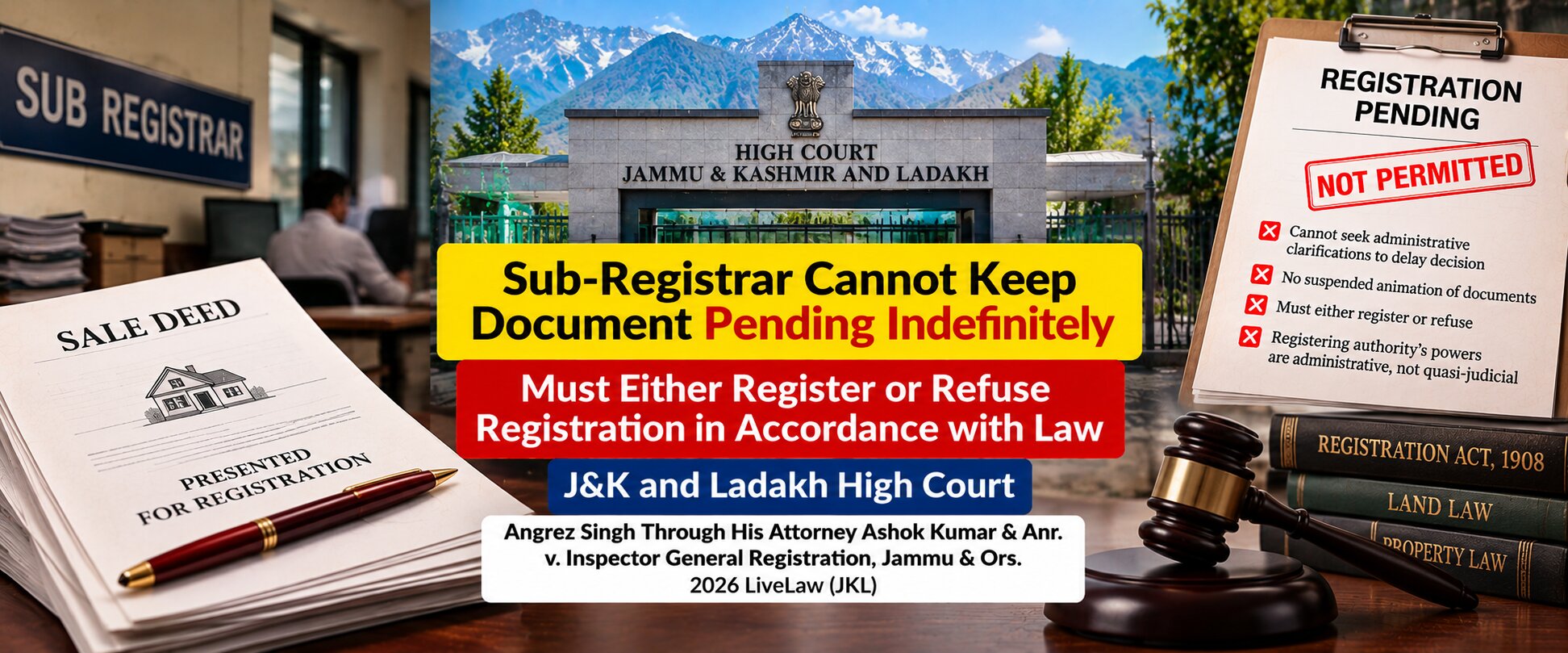
A Registering Authority must make a definitive decision either register the document or refuse registration in accordance with law.
Judgement Details
Court
Jammu & Kashmir and Ladakh High Court
Date of Decision
4 September 2026
Judges
Justice Rahul Bharti
Citation
Acts / Provisions
Facts of the Case
-
The petitioner had executed a registered General Power of Attorney dated 12 November 2018 in favour of Ashok Kumar.
-
The Power of Attorney authorised Ashok Kumar to act on the petitioner's behalf in relation to land measuring approximately 3.10 kanals situated at Village Chak Haria, Tehsil Marheen, District Kathua.
-
Acting through the attorney holder, Petitioner No. 1 executed a sale deed dated 25 November 2025 in favour of Petitioner No. 2.
-
Petitioner No. 2 was the son of the attorney holder, Ashok Kumar.
-
The sale deed concerned approximately 1 kanal and 15 marlas of land.
-
The sale deed was presented before the Sub-Registrar, Hiranagar, for registration.
-
The petitioners submitted the requisite supporting revenue documents along with the sale deed, including the fard intikhab/jamabandi and tatima issued by the competent revenue authorities.
-
The fard intikhab specifically certified that the proposed transaction did not violate the applicable provisions of the J&K Land Revenue Act, J&K Agrarian Reforms Act and the various Government Orders governing the land transaction.
-
Instead of either registering the document or refusing registration, the Sub-Registrar issued a communication dated 27 November 2025.
-
Through that communication, the Sub-Registrar stated that clarification had been sought from the Inspector General of Registration concerning execution and registration of documents relating to land acquired under Government Order REV (LB) 202 of 2007 dated 12 June 2007.
-
The petitioners were advised to “wait for further instructions” until directions were received from the higher authorities.
-
The petitioners challenged this communication before the High Court.
-
They contended that the Registration Act did not confer any power upon the Sub-Registrar to keep a document indefinitely pending while seeking administrative instructions from superior authorities.
-
The respondents were unable to identify any statutory provision authorising such indefinite deferment of the registration decision.
-
The High Court therefore examined the statutory scheme of the Registration Act and the nature of the powers exercised by a Registering Officer.
Issues
-
Whether a Sub-Registrar under the Registration Act, 1908 can indefinitely defer consideration of a document presented for registration while awaiting administrative instructions or clarification from superior authorities?
-
Whether the statutory scheme of the Registration Act requires the Registering Authority to either register the document or refuse registration in accordance with law?
-
Whether a Registering Officer possesses quasi-judicial authority to independently adjudicate questions of title or legality beyond the limited examination contemplated by the Registration Act?
-
Whether the Sub-Registrar was justified in directing the petitioners to wait for further instructions despite the sale deed being accompanied by the requisite revenue records and certifications?
-
Whether the communication issued by the Sub-Registrar, Hiranagar, was beyond the scope of his statutory jurisdiction?
Judgement
-
The High Court allowed the writ petition and found the impugned communication issued by the Sub-Registrar to be beyond the scope of his statutory jurisdiction.
-
The Court held that the statutory scheme of the Registration Act, 1908 does not contemplate keeping a document in indefinite suspension after it has been presented for registration.
-
According to the Court, once a document is presented under Sections 17 or 18 of the Registration Act, the Registering Authority has to take a definitive decision in accordance with law.
-
The Sub-Registrar must therefore either register the document or refuse registration on a legally sustainable ground.
-
The Court rejected the concept of placing registration proceedings in a state of “suspended animation” while awaiting instructions from superior administrative authorities.
-
The Court observed that the availability of an appeal under Section 72 of the Registration Act against refusal to register itself demonstrates that the statutory framework contemplates a definite decision by the Registering Officer.
-
The Court relied extensively upon the Supreme Court's decision in Satya Pal Anand v. State of Madhya Pradesh (2016).
-
Relying upon the principle stated in Satya Pal Anand, the Court observed that the Registering Officer does not exercise a general quasi-judicial power while registering documents.
-
The Registering Officer is required to examine whether the document is accompanied by the necessary supporting documents and whether the registration requirements under the Registration Act are satisfied.
-
The Registering Officer is not expected to adjudicate complicated questions of title or determine the ultimate validity of the parties' ownership rights.
-
In the present case, the sale deed was accompanied by the relevant revenue documents.
-
The fard intikhab specifically certified that the transaction did not violate the relevant land laws and Government Orders.
-
The Court therefore found no justification for the Sub-Registrar's decision to keep the matter pending merely because clarification had been sought from the Inspector General of Registration.
-
The Court held that the Sub-Registrar had no statutory authority to suspend decision-making in this manner.
-
The Court consequently directed the Sub-Registrar, Hiranagar, to either register the sale deed or refuse registration in accordance with law within four weeks from the date on which a copy of the judgment was made available to him.
-
The Court also directed that a copy of the judgment be forwarded to the Inspector General of Registration, Union Territory of Jammu & Kashmir, for circulation among Sub-Registrars and Registrars.
Held
-
A Sub-Registrar cannot indefinitely defer a document presented for registration.
-
The Registration Act does not contemplate keeping registration proceedings in “suspended animation.”
-
Seeking administrative clarification from superior authorities cannot be used as a substitute for exercising the statutory power of decision-making.
-
The existence of an appellate remedy under Section 72 reinforces the requirement that the Sub-Registrar must pass a definitive order when registration is refused.
-
The powers of the Registering Officer under the Registration Act are administrative and statutory in nature, rather than a general quasi-judicial power to adjudicate title disputes.
-
A Registering Officer is not expected to finally determine ownership or title while carrying out the registration process.
-
The Registering Officer's examination is principally directed towards compliance with the requirements of the Registration Act and accompanying documentation.
-
Where the presented document is complete in all material respects, the Registering Authority cannot simply instruct the parties to “wait for further instructions.”
-
The communication issued by the Sub-Registrar, Hiranagar, was therefore held to be legally unsustainable.
Analysis
-
No indefinite administrative delay: The central principle is that statutory authorities cannot avoid exercising a power that the statute requires them to exercise. The Sub-Registrar cannot leave a registration application pending indefinitely merely because administrative clarification is being sought.
-
Definitive decision is mandatory: The Court's emphasis on the alternatives of “register” or “refuse registration” establishes that the Registration Act does not provide a third option of indefinite postponement.
-
Meaning of Section 72: The existence of an appellate mechanism against refusal is significant. If a Sub-Registrar could simply postpone a decision indefinitely, the statutory appeal mechanism would effectively be undermined.
-
Limited role of Registering Officer: The judgment reiterates the principle from Satya Pal Anand that registration proceedings are not an occasion for the Sub-Registrar to undertake a full adjudication of title.
-
Registration is not title adjudication: Registration of a document does not necessarily conclusively establish ownership. Conversely, the Registering Officer cannot refuse or indefinitely postpone registration merely because he has concerns about a title issue that falls outside his statutory function.
-
Revenue records were important: In this case, the petitioners had produced the relevant revenue documentation, including the fard intikhab and tatima. The revenue authorities had specifically certified compliance with the relevant land laws and Government Orders.
-
Administrative hierarchy cannot override statute: The Sub-Registrar's decision to await instructions from the Inspector General of Registration was not supported by an identified statutory provision. The Court therefore treated the administrative communication as beyond jurisdiction.
-
Protection against bureaucratic uncertainty: The ruling protects parties presenting documents for registration from being placed indefinitely in uncertainty by an administrative authority.
-
Not a direction to register automatically: Importantly, the Court did not hold that every presented document must necessarily be registered. The Registering Authority retains the power to refuse registration where a lawful ground exists. What it cannot do is indefinitely postpone the decision without statutory authority.
-
Four-week direction: The Court converted the indefinite administrative uncertainty into a clear statutory obligation by directing the Sub-Registrar to take a definitive decision within four weeks.
-
Broader administrative-law principle: The judgment reflects the principle that statutory discretion must be exercised within the boundaries prescribed by the statute. An authority cannot create an additional procedure—such as indefinite reference to higher authorities—when the governing legislation does not provide for it.
-
Important distinction: The ruling concerns the registration function of the Sub-Registrar. It does not finally determine the validity of the underlying sale deed, the ultimate title to the property, or any substantive civil dispute between the parties.