
Anand Singh Rawat v. The State and Another & Anr., 2026
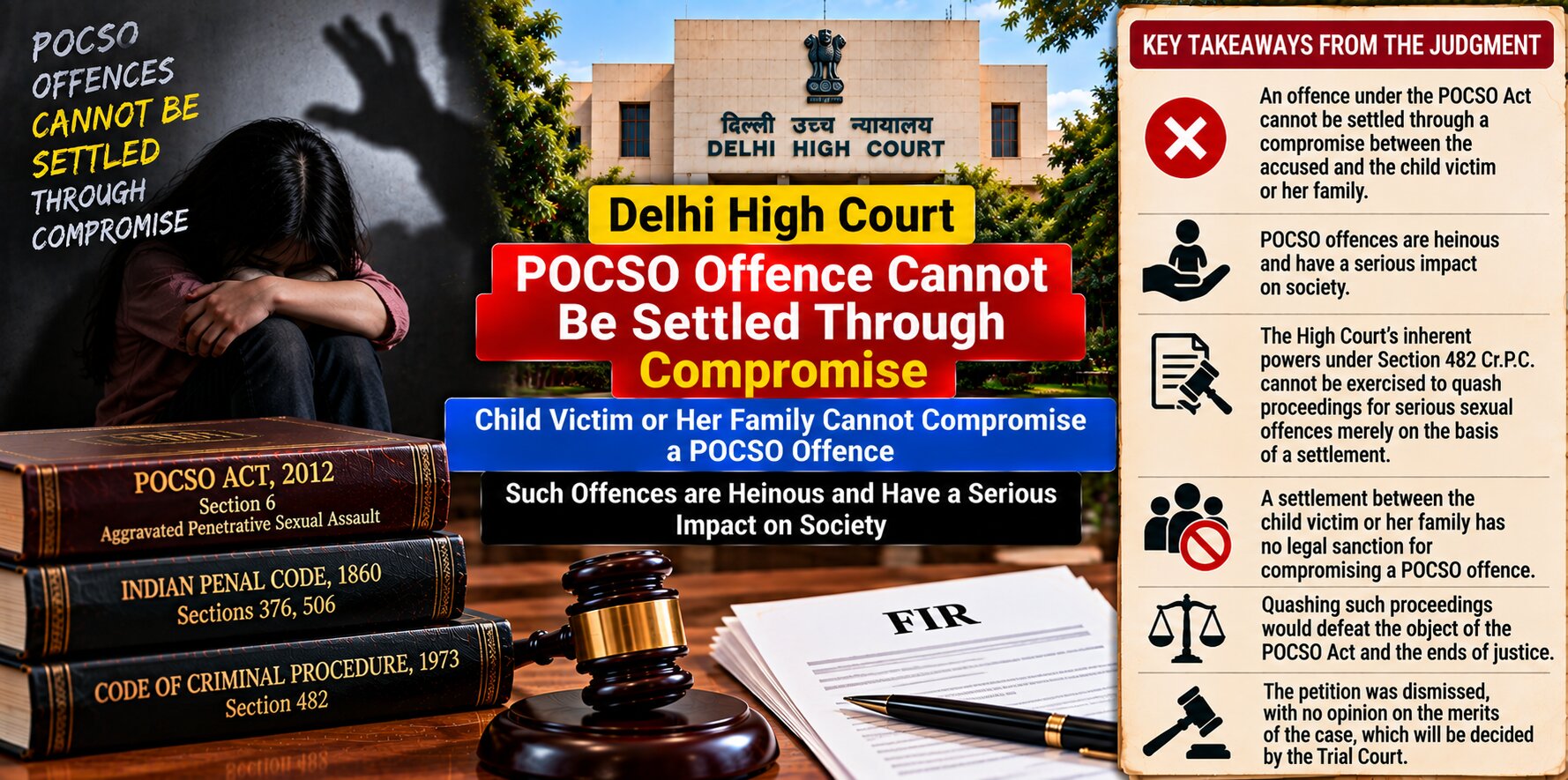
An offence under the POCSO Act cannot be compromised by the child victim or her family.
Judgement Details
Court
Delhi High Court
Date of Decision
24 September 2026
Judges
Justice Sachin Datta
Citation
Acts / Provisions
Facts of the Case
-
The petitioner, Anand Singh Rawat, was approximately 49 years old and approached the Delhi High Court seeking quashing of an FIR and the consequential criminal proceedings.
-
The FIR alleged commission of offences under Sections 376 and 506 IPC and Section 6 of the POCSO Act.
-
The allegations concerned sexual assault against a child victim, with the Court describing the allegations as involving aggravated penetrative sexual assault upon a child by a person in a position of trust or authority.
-
The petitioner sought exercise of the High Court's inherent jurisdiction under Section 482 Cr.P.C.
-
The principal basis for seeking quashing was a compromise/settlement allegedly arrived at between the petitioner and the victim, with the intervention of the victim's family.
-
The petitioner contended, in substance, that because the dispute had been settled, continuation of the criminal proceedings was no longer warranted.
-
The proceedings had already reached the stage of prosecution evidence before the Trial Court.
-
The Delhi High Court examined whether a settlement between the accused and the child victim or her family could provide a legal basis for quashing prosecution under the POCSO Act.
-
The Court considered the nature of POCSO offences and their impact beyond the individual parties to the criminal proceeding.
-
The Court relied upon the Supreme Court's decision in Gian Singh v. State of Punjab, which recognises that the High Court's inherent power to quash proceedings on the basis of settlement is subject to important limitations.
-
The High Court ultimately concluded that a POCSO offence could not be treated as a private dispute capable of being terminated through a compromise between the accused and the child victim or her family.
Issues
-
Whether an offence under Section 6 of the POCSO Act can be quashed by the High Court under Section 482 Cr.P.C. solely on the basis of a compromise between the accused and the child victim or her family?
-
Whether a settlement between the accused and the child victim or her family can confer legal sanction upon compromise of an offence involving aggravated penetrative sexual assault?
-
Whether the High Court can exercise its inherent jurisdiction to terminate prosecution for a heinous sexual offence merely because the parties claim to have settled the dispute?
-
Whether quashing the proceedings on the basis of such compromise would be inconsistent with the object of the POCSO Act and the ends of justice?
Judgement
-
The Delhi High Court dismissed the petition seeking quashing of the FIR and consequential criminal proceedings.
-
The Court held that an offence under the POCSO Act cannot be compromised by the child victim or her family.
-
The Court treated the allegations as concerning a heinous sexual offence against a child, having implications beyond a purely private dispute.
-
The Court relied upon Gian Singh v. State of Punjab, where the Supreme Court explained that although the High Court possesses inherent powers to quash criminal proceedings in appropriate cases, those powers cannot ordinarily be exercised to terminate proceedings concerning heinous and serious offences such as rape.
-
The Supreme Court's distinction between the High Court's inherent jurisdiction and the statutory power of compounding offences was relevant to the Court's reasoning.
-
The High Court observed that sexual offences of this nature are not merely private disputes between the accused and the victim and have a serious impact on society.
-
The Court specifically held that a settlement between the child victim or her family and the offender has no legal sanction for compromising a POCSO offence.
-
The Court concluded that accepting the compromise and quashing the proceedings at the stage when the case was already proceeding to prosecution evidence would undermine the object of the POCSO Act.
-
The Court further held that such quashing would also be contrary to the ends of justice.
-
Accordingly, the FIR and consequential proceedings were allowed to continue before the Trial Court.
-
At the same time, the High Court expressly clarified that its order did not amount to an opinion on the merits of the allegations.
-
The Court left the factual merits of the prosecution case to be determined by the Trial Court on the basis of the evidence produced during trial.
Held
-
A POCSO offence involving sexual assault against a child is not a purely private dispute between the accused and the victim.
-
The High Court's inherent power under Section 482 Cr.P.C. to quash criminal proceedings on the basis of settlement is not unlimited.
-
The power to quash cannot ordinarily be exercised merely because the parties have settled in cases involving heinous and serious sexual offences.
-
A settlement between the accused and the child victim or her family does not provide a legally valid basis for terminating a POCSO prosecution.
-
Quashing a POCSO proceeding solely on the basis of compromise may defeat the object and protective purpose of the POCSO Act.
-
The existence of a compromise does not require the High Court to terminate a prosecution where the alleged offence has a serious impact upon society.
-
The dismissal of the quashing petition does not amount to a finding of guilt; the allegations remain subject to adjudication by the Trial Court on the basis of evidence.
Analysis
-
The central principle of the judgment is the distinction between private disputes capable of settlement and serious criminal offences affecting society as a whole.
-
Section 482 Cr.P.C. gives the High Court broad inherent powers, but those powers are exercised to secure the ends of justice and prevent abuse of process; they are not equivalent to an unrestricted power to terminate any criminal prosecution merely because the parties have reached an agreement.
-
The Court's reliance on Gian Singh v. State of Punjab is significant. The Supreme Court recognised that settlement-based quashing may be appropriate in certain cases that are predominantly private or civil in character, but drew a clear limitation concerning heinous offences such as rape and other serious crimes.
-
A POCSO prosecution occupies a particularly sensitive position because the alleged victim is a child protected by a special statutory regime.
-
The judgment therefore rejects the proposition that the victim or the victim's family can privately extinguish criminal liability arising from a POCSO offence through a compromise.
-
The Court's approach is consistent with the legislative purpose of the POCSO Act, which establishes a special framework for protecting children from sexual offences and providing for their adjudication through criminal law.
-
The decision also prevents the concept of compromise from being used as a substitute for a judicial determination of allegations involving sexual offences against children.
-
The Court's observation that such offences have a serious impact on society reflects the principle that criminal prosecution in these circumstances is not concerned solely with vindicating a private monetary or personal claim.
-
The ruling is particularly important because the case had already reached the prosecution-evidence stage. At that point, terminating the proceedings solely because of a subsequent compromise would have prevented the allegations from being tested through the trial process.
-
Importantly, however, the Court did not determine whether the allegations were true. Refusal to quash is procedurally distinct from conviction, and the Trial Court remains responsible for determining guilt or innocence on the evidence.
-
The judgment therefore preserves the distinction between maintaining a prosecution in the public interest and determining the accused's criminal liability on merits.
-
Another significant aspect is the Court's statement that a child victim or her family cannot compromise a POCSO offence. This reflects the statutory character of the offence and the protective rationale underlying the legislation.
-
The ruling also demonstrates that the inherent jurisdiction under Section 482 cannot be used to circumvent the statutory scheme merely because continuation of prosecution has become inconvenient or the parties subsequently claim to have reconciled.
-
The decision does not mean that Section 482 can never be exercised in a case involving allegations under special criminal statutes. Rather, it reinforces that the nature and seriousness of the offence, the statutory objective and the public interest must be considered before invoking the extraordinary power to quash.
-
The judgment consequently strengthens the principle that allegations of sexual offences against children must ordinarily be adjudicated through the statutory criminal process rather than being privately resolved through compromise.
-
Finally, the Court's express reservation regarding the merits is important. The order determines only the legal effect of the alleged compromise on the continuation of prosecution; it does not prejudge the evidence that will ultimately be considered by the Trial Court.