
Ambrosia Restaurants Pvt. Ltd. v. Sunita Dileep Nevatia, 2026
A suit under Section 6 of the Specific Relief Act, 1963 is maintainable before the Civil Court even where the parties are in a licensor-licensee relationship.
Judgement Details
Court
Bombay High Court
Date of Decision
14 July 2026
Judges
Justice Farhan P. Dubash
Citation
Acts / Provisions
Facts of the Case
-
The appellant, Ambrosia Restaurants Pvt. Ltd., instituted a suit under Section 6 of the Specific Relief Act, 1963, before the City Civil Court.
-
The suit was filed within six months of the alleged dispossession and sought restoration of possession on the ground that the appellant had been dispossessed otherwise than in due course of law.
-
The respondents contended that the dispute arose out of a licensor-licensee relationship and, therefore, exclusive jurisdiction vested in the Court of Small Causes under Section 41 of the Presidency Small Causes Courts Act, 1882.
-
Accepting this contention, the City Civil Court returned the plaint under Order VII Rule 10 CPC for presentation before the Small Causes Court.
-
Aggrieved by that order, the appellant preferred the present appeal before the Bombay High Court.
-
The principal issue before the High Court was whether the existence of a licensor-licensee relationship automatically ousted the jurisdiction of the Civil Court in a suit instituted under Section 6 of the Specific Relief Act.
Issues
-
Whether a suit under Section 6 of the Specific Relief Act, 1963 remains maintainable before the Civil Court even where the parties stand in a licensor-licensee relationship?
-
Whether the existence of a licensor-licensee relationship by itself attracts the bar under Section 41 of the Presidency Small Causes Courts Act, 1882?
-
Whether the Trial Court was justified in returning the plaint under Order VII Rule 10 CPC for presentation before the Small Causes Court?
Judgement
-
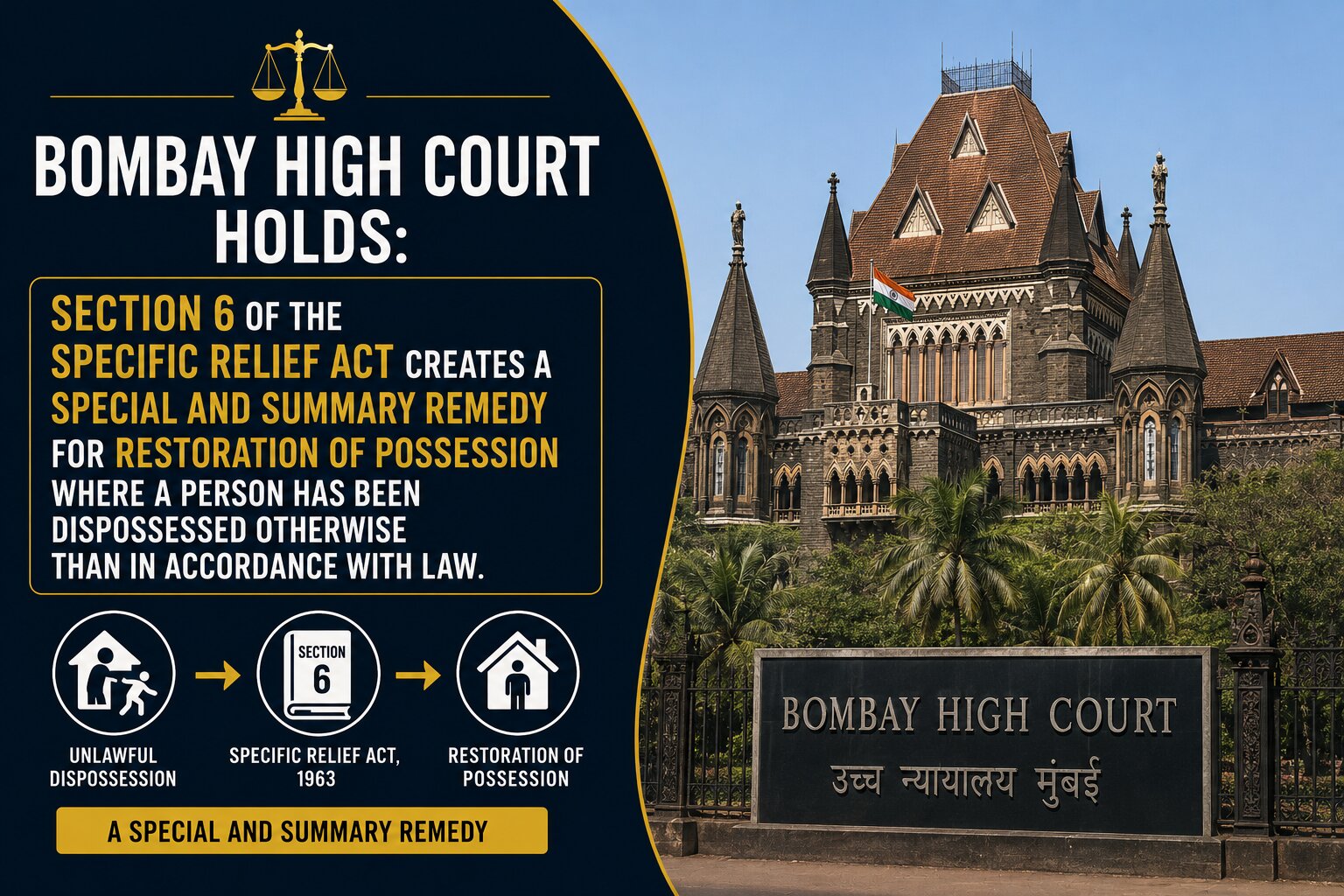
The Bombay High Court held that Section 6 of the Specific Relief Act creates a special and summary remedy for restoration of possession where a person has been dispossessed otherwise than in accordance with law.
-
The Court observed that in a Section 6 suit, the Court is concerned only with two questions:
-
whether the plaintiff was in prior possession; and
-
whether such possession was disturbed otherwise than in due course of law within six months before institution of the suit.
-
-
The Court clarified that questions relating to ownership or title fall outside the scope of proceedings under Section 6.
-
The Court held that the Trial Court erred in treating the existence of a licensor-licensee relationship as determinative without examining the true nature of the suit and the relief claimed.
-
The Court observed that the status of the parties is irrelevant in proceedings under Section 6.
-
It emphasized that the foundation of a Section 6 suit is prior lawful possession and unlawful dispossession, whereas proceedings under Section 41 of the Presidency Small Causes Courts Act are founded upon rights arising from the licensor-licensee or landlord-tenant relationship.
-
The Court held that the mere fact that the appellant originally entered the premises as a licensee does not transform a Section 6 suit into a proceeding governed by Section 41.
-
Consequently, the Court held that the Civil Court retained jurisdiction to entertain the suit.
-
Accordingly, the appeal was allowed, the order returning the plaint was set aside, and the suit was restored to the file of the City Civil Court.
Held
-
The existence of such relationship does not, by itself, attract the jurisdictional bar under Section 41 of the Presidency Small Causes Courts Act, 1882.
-
The determinative factor in a Section 6 suit is prior possession and unlawful dispossession, not the legal status of the parties.
-
The City Civil Court was directed to proceed with the suit after restoration of the plaint.
Analysis
-
The judgment clearly distinguishes between the nature of a possessory remedy under Section 6 of the Specific Relief Act and disputes founded upon contractual rights between licensors and licensees.
-
By emphasizing that Section 6 focuses exclusively on possession and unlawful dispossession, the Court reaffirmed the legislative objective of discouraging self-help and ensuring that dispossession occurs only through lawful process.
-
The decision prevents defendants from defeating the summary remedy under Section 6 merely by relying upon the underlying legal relationship between the parties.
-
The Court correctly interpreted Section 41 of the Presidency Small Causes Courts Act as applying to disputes based on rights flowing from the licensor-licensee relationship, rather than to independent possessory claims based on unlawful dispossession.
-
The ruling reinforces the long-standing principle that questions of title and contractual rights are irrelevant in proceedings under Section 6.
-
The judgment also provides important guidance to trial courts that jurisdiction must be determined from the substance of the pleadings and relief claimed, rather than merely from the relationship between the parties.
-
Overall, the decision strengthens the summary possessory remedy under Section 6 by ensuring that allegations of unlawful dispossession receive prompt adjudication before the appropriate civil forum.