
Amar Thapa v. State (NCT of Delhi), 2026
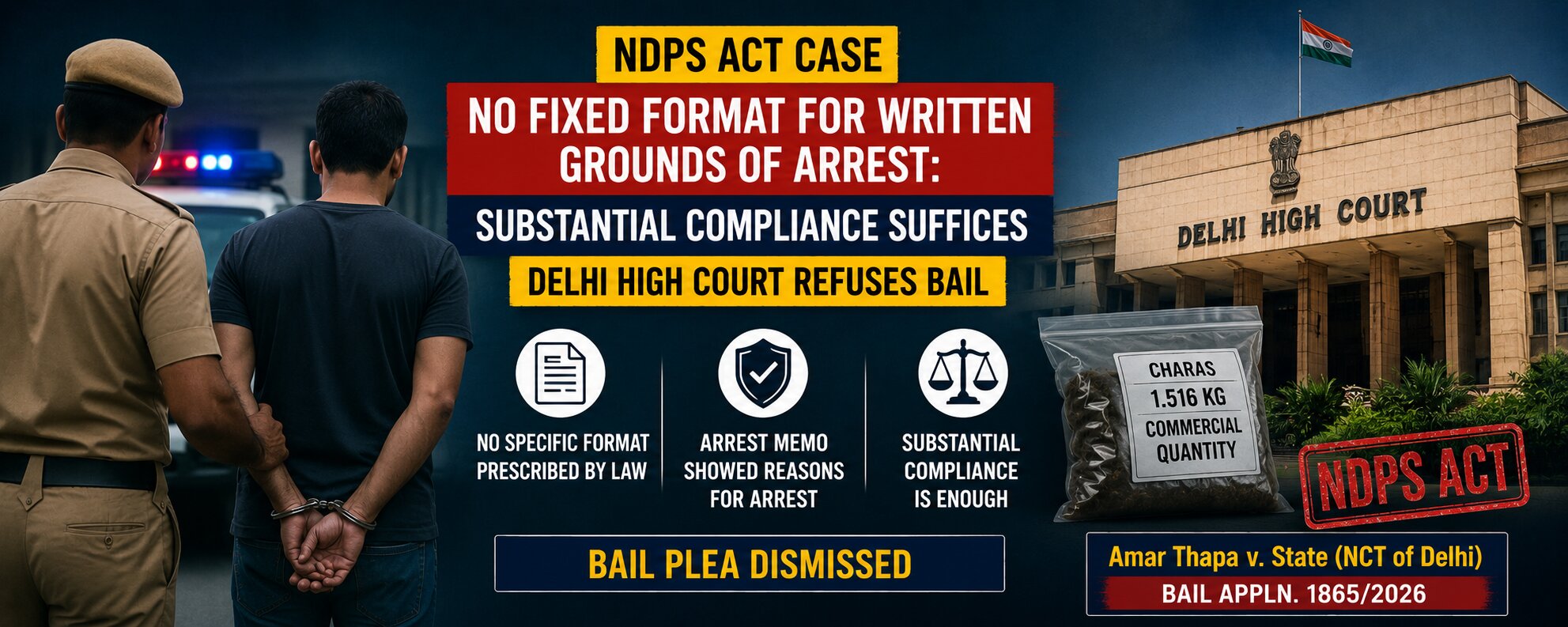
There is no prescribed statutory or judicial format for communicating written grounds of arrest.
Judgement Details
Court
Delhi High Court
Date of Decision
13 July 2026
Judges
Justice Girish Kathpalia
Citation
Acts / Provisions
Facts of the Case
-
The petitioner was arrested on 17 January 2025 in connection with an FIR registered under Sections 20 and 25 of the NDPS Act.
-
During the investigation, the police allegedly recovered 1.516 kg of charas (commercial quantity) from the petitioner's premises.
-
The petitioner sought regular bail before the Delhi High Court.
-
The principal contention was that the investigating agency had not furnished written grounds of arrest, rendering the arrest illegal.
-
The prosecution opposed the bail application, arguing that the arrest memo itself clearly communicated the grounds of arrest.
-
The State further submitted that the accused had suffered no prejudice because he was represented by legal counsel from the very first remand proceedings.
-
It was also argued that the Supreme Court's clarification regarding written communication of grounds of arrest came after the petitioner's arrest.
-
The Court examined the arrest memo, the surrounding circumstances, and the relevant Supreme Court precedents before deciding the bail application.
Issues
-
Whether Article 22(1) of the Constitution and Section 50 CrPC mandate a specific format for furnishing written grounds of arrest?
-
Whether the arrest memo prepared by the investigating agency substantially complied with the constitutional requirement of informing the accused about the grounds of arrest?
-
Whether the alleged failure to separately supply written grounds of arrest entitled the accused to bail under the NDPS Act?
-
Whether the accused had sufficient knowledge of the allegations to effectively defend himself and seek legal assistance?
-
Whether the petitioner satisfied the twin conditions for bail under Section 37 of the NDPS Act?
Judgement
-
The Delhi High Court dismissed the bail application.
-
The Court held that neither Article 22(1) of the Constitution nor Section 50 CrPC prescribes any legislatively or judicially mandated format for communicating the grounds of arrest.
-
It observed that the constitutional requirement is satisfied if the accused is informed of the reasons for arrest in a manner that enables him to seek legal assistance and defend himself.
-
The Court found that the arrest memo served upon the petitioner clearly mentioned the reasons for arrest, including the possibility of tampering with evidence, influencing witnesses, committing further offences, and evading legal proceedings.
-
The Court held that the arrest memo represented an honest understanding of the prevailing legal position by the Delhi Police.
-
It ruled that any technical defect in the format of the arrest memo could not automatically result in the accused's release.
-
The Court noted that the petitioner had legal representation from the earliest stage and had promptly filed a bail application, demonstrating adequate knowledge of the allegations.
-
The Court emphasized that there is no sharp distinction between generic and specific information, as information that appears general may sufficiently convey the allegations in a given case.
-
The Court also observed that investigating agencies dealing with narcotics offences often require immediate custodial action to identify suppliers and dismantle larger drug networks.
-
Since the case involved commercial quantity of charas, and the petitioner failed to satisfy the twin conditions under Section 37 of the NDPS Act, bail was refused.
Held
- Substantial compliance with the constitutional requirement under Article 22(1) is sufficient.
-
The arrest memo in the present case adequately informed the accused of the reasons for his arrest.
-
The petitioner failed to establish any prejudice caused by the alleged defect.
-
The twin conditions under Section 37 of the NDPS Act were not satisfied.
-
The bail application was dismissed.
Analysis
-
The judgment adopts a substance-over-form approach, emphasizing meaningful compliance rather than rigid procedural formalities.
-
It clarifies that the constitutional safeguard under Article 22(1) is intended to ensure that an accused understands the basis of arrest, not to mandate any particular document or format.
-
The Court harmonized earlier Supreme Court decisions by focusing on the practical objective of the right to be informed of the grounds of arrest.
-
The ruling recognizes that procedural defects should not automatically invalidate an arrest unless they result in actual prejudice to the accused.
-
The judgment reinforces the stringent bail regime under Section 37 of the NDPS Act, particularly where commercial quantity narcotics are involved.
-
By highlighting the operational challenges faced by investigating agencies, the Court acknowledged the need for prompt investigative action in narcotics cases.
-
The decision underscores the serious societal impact of drug trafficking, observing that illicit narcotics trade finances organized crime and can also contribute to activities threatening national security.
-
The ruling is significant because it clarifies that substantial constitutional compliance is sufficient, provided the accused is effectively informed of the reasons for arrest and is able to exercise his legal rights.