
Alok Sharma v. State of Madhya Pradesh
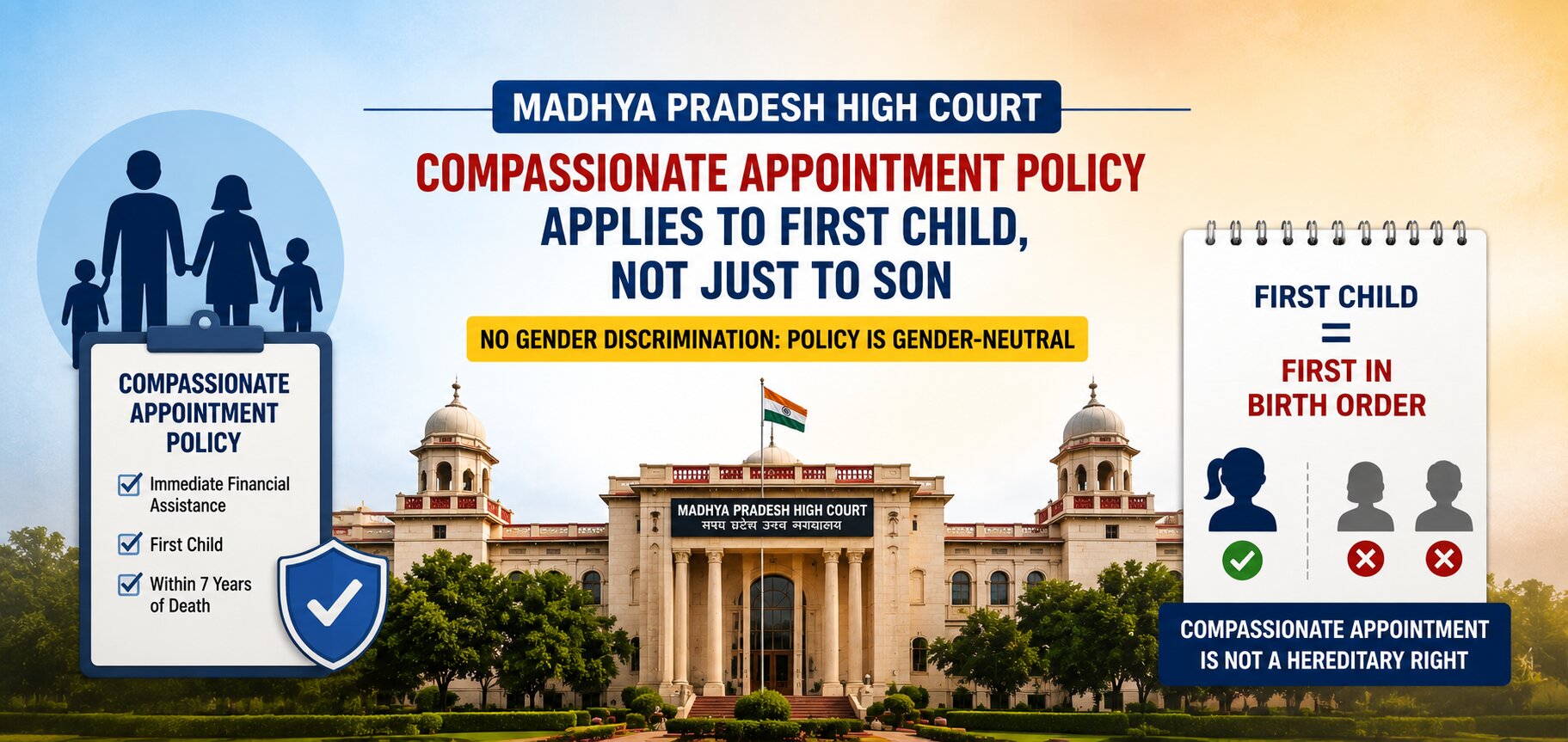
The expression “first child” must be applied according to birth order and cannot be interpreted as “first son.”
Judgement Details
Court
Madhya Pradesh High Court
Date of Decision
20 August 2026
Judges
Justice Milind Ramesh Phadke and Justice Pushpendra Yadav
Citation
Acts / Provisions
Facts of the Case
-
The appellant's father was a government employee who died in 1998 while in service.
-
At the time of his father's death, the appellant was approximately one year old.
-
The appellant had two elder sisters and was the only male child in the family.
-
The appellant's mother had earlier applied for compassionate appointment, but her application was rejected.
-
After attaining majority, the appellant sought compassionate appointment under the State's policy.
-
He relied upon Clause 3.2 of the applicable compassionate appointment policy.
-
The policy generally permitted consideration of a dependent for compassionate appointment where a post was available within seven years from the date of death of the employee.
-
An exception existed where the first child of the deceased employee was a minor at the time of death.
-
In such circumstances, the application could be considered within one year from the date on which the first child attained majority.
-
The appellant argued that because he was the only son and was a minor when his father died, his case deserved consideration under the exception.
-
The Single Judge rejected the claim.
-
The Single Judge held that the purpose of compassionate appointment had ceased to exist because more than two decades had passed since the employee's death.
-
The appellant challenged that decision before the Division Bench.
-
The Division Bench examined whether the appellant could be treated as the first child merely because he was the only son.
Issues
-
Whether the State's compassionate appointment policy distinguishes between male and female children while determining who constitutes the “first child” of a deceased employee?
-
Whether a son can be treated as the first child merely because he is the only male child when he has two elder sisters?
-
Whether the appellant, who was a minor at the time of his father's death, was entitled to invoke the exception under Clause 3.2 of the compassionate appointment policy?
-
Whether the appellant's claim for compassionate appointment could be entertained more than two decades after the death of the government employee?
-
Whether being the only son of the deceased employee creates a preferential entitlement to compassionate appointment over elder daughters?
-
Whether compassionate appointment can be claimed as a hereditary or vested right by a dependent of a deceased government employee?
Judgement
-
The Division Bench dismissed the appeal.
-
The Court held that the policy refers specifically to the “first child” and does not distinguish between a son and a daughter.
-
Since the appellant had two elder sisters, he could not be treated as the first child.
-
The fact that he was the only son did not give him any preferential status under the policy.
-
The Court rejected an interpretation that would effectively give preference to a male child over an elder female child.
-
The Bench emphasized that the policy must be interpreted consistently with the constitutional prohibition against gender discrimination.
-
The appellant therefore could not invoke the special exception available to a minor first child.
-
The ordinary seven-year period under the policy had already expired.
-
The appellant's father's death occurred in 1998, and the relevant seven-year period expired in January 2005.
-
The Court also emphasized that compassionate appointment is intended to provide immediate financial assistance to a family facing sudden financial crisis following the death of its breadwinner.
-
It cannot be treated as a hereditary right passing automatically from a deceased employee to his descendants.
-
Since the family had survived for more than two decades without compassionate appointment, the original purpose of the scheme no longer existed.
-
The Court therefore found no ground to interfere with the Single Judge's decision.
-
The appeal was accordingly dismissed.
Held
-
The Madhya Pradesh compassionate appointment policy does not distinguish between male and female children.
-
A son with elder sisters cannot claim to be the first child merely because he is the only male child.
-
The policy cannot create preferential treatment for sons over daughters.
-
Such gender-based differentiation would be inconsistent with constitutional equality principles.
-
A minor child can invoke the special provision for a minor first child only if that child is actually the first child of the deceased employee.
-
Compassionate appointment is intended to address an immediate financial crisis and cannot ordinarily be claimed after an excessively long period.
-
Compassionate appointment is not a hereditary right arising from the government employment of the deceased.
-
The appellant's claim, made more than two decades after his father's death, was therefore not maintainable.
-
The appeal was dismissed.
Analysis
-
Gender-neutral interpretation: The most significant aspect of the judgment is the Court's insistence that the policy must operate equally for sons and daughters. The term “first child” cannot be converted into “first male child.”
-
Constitutional equality: The Court connected the interpretation of the State policy with the constitutional principle against gender discrimination. A benefit available to the first child cannot be redirected to a younger son merely because he is male.
-
Birth order is decisive: The appellant's two elder sisters meant that he was not the first child. His status as the only son did not alter the chronological order of birth.
-
No preferential treatment for sons: The ruling rejects the traditional assumption that a son should receive priority merely because he is the only male child in the family.
-
Compassionate appointment is exceptional: Appointment on compassionate grounds is an exception to the ordinary rule of recruitment based on equal opportunity and merit.
-
Purpose of the scheme: The fundamental purpose is to provide immediate relief to a family that suddenly loses its breadwinner. It is not designed to provide employment to a family member whenever convenient years later.
-
Delay defeats the underlying purpose: In this case, the employee died in 1998 and the claim was pursued after more than two decades. The Court found that such a long delay undermined the very purpose of compassionate appointment.
-
No hereditary employment right: Government employment cannot be treated as an asset that automatically passes to a child after the employee's death.
-
Minor-child exception: The policy's special protection for a minor first child recognizes that such a child cannot immediately apply for employment. But that exception is narrowly linked to the status of being the first child.
-
Administrative policy must be followed: Courts cannot rewrite the eligibility requirements of a compassionate appointment scheme merely because an individual case appears sympathetic.
-
Equal treatment of daughters: The decision has broader significance because it confirms that daughters cannot be displaced by sons in the application of a gender-neutral government employment policy.
-
Practical significance: Families seeking compassionate appointment must satisfy the specific conditions and timelines contained in the applicable policy. Being the only son, by itself, does not create an entitlement.
-
Broader legal significance: The judgment combines equality principles, gender neutrality and the limited purpose of compassionate appointment, preventing the scheme from becoming a hereditary employment mechanism.