
ALFIYA.A v. STATE OF KERALA & ORS., 2026
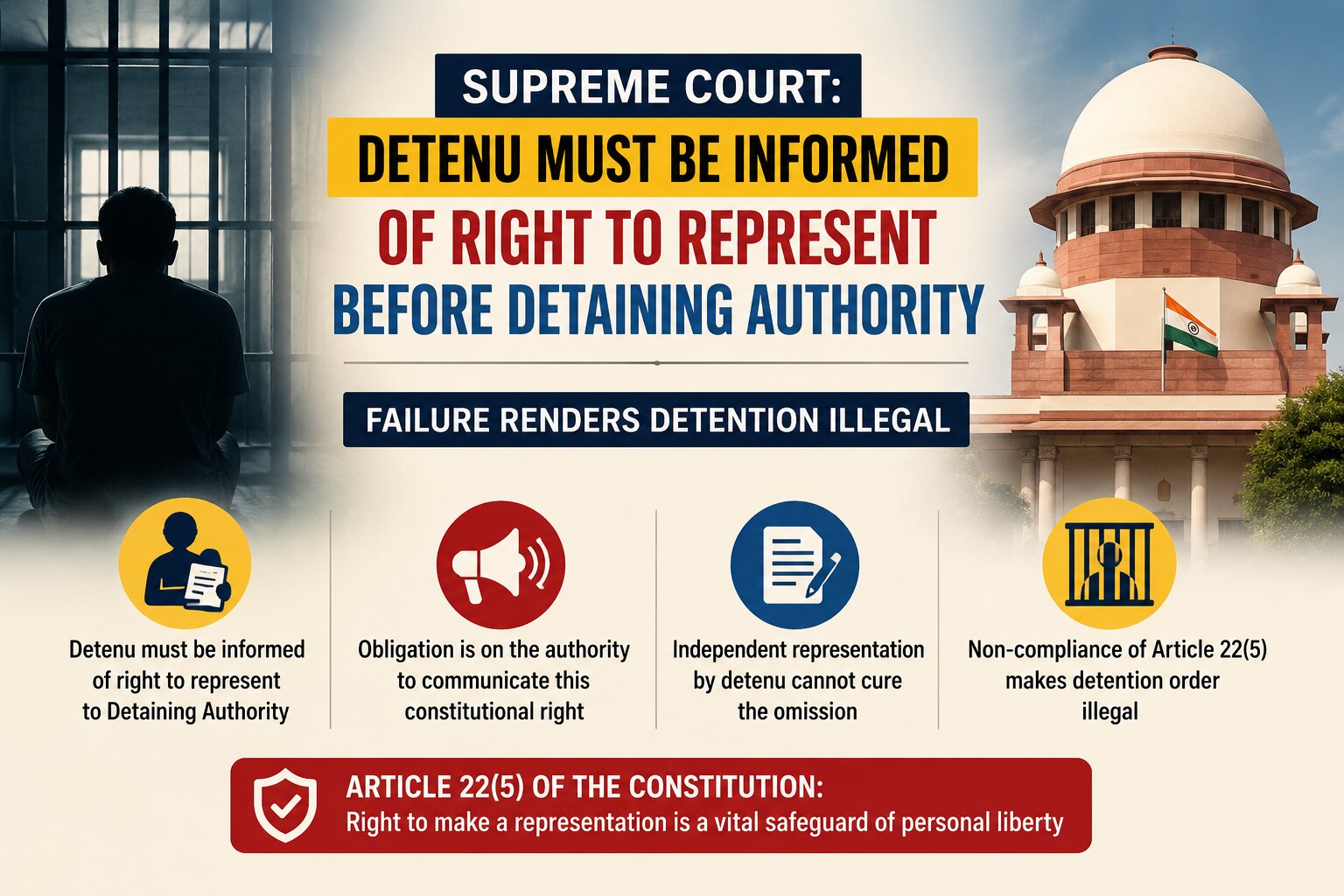
The detaining authority must inform a detenu of his right to make a representation to the specially empowered officer who passed the detention order, where that officer is competent to revoke the order.
Judgement Details
Court
Supreme Court of India
Date of Decision
10 August 2026
Judges
Justice Vikram Nath and Justice Sandeep Mehta
Citation
Acts / Provisions
Facts of the Case
-
The case concerned a preventive detention order passed against the detenu under the PITNDPS Act, 1988.
-
The detention order was passed by an officer who was specially empowered under Section 3(1) of the PITNDPS Act.
-
While communicating the detention order, the detenu was informed that he could make representations to the State Government, the Advisory Board and the Central Government.
-
However, the detaining authority did not separately inform the detenu that he had a right to make a representation to the very officer who had passed the detention order.
-
The detenu subsequently made one of his representations to the detaining authority.
-
The appellant, who was the wife of the detenu, challenged the detention before the Supreme Court.
-
The Kerala High Court had earlier confirmed the detention.
-
Before the Supreme Court, the appellant argued that the failure to inform the detenu of his right to make a representation to the detaining authority violated Article 22(5) of the Constitution.
-
The appellant relied upon the constitutional safeguard available to a person subjected to preventive detention.
-
The Supreme Court considered whether the detenu's independent act of making a representation to the detaining authority could cure the earlier failure of the authority to inform him of that right.
-
The Court held that the constitutional obligation was upon the detaining authority to communicate the right itself.
-
The Court further considered the fact that the detenu had remained in detention for nearly seven months.
Issues
-
Whether failure of the detaining authority to inform a detenu of his right to make a representation to the officer who passed the preventive detention order violates Article 22(5) of the Constitution?
-
Whether a detenu's independent submission of a representation to the detaining authority can cure the failure of the authority to inform him of his constitutional right to make such a representation?
-
Whether a preventive detention order passed by an officer specially empowered under Section 3(1) of the PITNDPS Act can remain legally valid when the detenu is not informed of his right to represent to that officer?
-
Whether failure to communicate the right of representation to the specially empowered detaining authority deprives the detenu of a valuable constitutional safeguard and renders the continued detention illegal?
Judgement
-
The Supreme Court allowed the appeal filed by the appellant.
-
The Court set aside the detention order passed against the detenu under the PITNDPS Act.
-
The Court found that the detaining authority had failed to inform the detenu about his right to make a representation to the officer who had himself passed the detention order.
-
The Court observed that where an officer is specially empowered under Section 3(1) of the PITNDPS Act to make the detention order, the detenu is entitled to make a representation to that officer.
-
The Court held that the detaining authority has an independent obligation to communicate this right to the detenu.
-
The Court rejected the argument that the detenu's subsequent representation to the detaining authority could cure the omission.
-
According to the Court, the constitutional safeguard cannot depend upon the detenu independently discovering or exercising a right which the authority was legally required to communicate.
-
The Court held that the failure to inform the detenu of this right made the opportunity of representation incomplete.
-
The Court found that the omission violated Article 22(5) of the Constitution.
-
The detention was therefore held to be illegal.
-
The Court consequently quashed the detention order, paving the way for the detenu's release.
Held
-
Merely informing the detenu of his right to make representations to the State Government, Advisory Board and Central Government is insufficient in such circumstances.
-
The detenu's independent submission of a representation to the detaining authority does not cure the constitutional violation caused by failure to inform him of that right.
-
The obligation to communicate the right rests upon the detaining authority and cannot be shifted to the detenu.
-
Failure to communicate this right deprives the detenu of a valuable constitutional safeguard under Article 22(5).
-
Such failure renders the opportunity to make an effective representation incomplete.
-
The detention in the present case was therefore illegal.
-
The Supreme Court quashed the detention order and allowed the appeal.
Analysis
-
Central constitutional safeguard: The judgment emphasizes that Article 22(5) is not satisfied merely by supplying the grounds of detention and generally informing the detenu about available avenues of representation. The detenu must receive the specific information necessary to exercise the constitutional safeguard effectively.
-
Right to approach the detaining authority: Where the detention order is passed by an officer specially empowered under Section 3(1) of the PITNDPS Act, that officer is relevant because he possesses the statutory power connected with the detention order. The detenu must therefore be informed of the right to approach that officer.
-
Communication of the right is mandatory: The Court treated communication of the right as an obligation of the detaining authority. It is not sufficient that the detenu somehow becomes aware of the right independently.
-
Independent representation does not cure the defect: This is the most significant aspect of the judgment. Even though the detenu actually submitted a representation to the detaining authority, the Court held that this subsequent conduct could not retrospectively cure the failure to inform him of the constitutional right.
-
Effective opportunity of representation: The purpose of Article 22(5) is to provide the detenu with a meaningful opportunity to challenge the detention. According to the Court's reasoning, an opportunity cannot be considered complete when the detenu has not been informed of an available and legally significant avenue of representation.
-
Reliance on precedent: The Court relied upon Kamleshkumar Ishwardas Patel v. Union of India, (1995) 4 SCC 51, as stated in the supplied material. That decision was relied upon for the principle that where detention is ordered by a specially empowered officer, the detenu must be informed of his right to make a representation to that officer.
-
Strict approach to preventive detention safeguards: The judgment reflects the principle that preventive detention, although permitted by law, involves a serious restriction upon personal liberty. Therefore, constitutional safeguards relating to representation must be properly observed.
-
Defect apparent from the detention order: The Court found the omission directly from the detention order itself. The order informed the detenu about representations to other authorities but did not separately communicate the right to represent to the officer who had made the detention order.
-
Protection of personal liberty: The decision reinforces judicial scrutiny of preventive detention because the consequences of procedural non-compliance can directly affect an individual's liberty.
-
Impact on preventive detention law: The judgment makes clear that authorities exercising preventive detention powers must carefully identify all constitutionally required avenues of representation and communicate them to the detenu.
-
Practical significance: A detaining authority cannot defend an omission merely by showing that the detenu ultimately made a representation to that authority. The initial constitutional obligation to inform the detenu remains mandatory.
-
Result of non-compliance: Because the omission was considered sufficient to violate Article 22(5), the continued detention was held illegal and the detention order was quashed.