
Alakh Pandey v. John Doe & Ors., 2026
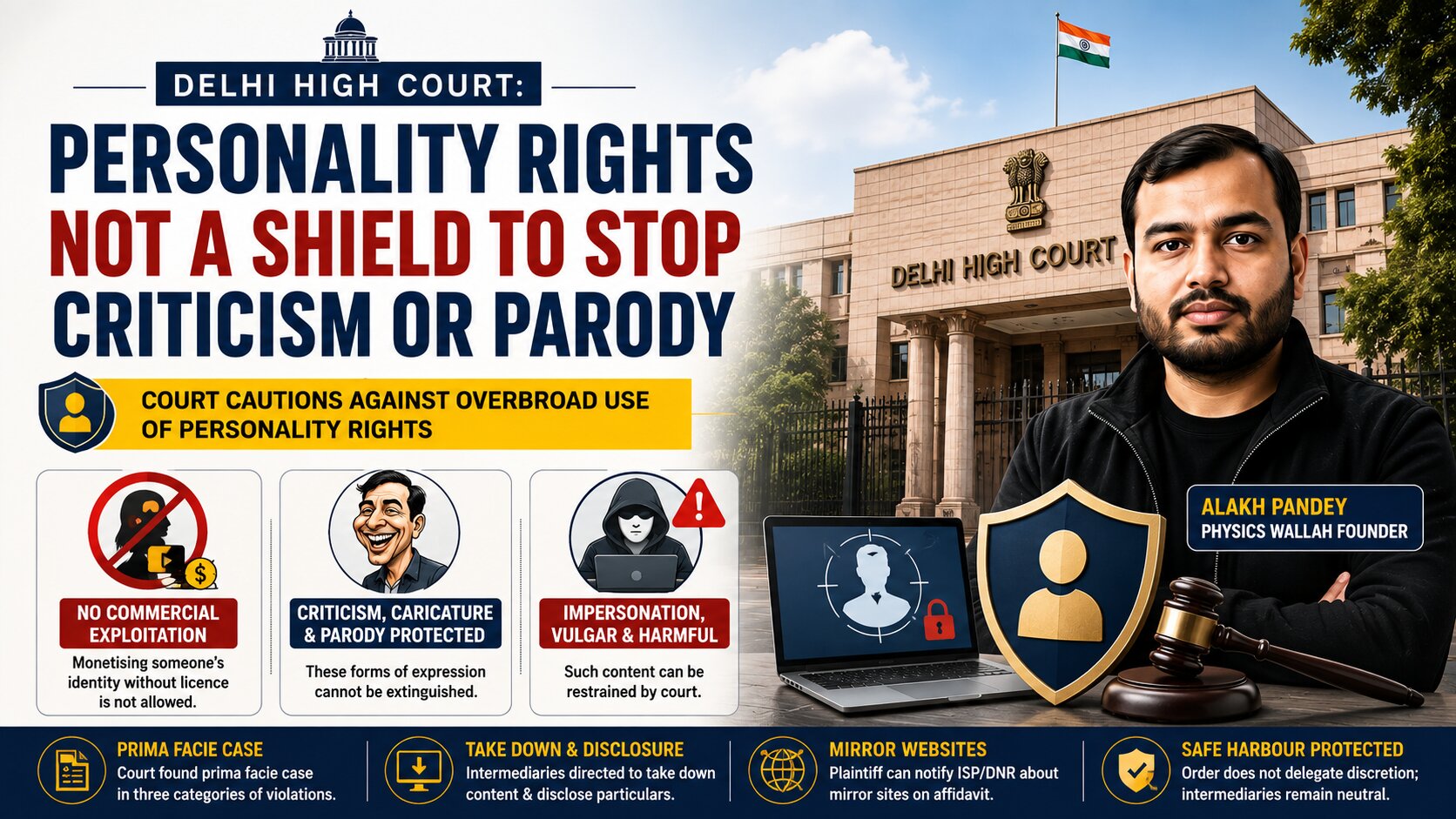
Personality rights protect individuals from unauthorized commercial exploitation and impersonation, but they cannot be used as a blanket shield against criticism, caricature, lampooning or parody.
Judgement Details
Court
Delhi High Court
Date of Decision
22 August 2026
Judges
Justice Anup Jairam Bhambhani
Citation
Acts / Provisions
Facts of the Case
-
Alakh Pandey, founder of Physics Wallah, approached the Delhi High Court alleging infringement of his personality and publicity rights by various online platforms.
-
He complained of online content allegedly using his identity and persona without authorization.
-
The alleged content included material involving commercial exploitation, impersonation and sexually vulgar portrayals.
-
The defendants included online platforms and unidentified persons/accounts.
-
Pandey sought protection against the allegedly infringing content and directions to intermediaries.
-
The Court considered whether personality rights could be invoked broadly enough to restrain forms of expression such as parody, caricature and criticism.
Issues
-
Whether personality rights can be invoked in an overbroad manner to restrain criticism, caricature, lampooning or parody?
-
Whether unauthorized commercial exploitation of an individual's personality can constitute an infringement of personality or publicity rights?
-
Whether impersonation and sexually vulgar portrayals of an individual warrant interim judicial protection?
-
Whether online intermediaries can be directed to take down identified infringing content and disclose information concerning the persons operating the relevant accounts or websites?
-
Whether an Internet Service Provider or Domain Name Registrar can be directed to technically identify mirror or redirect websites without independently deciding the merits of the alleged infringement?
Judgement
-
The Court cautioned that personality rights must not be interpreted so broadly that they suppress legitimate expression.
-
It specifically recognized the importance of preserving forms of expression such as caricature, lampooning, parody and criticism, where there is no commercial exploitation of personality rights.
-
However, the Court found a prima facie case in three categories:
-
sexually vulgar portrayals;
-
unauthorized commercial monetisation of Pandey's personality; and
-
impersonation.
-
-
The Court granted ex-parte ad-interim protection concerning those categories.
-
Certain intermediary defendants were directed to take down offending URLs and disclose relevant information concerning the accounts/content.
-
The Court permitted technical verification of alleged mirror or redirect websites for enforcement of the injunction.
-
The Court clarified that intermediaries were not being given authority to independently determine whether content infringed personality rights.
Held
-
Personality rights cannot become a weapon to suppress legitimate criticism, parody or caricature.
-
Unauthorized commercial exploitation and impersonation may justify protection of personality/publicity rights.
-
Sexually vulgar or otherwise seriously objectionable portrayals may warrant interim restraint.
-
Intermediaries must remain neutral to retain safe-harbour protection under Section 79 of the IT Act.
-
The Court can direct technical verification of mirror websites for enforcement of an existing injunction without transferring adjudicatory powers to intermediaries.
Analysis
-
Balance between personality rights and free expression: The most significant aspect is the Court's warning against treating personality rights as an unlimited proprietary right over everything associated with a person.
-
Protection against commercial exploitation: The Court distinguishes legitimate expression from unauthorized monetisation. A person's identity cannot simply be commercially exploited without a licence or legal basis.
-
Parody and criticism: The judgment protects an important area of public discourse. If personality-right claims could prevent every caricature or parody, they could have a chilling effect on criticism and creative expression.
-
Impersonation: Unlike ordinary criticism, impersonation can mislead the public into believing that the individual actually created, endorsed or communicated the content. This provides a stronger basis for judicial protection.
-
Intermediary liability: The Court carefully avoided turning ISPs and domain registrars into adjudicators. Their role remains largely technical and neutral, which is important for preserving the statutory safe-harbour framework.
-
Interim relief: The Court did not grant blanket protection over Pandey's entire personality. Instead, it confined interim protection to specific categories where a prima facie case, balance of convenience and risk of irreparable injury were established.
-
Broader legal significance: The ruling illustrates the need for Indian personality-rights jurisprudence to develop through a balance between individual identity, commercial interests, free expression and technological realities.