
Akthar Hussain Laskar @ Md. Hussain & Abdul Aleem Mondal @ Md. Jubal @ Md. Jubab v. NIA & Ors., 2026
Reduction of sentence is not an automatic or vested right of a convicted person.
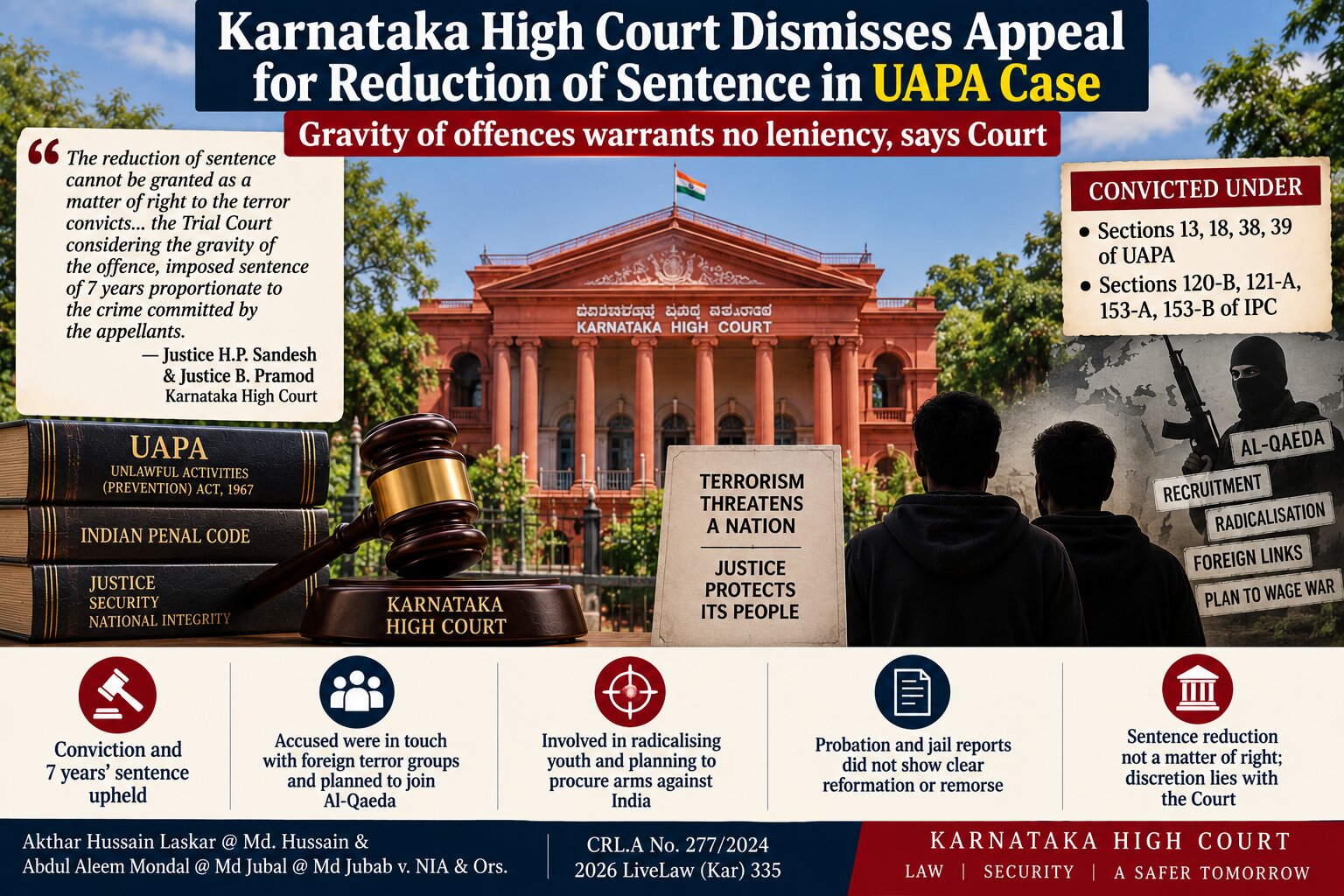
Judgement Details
Court
Karnataka High Court
Date of Decision
7 September 2026
Judges
Justice H.P. Sandesh and Justice B. Pramod
Citation
Acts / Provisions
Facts of the Case
-
The appellants were convicted by the Bengaluru Special Court for NIA Cases for offences under several provisions of the UAPA and IPC.
-
The convictions included offences under Sections 13, 18, 38 and 39 of the UAPA.
-
The appellants were also convicted under Sections 120-B, 121-A, 153-A and 153-B IPC.
-
The Trial Court sentenced the appellants to seven years of imprisonment.
-
The appellants had already undergone approximately four years of imprisonment.
-
The appellants approached the Karnataka High Court seeking reduction of the sentence from seven years to five years.
-
The appellants relied upon their conduct during incarceration and sought consideration for a lesser sentence.
-
The High Court called for reports from the jail authorities concerning the conduct of the appellants during their incarceration.
-
The Court also called for reports from the probation officer concerning their antecedents and circumstances.
-
The probation officer's reports were found to be based substantially upon statements made by the appellants themselves and did not contain independent individual assessments.
-
The Jail Superintendent's report also did not clearly provide sufficient sentencing-related details or an assessment of whether the appellants had reformed or demonstrated remorse.
-
The Trial Court had found that the appellants were active on various Telegram groups and maintained contact with foreign terrorist organisations.
-
According to the prosecution case accepted by the Trial Court, the appellants had planned to travel through Kashmir towards Afghanistan with the intention of joining Al-Qaeda.
-
The Trial Court had also found allegations concerning radicalisation and recruitment of young persons for banned organisations.
-
The prosecution case further involved allegations that the appellants planned to procure arms for activities directed against the Indian State.
-
The Trial Court had taken note of statements and conduct indicating the appellants' willingness to sacrifice their lives for terrorist organisations.
-
The appellants relied upon an earlier Karnataka High Court decision in which a sentence in a different case involving mob violence had been reduced from seven years to six years.
-
The State and prosecution opposed reduction of sentence, relying upon the gravity and nature of the offences.
-
The High Court considered whether the appellants were entitled, as a matter of right, to reduction of the sentence to the minimum period of five years.
Issues
-
Whether the appellants were entitled as a matter of right to reduction of their seven-year sentence to five years merely because they had pleaded guilty without undergoing a full trial?
-
Whether the gravity and nature of the offences under the UAPA and IPC justified continuation of the seven-year sentence imposed by the Trial Court?
-
Whether the conduct of the appellants during incarceration and the probation officer's reports justified reduction of their sentence?
-
Whether the sentence could be reduced merely on the ground that the appellants had already undergone approximately four years of imprisonment?
-
Whether the previous Karnataka High Court decision reducing a sentence in a different mob-fury case could be applied to the present case involving offences concerning terrorist organisations and activities against the State?
-
Whether the Trial Court had exercised its sentencing discretion appropriately in imposing seven years' imprisonment having regard to the nature and gravity of the offences?
Judgement
-
The Karnataka High Court dismissed the criminal appeals filed by the appellants.
-
The Court declined to reduce their sentence from seven years to five years.
-
The Bench held that an accused cannot claim reduction of sentence to the minimum prescribed punishment as a matter of right.
-
The Court emphasised that sentencing involves judicial discretion and must take into account the nature and gravity of the offence.
-
The Court found that the offences for which the appellants had been convicted were substantially serious and involved provisions of the UAPA as well as offences against the State under the IPC.
-
The Court considered the Trial Court's findings concerning the appellants' alleged association with terrorist organisations and their activities.
-
The Court noted the findings relating to their contact with foreign terrorist organisations and their alleged plans concerning joining such organisations.
-
The Court also considered the findings concerning alleged radicalisation and recruitment for banned organisations.
-
The Court took note of the allegation that the appellants intended to procure arms for activities directed against the country.
-
The Court held that these circumstances distinguished the case from an ordinary offence where reduction of sentence might be considered on different grounds.
-
The Court found that the probation officer's reports did not provide sufficiently independent material demonstrating reformation or remorse.
-
The Jail Superintendent's report also did not contain a clear assessment supporting reduction of sentence.
-
The Court rejected reliance on the earlier decision concerning reduction of sentence in a mob-fury case, holding that the factual and legal circumstances were materially different.
-
The Court observed that the present case concerned offences involving activities directed against the country and terrorist organisations.
-
The High Court therefore found no sufficient basis to interfere with the seven-year sentence imposed by the Trial Court.
-
The criminal appeals were accordingly dismissed.
Held
-
A court has discretion to determine the appropriate sentence after considering the nature, gravity and circumstances of the offence.
-
A guilty plea does not automatically entitle an accused to the minimum sentence prescribed by law.
-
Serious offences under the UAPA, particularly those involving terrorist organisations and activities directed against the State, require careful consideration while determining punishment.
-
The fact that an accused has already spent several years in custody does not, by itself, require reduction of the sentence.
-
Reports concerning conduct during imprisonment must provide meaningful and reliable material before they can support a reduction of sentence.
-
A probation report based substantially upon statements of the convicted persons themselves may have limited value when there is no independent assessment of their conduct and rehabilitation.
-
The absence of a clear finding of reformation or remorse was relevant to the Court's consideration.
-
A sentencing decision in a materially different case cannot automatically be applied to reduce punishment in a serious UAPA case.
-
The Trial Court's decision to impose seven years' imprisonment was not found to warrant interference.
-
The appellants were therefore not entitled to reduction of sentence from seven years to five years.
Analysis
-
Sentencing is discretionary: The principal legal principle is that the minimum sentence prescribed by statute does not automatically become the sentence in every case. The court must exercise judicial discretion based on the facts and circumstances.
-
Gravity of UAPA offences: The High Court placed substantial emphasis on the nature of the offences for which the appellants were convicted. The allegations involved terrorist organisations, conspiracy and activities directed against the State.
-
Guilty plea does not guarantee minimum sentence: The Court clarified that even where an accused pleads guilty without undergoing a full trial, the plea does not create an automatic entitlement to the minimum possible sentence.
-
Conduct in custody: The Court considered the appellants' conduct during incarceration but found that the material placed before it was insufficient to establish circumstances warranting reduction.
-
Probation report: The Court noted that the probation officer's assessment was substantially based on statements of the appellants themselves. The absence of independent individual reports weakened its usefulness for determining whether genuine reform had occurred.
-
Reformation and remorse: The Court also noted that the jail report did not clearly express an opinion concerning whether the appellants had reformed or shown remorse. Such material could have been relevant to a sentencing request, but its absence did not support reduction.
-
Nature of the offence versus period already served: The appellants had served approximately four years, but the Court did not consider the period already undergone in isolation. The seriousness of the offences remained an important consideration.
-
Comparison with earlier case: The appellants relied upon a previous judgment where a sentence in a mob-fury case was reduced. The Court distinguished that case because the present convictions involved a fundamentally different category of offences.
-
Individualised sentencing: The decision demonstrates that sentencing comparisons must be based upon the nature of the offence, statutory provisions, factual circumstances and degree of culpability, rather than merely comparing the length of sentences imposed in different cases.
-
Protection of national security interests: In the context of UAPA offences, the Court treated allegations and findings concerning terrorist organisations and activities against the State as circumstances requiring serious consideration in sentencing.
-
Limited scope of appellate interference: The High Court did not find the Trial Court's seven-year sentence to be disproportionate in the circumstances and therefore declined to substitute its own sentencing assessment.
-
Overall significance: The judgment reinforces that sentence reduction cannot be claimed as a matter of right, particularly where the conviction concerns serious offences under anti-terror legislation and the material does not demonstrate sufficient grounds for reducing the punishment.