
Akhaya Kumar Rout & Anr. v. State of Odisha (Vigilance), 2026
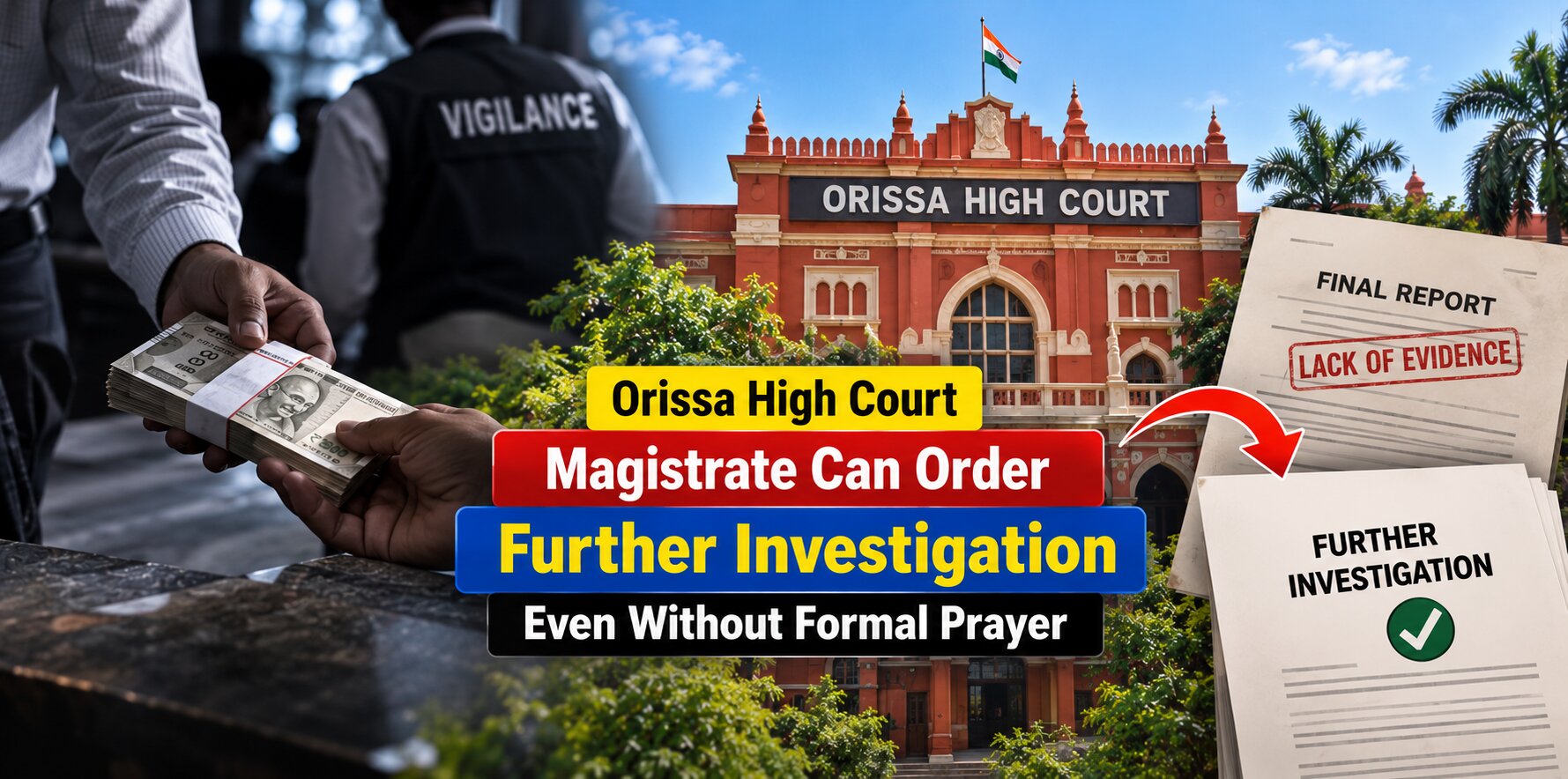
The Court held that non-recovery of tainted currency is not, by itself, necessarily fatal to a corruption prosecution.
Judgement Details
Court
Orissa High Court
Date of Decision
1 September 2026
Judges
Justice Sanjeeb Kumar Panigrahi
Citation
Acts / Provisions
Facts of the Case
-
Petitioner No. 1 was serving as a Tahasildar, Baranga, while Petitioner No. 2 was functioning as a private Amin.
-
A Vigilance Police Station case was registered alleging that Petitioner No. 1 had demanded ₹4,00,000 as illegal gratification.
-
According to the prosecution, the amount was to be paid in instalments, with the first instalment being ₹50,000.
-
Based upon the complaint, the Vigilance authorities arranged a trap operation.
-
During the trap, the complainant allegedly handed over the tainted currency notes of ₹50,000 to Petitioner No. 2.
-
The prosecution alleged that Petitioner No. 2 had received the money pursuant to the instructions of Petitioner No. 1.
-
A positive hand-wash test was obtained in respect of Petitioner No. 2.
-
Before the Vigilance team could recover the tainted currency, the bundle of notes was allegedly handed over to another person.
-
Consequently, the tainted currency notes could not be physically recovered from either petitioner.
-
The investigating agency subsequently submitted Final Report No. 40 dated 24 December 2016, stating that there was insufficient evidence to proceed, particularly because the tainted money had not been recovered and the overhearing witness had not provided supporting evidence.
-
The Special Judge (Vigilance), Bhubaneswar, declined to accept the final report.
-
By order dated 11 December 2017, the Special Judge directed further investigation under Section 173(8) CrPC.
-
The petitioners challenged that order before the Orissa High Court under Section 482 CrPC / Section 528 BNSS.
-
The petitioners argued that neither the Vigilance Department nor the complainant had formally requested further investigation.
-
They further argued that because the tainted currency had not been recovered, the essential foundation of the trap case was absent.
-
The petitioners also relied upon the prolonged period during which the further investigation remained pending.
-
The Vigilance Department opposed the petition and maintained that the Special Judge had correctly refused to accept the final report.
-
According to the Vigilance Department, the investigating officer had focused excessively on the non-recovery of the tainted money while overlooking evidence relating to demand and acceptance.
-
During the further investigation, additional witnesses were examined.
-
The Vigilance Department stated that fresh material had also emerged on 22 January 2026 concerning the disappearance of the tainted currency notes, based on the statement of Biswajit Sahoo, the driver of a vehicle allegedly used by Petitioner No. 1.
-
The Vigilance authorities further informed the High Court that the further investigation had been completed and that steps were being taken to submit the final report.
Issues
-
Whether the Special Judge (Vigilance), Bhubaneswar, was legally justified in directing further investigation under Section 173(8) CrPC despite the investigating agency having submitted a final report?
-
Whether the absence of recovery of the tainted currency notes in a trap case automatically destroys the prosecution case and prevents further investigation?
-
Whether the absence of a formal request for further investigation from the Vigilance Department or the complainant deprives the Magistrate or Special Judge of the power to direct further investigation under Section 173(8) CrPC?
-
Whether the prolonged pendency of the further investigation constituted such an abuse of the process of law as to justify interference by the High Court under Section 482 CrPC or Section 528 BNSS?
-
Whether the High Court could assess the evidentiary value of the alleged demand, acceptance, hand-wash result and newly discovered material while exercising its limited inherent jurisdiction at the pre-trial stage?
Judgement
-
The Orissa High Court dismissed the criminal miscellaneous petition filed by the petitioners.
-
The Court held that the power of a Magistrate or Special Judge to direct further investigation under Section 173(8) CrPC is well established.
-
The Court emphasized that the power exists to ensure that criminal investigations are comprehensive, fair and effective.
-
The Court rejected the argument that the Special Judge could not direct further investigation because neither the Vigilance Department nor the complainant had specifically requested it.
-
The Court held that the absence of a formal prayer does not, by itself, deprive the Court of jurisdiction to direct further investigation where the facts justify such intervention.
-
The Court examined the petitioners' contention that the absence of physical recovery of the tainted currency constituted a fatal defect.
-
The Court held that non-recovery of the tainted money does not automatically eliminate the possibility of establishing the alleged offence.
-
The Court observed that the gravamen of a corruption allegation lies in the demand and acceptance of illegal gratification, while recovery of the tainted currency may constitute important corroborative evidence.
-
The Court noted that the Special Judge had given cogent reasons for declining to accept the final report.
-
According to the Special Judge's reasoning, the Investigating Officer had focused primarily on the absence of recovery while overlooking other circumstances relating to the alleged demand and acceptance.
-
The High Court found no patent illegality, jurisdictional error or perversity in the Special Judge's order directing further investigation.
-
The Court also considered the substantial delay in the investigation.
-
It observed that prolonged investigative delay is undesirable and that the constitutional guarantee under Article 21 includes the right to fair and expeditious investigation and trial.
-
However, the Court declined to quash the proceedings because the Vigilance Department had informed the Court that further investigation had actually produced additional material.
-
The Court specifically noted the fresh evidence said to have emerged in January 2026 concerning the disappearance of the tainted currency.
-
The High Court held that it could not undertake a detailed evaluation of the credibility, admissibility or ultimate evidentiary value of that material while exercising its inherent jurisdiction.
-
The Court held that questions concerning whether the prosecution could ultimately establish demand and acceptance, whether constructive acceptance was proved, and what effect the absence of physical recovery would have were matters for the trial court.
-
The Court also rejected the attempt to convert the Section 482/Section 528 proceedings into a mini-trial.
-
Nevertheless, because of the considerable delay, the Court imposed a time-bound direction.
-
The Investigating Agency was directed to submit the final form within eight weeks, if it had not already been submitted.
-
The Special Judge was directed to proceed with the matter in accordance with law and with expedition.
-
The criminal miscellaneous case was therefore dismissed.
-
No order as to costs was made, and any interim order previously granted was vacated.
Held
-
The Court held that a Magistrate or Special Judge can direct further investigation under Section 173(8) CrPC even in the absence of a formal request from the investigating agency or complainant, provided the factual circumstances justify such a direction.
-
The Court recognized that evidence concerning demand and acceptance of illegal gratification may be established through surrounding circumstances, witness testimony and other incriminating material.
-
The Court held that the Special Judge had provided adequate reasons for declining to accept the final report and directing further investigation.
-
The Court held that the Special Judge's order did not suffer from patent illegality, jurisdictional error or perversity.
-
The Court held that the prolonged investigation was a matter of serious concern but did not, in the circumstances of the case, justify quashing the proceedings.
-
The Court held that questions concerning the credibility and ultimate sufficiency of the evidence must be determined by the trial court and not in proceedings under Section 482 CrPC/Section 528 BNSS.
-
The petitioners' challenge was therefore dismissed, with a direction to the investigating agency to submit the final form within eight weeks.
Analysis
-
Judicial power to order further investigation: The most important principle in the judgment is that the power to direct further investigation is not dependent upon a formal request from the police or complainant. The Court may intervene where the material before it indicates that further investigation is necessary to advance the cause of justice.
-
Section 173(8) CrPC: The provision recognizes the possibility of investigation continuing even after submission of the police report. The judgment reinforces that the criminal court's role is not limited to mechanically accepting a closure/final report.
-
Final report is not automatically binding: The investigating agency's decision to submit a final report because of insufficient evidence does not necessarily end the matter. The competent court may examine the material and determine whether further investigation is warranted.
-
No formal prayer required: The Court expressly rejected the proposition that further investigation can be ordered only when the investigating agency or complainant formally asks for it. The power is linked to the Court's responsibility to ensure a proper investigation.
-
Non-recovery of bribe money: The judgment draws an important distinction between recovery and the broader evidentiary question of demand and acceptance. Physical recovery is important corroborative evidence, but the Court held that its absence does not automatically terminate the prosecution.
-
Demand and acceptance: The Court treated demand and acceptance as central aspects of a corruption prosecution. Whether those elements are ultimately established is a matter for evaluation of evidence at trial rather than a question to be conclusively determined at the quashing stage.
-
Positive hand-wash evidence: The prosecution relied upon the positive hand-wash result of Petitioner No. 2 as part of the surrounding circumstances supporting its case. The High Court did not finally determine the evidentiary value of this material.
-
Constructive acceptance: The prosecution's case involved an allegation that Petitioner No. 2 received the money pursuant to Petitioner No. 1's instructions. Whether such circumstances establish constructive acceptance was left for determination by the trial court.
-
Limits of Section 482/Section 528 jurisdiction: The judgment strongly emphasizes that inherent jurisdiction is not intended to become a substitute for trial. The High Court should not ordinarily weigh disputed evidence, test witness credibility or determine whether the prosecution will ultimately prove its case beyond reasonable doubt at this stage.
-
Delay in investigation: The Court was critical of the prolonged investigation. The case originated in 2015, and the Special Judge's direction for further investigation was issued in 2017. The High Court noted that investigative delay can prejudice accused persons and undermine public confidence in the criminal justice system.
-
Article 21: The Court connected expeditious investigation with the constitutional guarantee of fair procedure under Article 21. Thus, while the Court permitted the investigation to continue, it imposed a strict eight-week deadline for submission of the final form.
-
Balancing competing interests: The judgment balances two competing considerations: the accused's right to speedy justice and society's interest in a complete investigation of alleged corruption by a public servant.
-
Fresh evidence changed the context: A significant factor was the Vigilance Department's assertion that further investigation had generated additional evidence in 2026. This distinguished the case from situations where an investigation remains stagnant for years without meaningful progress.
-
Distinction from an earlier precedent: The Court distinguished Dr. Rabindra Kumar Jena & Prof. (Dr.) Truptirekha Swain v. State of Odisha (Vigilance) because, in that case, the Court found a lack of meaningful investigative progress despite extraordinary delay. In the present matter, the State claimed that further investigation had produced additional incriminating material and had been completed.
-
No finding of guilt: The judgment does not hold that the petitioners committed corruption. It only holds that the proceedings should not be quashed at the threshold and that the investigative material must proceed through the legally prescribed process.
-
Practical significance: The decision strengthens the principle that criminal courts can insist upon a more complete investigation where a closure report appears to have been based too narrowly on one missing piece of evidence while other potentially relevant circumstances remain unexplored.
-
Overall legal principle: The core proposition is that the Court's power to direct further investigation under Section 173(8) CrPC is independent of a formal request by the investigating agency or complainant and may be exercised where necessary to ensure a fair and effective investigation.