
Akbar Khan and another v. State of Punjab and others, 2026
Protection of life and liberty sought by a Muslim couple who married against the wishes of the woman's family.
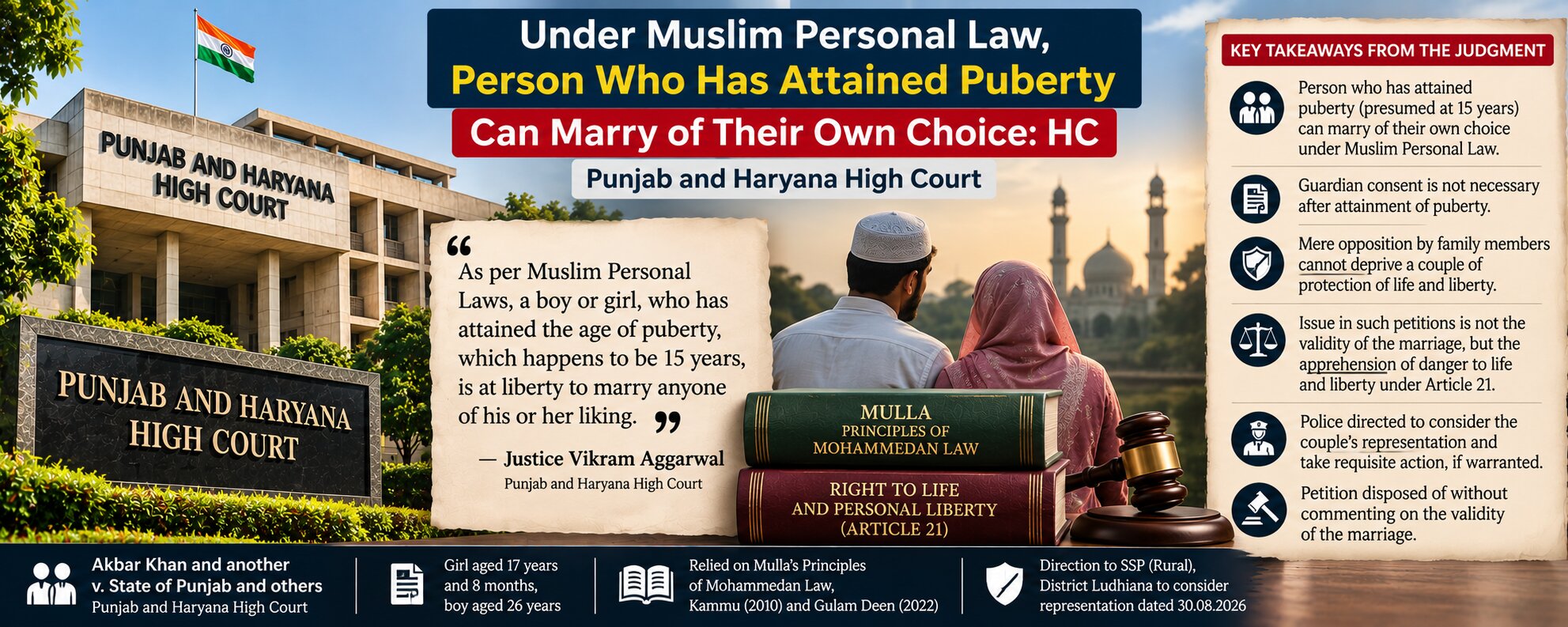
Judgement Details
Court
Punjab and Haryana High Court
Date of Decision
16 September 2026
Judges
Justice Vikram Aggarwal
Citation
Acts / Provisions
Facts of the Case
-
The petitioners were a Muslim couple governed by Muslim Personal Law.
-
Petitioner No. 1, the male petitioner, was stated to be 26 years old.
-
Petitioner No. 2, the female petitioner, was stated to be 17 years and 8 months old.
-
The petitioners stated that they had known each other for some time.
-
They developed a liking for each other and decided to marry.
-
The family of petitioner No. 2, particularly her father, was opposed to the proposed marriage.
-
Due to the opposition from her family, petitioner No. 2 left her parental home on 22 August 2026.
-
On the same day, the petitioners performed Nikah according to Muslim rites.
-
The petitioners alleged that members of petitioner No. 2's family were opposed to the marriage.
-
They apprehended danger to their life and liberty from respondent Nos. 4 to 7, who were members of petitioner No. 2's family.
-
The petitioners submitted a representation dated 30 August 2026 before the police seeking protection.
-
According to the petitioners, the representation remained undecided.
-
The petitioners therefore approached the Punjab and Haryana High Court seeking appropriate protection of their life and liberty.
-
Counsel for the petitioners argued that under Muslim Personal Law, puberty and majority are treated as synonymous for the purpose of marriage.
-
It was submitted that puberty is presumed to have been attained at 15 years of age in the absence of evidence to the contrary.
-
On this basis, counsel argued that a Muslim person who has attained puberty is competent to marry a person of their choice without requiring the consent of a guardian.
-
The petitioners relied upon Article 195 of Sir Dinshah Fardunji Mulla's Principles of Mohammedan Law.
-
The petitioners also relied upon the decision in Kammu v. State of Haryana and others (2010).
-
In that case, a Coordinate Bench had recognised the principle that a Muslim boy or girl who has attained puberty is at liberty to marry a person of their choice.
-
Reliance was also placed upon Gulam Deen v. State of Punjab (2022).
-
That decision emphasised that in a petition seeking protection of life and liberty, the principal concern is the apprehension of danger rather than determination of the validity of the marriage.
-
The State did not dispute the factual circumstances or the legal position relied upon by the petitioners.
-
The High Court therefore considered the petition principally from the perspective of the petitioners' right to life and personal liberty.
Issues
-
Whether a Muslim person who has attained puberty, which is presumed at 15 years in the absence of evidence to the contrary, is recognised under Muslim Personal Law as competent to enter into a marriage of their own choice?
-
Whether the fact that a Muslim couple has married against the wishes of their family members is by itself sufficient to deny them protection of their life and personal liberty under Article 21 of the Constitution of India?
-
Whether the High Court, while considering a petition seeking protection of life and liberty arising from a marriage opposed by family members, is required to determine the validity of the marriage before granting or directing consideration of protection?
-
Whether the apprehension of danger to the life and liberty of the petitioners required consideration and appropriate action by the police authorities in the circumstances of the case?
-
Whether the Senior Superintendent of Police was required to consider the petitioners' representation dated 30 August 2026 and take appropriate action in accordance with law?
Judgement
-
The Punjab and Haryana High Court disposed of the petition seeking protection of life and liberty.
-
The Court noted that petitioner No. 1 was 26 years old, while petitioner No. 2 was 17 years and 8 months old.
-
The Court observed that both petitioners were Muslims and were governed by Muslim Personal Law.
-
Referring to the principles of Mohammedan Law, the Court observed that a Muslim boy or girl who has attained puberty, presumed at 15 years, is at liberty to marry a person of their choice.
-
The Court referred to Article 195 of Mulla's Principles of Mohammedan Law, which recognises the capacity of a Mohammedan of sound mind who has attained puberty to enter into a contract of marriage.
-
The Court also relied upon the decision in Kammu v. State of Haryana and others, which recognised the right of a Muslim person who has attained puberty to choose a spouse.
-
The Court further referred to Gulam Deen v. State of Punjab, where the focus in a protection petition was identified as the petitioners' apprehension of danger to their life and liberty rather than determination of the validity of the marriage.
-
The Court observed that merely because the petitioners had married against the wishes of their family members, they could not be deprived of their fundamental rights.
-
The State counsel was unable to dispute the factual position or the legal principles relied upon by the petitioners.
-
However, the High Court expressly refrained from giving any finding regarding the validity of the marriage.
-
Instead, the Court directed the Senior Superintendent of Police (Rural), District Ludhiana, to consider the representation dated 30 August 2026 submitted by the petitioners.
-
The police authority was directed to take requisite action, if warranted, having regard to the facts and circumstances and in accordance with law.
-
The petition was accordingly disposed of.
Held
-
The Court recognised, for the purpose of considering the protection petition, the position under Muslim Personal Law that a person who has attained puberty, presumed at 15 years of age, may have the capacity to marry a person of their choice.
-
The Court reiterated that the mere fact that a couple has married against the wishes of their family members does not, by itself, justify denial of constitutional protection of life and liberty.
-
The Court treated the petition primarily as a matter concerning apprehension of danger to life and personal liberty under Article 21.
-
The Court did not adjudicate upon the ultimate validity or legality of the marriage.
-
The appropriate police authority was directed to consider the petitioners' representation and take action if warranted in accordance with law.
-
The petition was consequently disposed of.
Analysis
-
The Court distinguished between two separate questions:
-
the validity of the marriage, and
-
the right of the petitioners to seek protection of their life and liberty.
-
-
The Court made it clear that the present proceedings were primarily concerned with the second question.
-
The petitioners alleged a genuine apprehension of danger from members of the woman's family because the marriage had taken place against their wishes.
-
The Court therefore focused upon the constitutional protection available to individuals who apprehend threats to their life and personal liberty.
-
The Court also considered the legal position under Muslim Personal Law concerning the age of puberty and capacity to marry.
-
The Court relied upon Article 195 of Mulla's Principles of Mohammedan Law, under which puberty is presumed at 15 years in the absence of evidence to the contrary.
-
The Court further relied upon earlier decisions recognising the liberty of a Muslim person who has attained puberty to choose a spouse.
-
Importantly, the Court did not convert the protection petition into a proceeding for determining the complete validity of the marriage.
-
Instead, it adopted a limited approach and directed the police authority to examine the petitioners' representation and take appropriate action according to law.
-
This approach allowed the Court to address the alleged threat without making a definitive adjudication on all questions concerning the marriage.