
AK Ghosh & Company and Others v. Biman Bose and Others, 2026
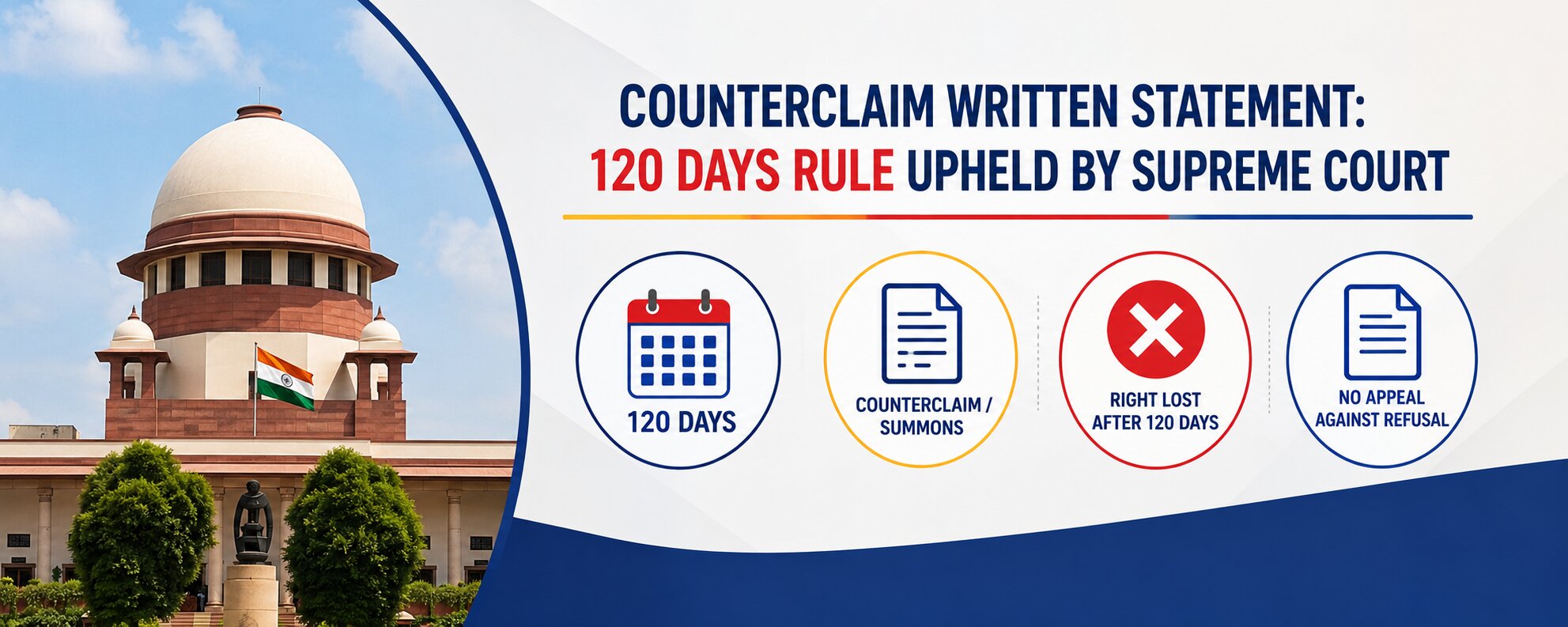
The mandatory 120-day limit under the Commercial Courts Act applies equally to a plaintiff's written statement filed in response to a defendant's counterclaim.
Judgement Details
Court
Supreme Court of India
Date of Decision
16 July 2026
Judges
Justice Sanjay Kumar & Justice K. Vinod Chandran
Citation
Acts / Provisions
Facts of the Case
-
The plaintiffs instituted a commercial suit before the Calcutta High Court seeking recovery of alleged unpaid dues for the supply of printing paper.
-
The defendants filed their written statement along with a counterclaim in July 2023.
-
The plaintiffs did not file a written statement to the counterclaim within the prescribed period.
-
After a delay of 238 days, the plaintiffs sought leave from the Court to file their written statement to the counterclaim.
-
The learned Single Judge of the Calcutta High Court rejected the application on the ground that the statutory period had expired.
-
The plaintiffs challenged the order before the Commercial Appellate Division of the High Court.
-
The Division Bench also dismissed the appeal.
-
Aggrieved, the plaintiffs approached the Supreme Court.
-
The principal issue before the Supreme Court was whether the mandatory 120-day time limit under the Commercial Courts Act also governs a plaintiff's written statement to a defendant's counterclaim.
Issues
-
Whether the mandatory outer limit of 120 days prescribed under the proviso to Order VIII Rule 1 CPC applies to a plaintiff's written statement filed in response to a defendant's counterclaim in a commercial suit?
-
Whether the absence of a court-fixed timeline under Order VIII Rule 6A(3) CPC permits a plaintiff to file a written statement to a counterclaim beyond 120 days?
-
Whether an order refusing leave to file a delayed written statement to a counterclaim is appealable under Section 13 of the Commercial Courts Act?
Judgement
-
The Supreme Court dismissed the appeals and upheld the orders of the Calcutta High Court.
-
The Court held that a plaintiff in a commercial suit must ordinarily file a written statement to a counterclaim within 30 days from service of the counterclaim or summons.
-
The Court clarified that although the period may be extended for sufficient cause, such extension cannot exceed 120 days.
-
Upon expiry of 120 days, the plaintiff's right to file the written statement stands forfeited.
-
The Bench rejected the contention that the limitation period begins only after the Court specifically fixes a timeline under Order VIII Rule 6A(3) CPC.
-
It held that Order VIII Rule 6G CPC expressly makes all provisions applicable to a defendant's written statement equally applicable to a plaintiff's reply to a counterclaim.
-
The Court observed that accepting the contrary interpretation would enable indefinite delays whenever courts omitted to prescribe a specific timeline, thereby defeating the purpose of the Commercial Courts Act.
-
The Bench disagreed with contrary views taken by the Bombay and Madras High Courts.
-
The Court emphasized that the Commercial Courts Act was enacted to ensure speedy disposal of commercial disputes and promote an efficient business environment.
-
On the question of maintainability, the Court held that no appeal lies against an order refusing permission to file a belated written statement to a counterclaim, since such an order is not enumerated under Order XLIII CPC or Section 37 of the Arbitration and Conciliation Act.
-
Consequently, the Supreme Court upheld the rejection of the plaintiffs' application and vacated the interim stay granted earlier.
Held
-
The timeline begins from the date of service of the counterclaim or summons and is not dependent upon the Court fixing a separate period under Order VIII Rule 6A(3) CPC.
-
Order VIII Rule 6G CPC extends the rules governing written statements by defendants to replies filed by plaintiffs against counterclaims.
-
After expiry of 120 days, the plaintiff forfeits the right to file the written statement.
-
An order refusing leave to file a delayed written statement to a counterclaim is not appealable under Section 13 of the Commercial Courts Act.
Analysis
-
The judgment reinforces the legislative objective of the Commercial Courts Act to ensure expeditious adjudication of commercial disputes by imposing strict procedural timelines on all parties.
-
The Court adopted a purposive interpretation of Order VIII Rule 6G CPC, ensuring procedural parity between defendants filing written statements and plaintiffs responding to counterclaims.
-
By rejecting the view that limitation begins only after judicial fixation of time under Order VIII Rule 6A(3), the Court prevented procedural loopholes that could encourage unnecessary delays.
-
The ruling clarifies conflicting High Court decisions and settles the legal position that the strict timeline applies equally to counterclaim pleadings.
-
The judgment also reiterates that appellate remedies under the Commercial Courts Act remain narrowly confined to orders expressly made appealable, thereby preventing interlocutory delays in commercial litigation.
-
Overall, the decision strengthens procedural discipline in commercial litigation and furthers the objective of creating a speedy, predictable, and investor-friendly dispute resolution framework.