
Abu @ Syed Abuthagir and Others v. Union of India, 2026
Witness protection, witness anonymity, redaction of witness statements and the accused's right to cross-examination in proceedings under the UAPA.
Judgement Details
Court
Madras High Court
Date of Decision
16 September 2026
Judges
Justice Anita Sumanth and Justice Sunder Mohan
Citation
Acts / Provisions
Facts of the Case
-
The petitioners were a group of accused persons who were members of the Popular Front of India (PFI), which had been banned.
-
The petitioners were accused of conspiring to strike terror among a section of people in the country.
-
They were also accused in connection with the killing of the then spokesperson of Hindu Munnani in Coimbatore.
-
The investigation was conducted by the Special Investigation Division of the CB-CID.
-
During the proceedings, the investigating agency filed an application seeking protection for certain witnesses.
-
The prosecution sought orders declaring certain persons as protected witnesses.
-
It also sought directions preventing the accused from receiving copies of statements recorded in respect of those protected witnesses.
-
The Special Court granted protection to certain witnesses, including protection that was stated to operate for their lifetime.
-
Subsequently, the accused sought to recall certain protected witnesses for the purpose of cross-examination.
-
The Special Court rejected the application seeking recall of those witnesses.
-
The accused therefore approached the Madras High Court challenging the decision of the Special Court.
-
The petitioners argued that there was no sufficient justification for treating the concerned witnesses as protected witnesses.
-
They contended that the protection had been granted without adequate judicial scrutiny and that the selection of protected witnesses was arbitrary.
-
The accused further argued that they had been prejudiced because the protection measures prevented them from effectively exercising their right to cross-examine the witnesses.
-
The petitioners also contended that they should have been permitted to recall witnesses where they had not received an adequate opportunity to cross-examine them earlier.
-
The prosecution defended the witness-protection measures and maintained that the protection was necessary in the circumstances of the case.
-
During its examination of the matter, the High Court noticed a broader concern regarding the manner in which applications for witness protection were being dealt with.
-
The Court observed that in some cases protection appeared to be granted merely on the asking, without sufficient clarity regarding the nature, duration and justification of the protection.
-
The High Court therefore examined the legal relationship between witness protection and the accused's fundamental right to cross-examination.
-
The Court also considered the extent to which the identity and address of a protected witness could be redacted from investigative material.
Issues
-
Whether witness protection under Section 44 of the Unlawful Activities (Prevention) Act can be granted mechanically without the Court first examining the nature and gravity of the threat faced by the particular witness?
-
Whether witness-protection measures under the UAPA can be used to restrict or substantially curtail the accused's valuable right to cross-examine prosecution witnesses?
-
Whether the prosecution can seek blanket or omnibus protection for multiple witnesses without making specific averments regarding the threat or danger faced by each individual witness?
-
Whether the investigating officer can withhold an entire statement recorded under Section 161(3) CrPC or Section 193(7) BNSS when seeking protection of a witness?
-
Whether redaction of a witness's identity and address can extend to other identifying characteristics such as the witness's native place, profession or other special features capable of identifying the witness to the accused?
-
Whether the Public Prosecutor can have the final authority to determine what portions of a witness's statement should be redacted for protection purposes?
-
Whether an accused has a right of hearing when an application seeking witness protection under Section 44(2) UAPA is considered while remaining temporarily unaware of the identity of the witnesses concerned?
-
Whether witness anonymity can be ordered as a matter of routine or whether such protection constitutes an exceptional departure from the principle of open justice requiring strict judicial scrutiny?
-
Whether the duration and extent of witness protection must be specifically determined by the Court having regard to the gravity and duration of the threat?
-
Whether evidence given by an anonymous or protected witness should be assessed with particular caution because the accused's ability to fully cross-examine such witness may be restricted?
-
Whether the accused in the present case had demonstrated that the protection granted to the concerned witnesses had actually curtailed or abridged their right of cross-examination so as to warrant interference by the High Court?
Judgement
-
The Madras High Court laid down detailed principles governing witness protection under the UAPA while ultimately declining to interfere with the proceedings in the present case.
-
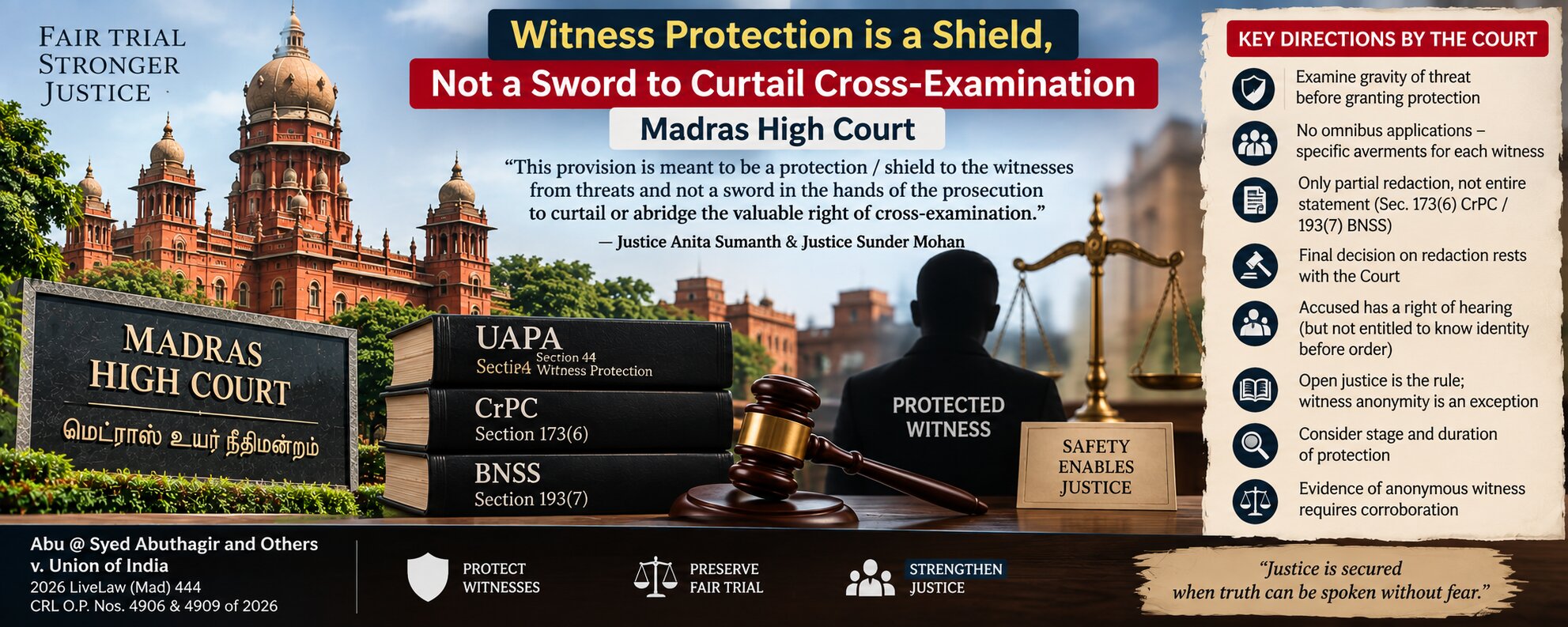
The Court emphasised that witness protection is intended to function as a shield for witnesses facing genuine threats, and not as a weapon for the prosecution to unnecessarily restrict the accused's right of cross-examination.
-
The Court held that a witness-protection application cannot be dealt with mechanically.
-
Before granting protection, the Court must examine the gravity of the threat.
-
The Court must consider whether the witness's life is actually in danger.
-
The Court must also determine whether the threat is likely to continue only until the witness gives evidence or whether protection is required for a longer period.
-
The Court held that an application for witness protection must contain specific averments concerning each witness.
-
The prosecution cannot ordinarily file an omnibus application seeking protection for a group of witnesses without identifying the circumstances giving rise to the alleged danger in respect of each witness.
-
The Court held that Section 173(6) CrPC and Section 193(7) BNSS do not authorise the withholding of an entire statement recorded under Section 161(3) CrPC.
-
According to the Court, only the necessary portion may be redacted where the statutory requirements concerning the interests of justice and public interest are satisfied.
-
The investigating officer must also provide brief reasons explaining why redaction is necessary.
-
The Court clarified that the concepts of identity and address may extend beyond a person's name and residential address.
-
Relevant identifying characteristics such as a witness's native place, profession or other distinctive features may also require protection if disclosure could reveal the witness's identity to the accused.
-
Although the Public Prosecutor may suggest material requiring redaction, the final decision must rest with the Court.
-
The Court must independently satisfy itself that the protective measures are appropriate under the applicable statutory framework.
-
The Court held that an accused has a right of hearing when an application for witness protection is considered under Section 44(2) UAPA.
-
However, the accused is not necessarily entitled to know the identity of the witnesses concerned before the Court decides the protection application.
-
The Court reaffirmed the principle of open justice.
-
Witness anonymity constitutes an exception to that principle and therefore must be applied only in exceptional circumstances.
-
The identity of a witness should be withheld only when the Special Court is satisfied that the witness's life is genuinely in jeopardy.
-
The Court further held that even when witness protection is granted, the Court must determine the extent and duration of the protection.
-
The Court should consider whether the protected information can be disclosed before the commencement of trial or before cross-examination becomes necessary.
-
The Court also observed that testimony from an anonymous witness must be assessed with appropriate caution because the accused may not have enjoyed the same opportunity for cross-examination as would ordinarily be available.
-
Consequently, the Court stated that the probative value of such testimony may not necessarily be equivalent to that of evidence which has been fully tested through cross-examination.
-
The Court indicated that courts should therefore look for corroboration when evaluating such testimony.
-
With respect to the present case, however, the High Court found that the accused's right of cross-examination had not actually been abridged or curtailed.
-
In respect of certain witnesses, the defence had either exercised the opportunity of cross-examination or had chosen not to do so.
-
In cases where an opportunity had not initially been provided, the Special Court subsequently allowed the accused to cross-examine the witnesses.
-
The Court also noted that the chief examination had taken place in the presence of the accused.
-
Even the redacted portions had been elicited during the proceedings in the presence of the accused.
-
Accordingly, the High Court found no sufficient ground to interfere with the orders in the present case.
Held
-
Witness protection under the UAPA is intended to be a shield against genuine threats to witnesses, not a means of unnecessarily restricting the accused's right to cross-examination.
-
A court must not grant witness protection mechanically merely because the prosecution requests it.
-
The Court must examine the gravity and nature of the threat and determine whether the witness's life is genuinely endangered.
-
The Court must also consider the duration for which protection is actually necessary.
-
An application seeking witness protection must contain specific averments concerning each individual witness.
-
An omnibus witness-protection application is impermissible.
-
Section 173(6) CrPC and Section 193(7) BNSS do not authorise the blanket withholding of an entire statement recorded under Section 161(3) CrPC.
-
Redaction must be limited to the portion genuinely requiring protection and must be supported by reasons.
-
Identifying information may include not only the witness's name and address, but also other details capable of revealing the witness's identity.
-
The Public Prosecutor may recommend redactions, but the Court retains the final decision regarding what information should be withheld.
-
The accused has a right of hearing when a witness-protection application is considered, although disclosure of the witness's identity may be withheld until the Court determines the application.
-
Open justice is the rule; witness anonymity is an exception.
-
Witness anonymity should therefore be ordered only in exceptional circumstances, particularly where the Court is satisfied that the witness's life is in jeopardy.
-
Courts must carefully consider the stage and duration of witness protection and whether protected information can subsequently be disclosed before trial or cross-examination.
-
Evidence of an anonymous witness may require greater judicial caution, since the accused's opportunity to test the testimony through cross-examination may have been restricted.
-
Such evidence should, where appropriate, be assessed with reference to corroborating material.
-
In the present case, however, the High Court found that the accused's right to cross-examination had not been unlawfully curtailed.
Analysis
-
The central concern of the High Court was the need to maintain a balance between witness safety and the accused's right to a fair trial.
-
The Court recognised that witnesses in serious criminal cases, particularly cases involving national-security legislation, may face genuine threats.
-
At the same time, protection of a witness cannot automatically justify restrictions that prevent the accused from effectively testing the prosecution evidence.
-
Cross-examination is an important component of the criminal trial process because it allows the accused to challenge the accuracy, reliability and credibility of prosecution evidence.
-
The Court therefore characterised witness protection as a protective shield rather than a prosecutorial weapon.
-
The Court considered that judicial scrutiny is necessary because witness-protection orders can potentially have a direct impact on the fairness of the trial.
-
The Court was particularly concerned about situations where protection is granted without specifying:
-
the nature of the threat;
-
the identity of the particular witness requiring protection;
-
the duration of the protection;
-
the precise information requiring redaction; and
-
the reasons why disclosure would create a danger.
-
-
The Court consequently required a more individualised and reasoned approach to witness-protection applications.
-
The Court also recognised that witness identity can sometimes be revealed indirectly.
-
Therefore, protection cannot be limited mechanically to a person's name and address. Details such as profession, native place or distinctive characteristics may also reveal identity.
-
However, the Court made clear that redaction must remain proportionate to the actual protective requirement.
-
The entire statement of a witness cannot simply be withheld merely because some part of it contains identifying information.
-
The Court also retained the ultimate decision-making authority with the judiciary rather than the prosecution.