
Abdul Rauf M. v. State of Kerala and Anr., 2026
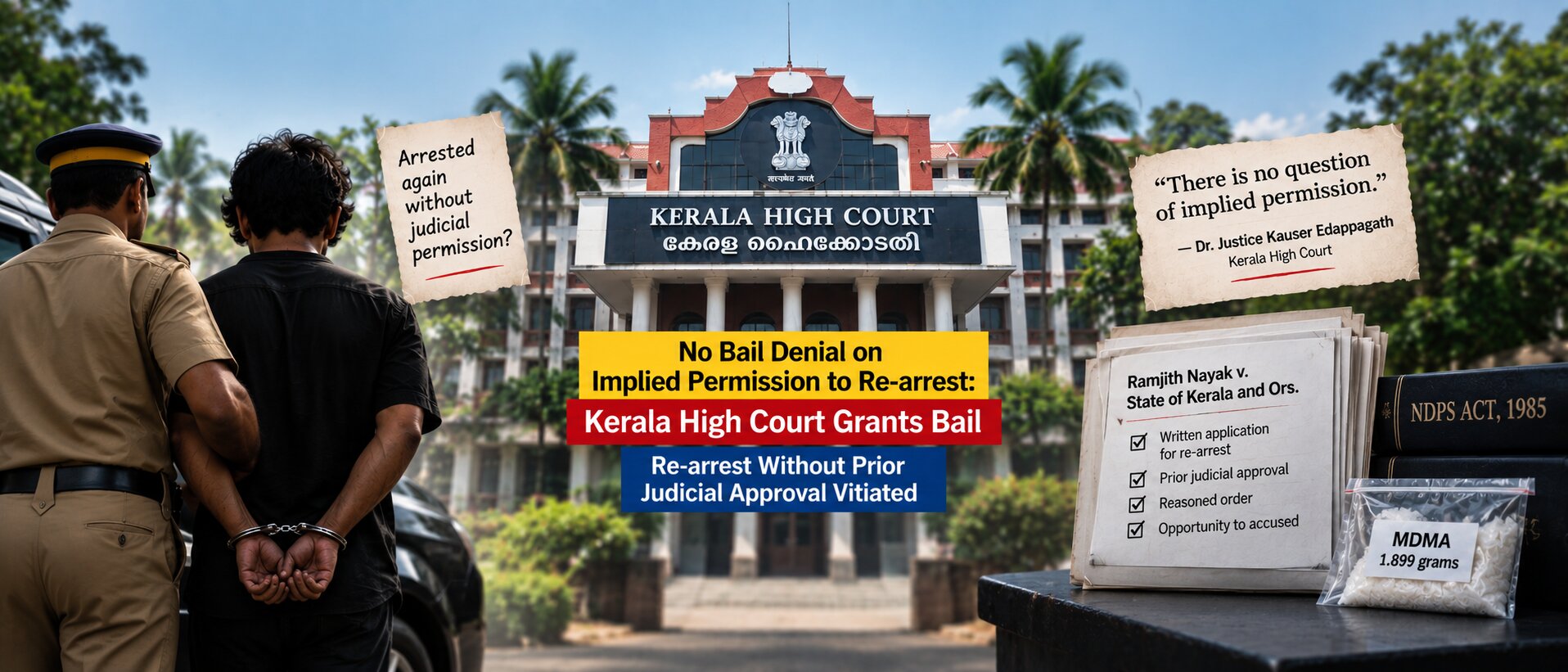
After an arrest is declared illegal, the investigating agency must obtain prior judicial approval before re-arresting the accused.
Judgement Details
Court
Kerala High Court
Date of Decision
25 August 2026
Judges
Dr. Justice Kauser Edappagath
Citation
Acts / Provisions
Facts of the Case
-
The petitioner was the first accused in a case registered under the Narcotic Drugs and Psychotropic Substances Act, 1985.
-
The prosecution alleged that the petitioner, along with another accused, was found in possession of 1.899 grams of MDMA in a car.
-
The petitioner was arrested and produced before the Magistrate on the following day.
-
During the proceedings, it was noticed that the grounds of arrest had not been communicated to the petitioner as required by law.
-
Since the initial arrest was found to be legally defective, the Magistrate released the petitioner.
-
A few hours after his release, the investigating agency re-arrested the petitioner.
-
The petitioner was again produced before the same Magistrate and was remanded to judicial custody.
-
The petitioner challenged the subsequent arrest and sought bail before the Sessions Court.
-
He relied upon the Kerala High Court's earlier decision in Ramjith Nayak v. State of Kerala and Ors.
-
In Ramjith Nayak, the High Court had directed that where an initial arrest is declared illegal for violation of constitutional safeguards, the investigating agency must obtain prior judicial approval before re-arresting the accused.
-
The Sessions Court rejected the petitioner's bail plea.
-
The Sessions Court took the view that permission for re-arrest could be implied because the Magistrate was aware of the earlier proceedings.
-
The petitioner thereafter approached the Kerala High Court.
-
The High Court examined whether the investigating agency had complied with the mandatory procedure prescribed in Ramjith Nayak before carrying out the subsequent arrest.
Issues
-
Whether the petitioner could be re-arrested after his initial arrest was declared illegal for failure to communicate the grounds of arrest without obtaining prior judicial permission?
-
Whether the Magistrate could be presumed to have given implied permission for re-arrest when no written application was submitted by the investigating agency?
-
Whether the subsequent arrest was vitiated when the procedure laid down in Ramjith Nayak v. State of Kerala was not followed?
-
Whether the petitioner was entitled to bail when his subsequent arrest was found to be contrary to the directions of the High Court?
-
Whether the Magistrate and Sessions Court were required to follow the judicial safeguards laid down by the High Court concerning re-arrest after an illegal arrest?
Judgement
-
The Kerala High Court allowed the bail application filed by Abdul Rauf M.
-
The Court held that there could be no implied permission for re-arrest in the circumstances of the case.
-
The Court relied upon its earlier decision in Ramjith Nayak v. State of Kerala and Ors.
-
The Court reiterated that when an initial arrest is declared illegal because of violation of constitutional safeguards, the investigating agency must make a written application seeking permission to re-arrest.
-
The Magistrate must consider such an application and pass a reasoned order after giving an opportunity to the accused.
-
In the present case, no such application was moved by the investigating agency.
-
The Magistrate also failed to properly examine whether the proposed re-arrest was legally permissible.
-
Instead, the petitioner was mechanically remanded to judicial custody after his subsequent arrest.
-
The High Court rejected the Sessions Court's reasoning that permission for re-arrest could be implied merely because the Magistrate was aware of the earlier proceedings.
-
The Court held that the subsequent arrest was also illegal.
-
Since the arrest was vitiated, the petitioner was held entitled to be released on bail.
-
The High Court directed the Registry to seek an explanation from the Magistrate and the Sessions Court regarding non-compliance with the directions in Ramjith Nayak.
-
The Court further directed that a copy of the decision be forwarded to all criminal courts in Kerala for compliance.
Held
-
Implied permission cannot be presumed when judicial approval is specifically required before re-arrest.
-
The investigating agency must submit a written application seeking permission to re-arrest.
-
The Magistrate must pass a reasoned order after giving the accused an opportunity of being heard.
-
Failure to follow this procedure renders the subsequent arrest vitiated.
-
The petitioner was therefore entitled to bail.
-
The High Court directed subordinate criminal courts to follow the safeguards laid down in Ramjith Nayak.
Analysis
-
Protection against illegal arrest: The judgment strongly reinforces constitutional safeguards available to an accused at the time of arrest.
-
No implied judicial permission: The Court made it clear that judicial permission cannot be presumed merely because the Magistrate knows about the previous proceedings.
-
Written application is necessary: The investigating agency must specifically approach the Magistrate with a written request for re-arrest rather than treating the second arrest as an automatic consequence of the first proceeding.
-
Reasoned judicial order: The Magistrate is required to independently consider the legality of the proposed re-arrest and provide reasons for granting or refusing permission.
-
Opportunity to the accused: The procedure protects the accused by requiring an opportunity to contest the proposed re-arrest.
-
Importance of Ramjith Nayak: The decision applies and reinforces the safeguards previously laid down by the Kerala High Court regarding re-arrest following an illegal arrest.
-
Mechanical remand disapproved: The Court criticised the failure to examine the legality of the second arrest before remanding the petitioner to judicial custody.
-
Judicial accountability: The direction to obtain explanations from the Magistrate and Sessions Court demonstrates the seriousness with which the High Court viewed non-compliance with its earlier directions.
-
Wider institutional impact: Forwarding the judgment to all criminal courts in Kerala is intended to ensure consistent compliance with the prescribed procedure.
-
Bail consequence: Where the subsequent arrest itself is vitiated because mandatory safeguards were not followed, the accused may obtain relief through the bail jurisdiction of the High Court.
-
Significance: The judgment emphasises that procedural safeguards surrounding arrest are not merely technical requirements; they are connected with the protection of personal liberty and fundamental rights.