
Aarambh Agro Purposes Co-Operative Society Ltd. & Anr. v. State of U.P. & 13 Ors., 2026
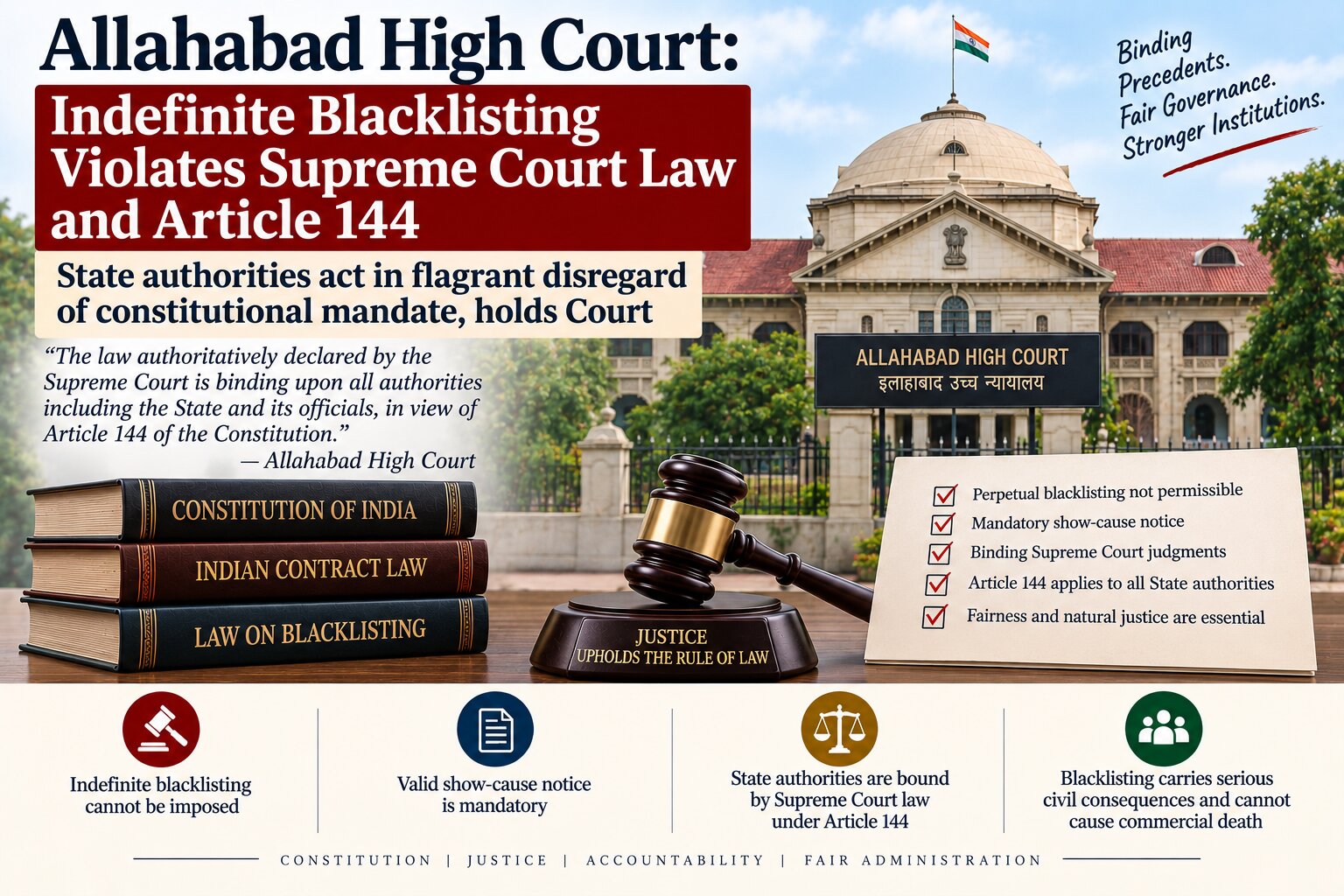
The law authoritatively declared by the Supreme Court is binding on State authorities under Article 144.
Judgement Details
Court
Allahabad High Court
Date of Decision
28 August 2026
Judges
Justice J.J. Munir and Justice Indrajeet Shukla
Citation
Acts / Provisions
Facts of the Case
-
Petitioner No. 1 was a society registered under the Multi State Cooperative Societies Act, 2002.
-
Petitioner No. 2, Ritu Meena, was elected President of the Society on 15 March 2019 and was recognised by the Central Registrar.
-
Despite this, the erstwhile President allegedly executed an agreement dated 2 April 2019 in favour of respondent No. 9.
-
On the basis of that agreement, the District Magistrate, Rampur allotted 11 wheat purchase centres to the Society.
-
A show-cause notice dated 26 August 2019 was issued to respondent No. 9, describing him as “Sachiv/Adhyaksh”.
-
On 5 October 2019, the Society was debarred/blacklisted for an indefinite period.
-
The Society claimed that neither it nor its recognised President had been served with the show-cause notice.
-
It came to know about the debarment only after receiving a demand notice dated 6 March 2021 for ₹4,08,191 towards Mandi fee and development cess.
-
The Society alleged that it had been made a victim of fraud and collusion involving private parties and State officials.
-
The State defended the action by contending that the Society had procured 2,568.60 metric tonnes of wheat but failed to supply the entire quantity to the Food Corporation of India.
Issues
-
Whether an authority can impose indefinite or perpetual blacklisting contrary to the law declared by the Supreme Court?
-
Whether a show-cause notice issued to a person who was neither the authorised office bearer nor representative of the Society constitutes valid notice to the Society?
-
Whether blacklisting without a meaningful opportunity of hearing violates the principles of natural justice?
-
Whether State authorities acting contrary to binding Supreme Court precedent violate their constitutional obligation under Article 144?
-
Whether the petitioner-Society could be saddled with Mandi fee and development charges when it had not itself undertaken the relevant wheat procurement?
Judgement
-
The Allahabad High Court allowed the writ petition.
-
It held that the law declared by the Supreme Court is binding upon State authorities and officials by virtue of Article 144 of the Constitution.
-
The Court found that the State authorities had acted in flagrant disregard of the Supreme Court's settled law that blacklisting cannot be imposed permanently or indefinitely.
-
The show-cause notice issued to respondent No. 9 could not be treated as valid notice to the petitioner-Society because he was neither its member nor office bearer at the relevant time.
-
The Court held that the purported notice was effectively no notice at all to the Society.
-
The order dated 5 October 2019, imposing indefinite debarment, was quashed.
-
The Court also held that the Society could not be saddled with Mandi fee and development charges when it had not itself procured the wheat.
-
The demand was directed to be liquidated by the Regional Food Controller.
-
The writ petition was accordingly allowed.
Held
-
State authorities cannot disregard binding Supreme Court judgments while exercising administrative or contractual powers.
-
Blacklisting/debarment cannot be perpetual or indefinite.
-
Blacklisting carries serious civil and commercial consequences and can amount to the commercial death of an entity if imposed permanently.
-
Before blacklisting, the affected firm, society or contractor must receive a valid and meaningful show-cause notice.
-
A notice served upon an unauthorised person cannot automatically be treated as notice to the concerned legal entity.
-
The absence of a valid notice and opportunity of hearing vitiates the blacklisting order.
-
The State's power to blacklist must be exercised consistently with natural justice, fairness and proportionality.
-
An entity cannot be saddled with financial liabilities for procurement which it did not itself undertake.
Analysis
-
The judgment strongly reinforces the constitutional significance of Article 144, which requires all civil and judicial authorities to act in aid of the Supreme Court.
-
The High Court treated disregard of binding Supreme Court precedent not merely as an ordinary legal error but as a constitutional violation.
-
The Court's treatment of indefinite blacklisting is particularly important because blacklisting can effectively prevent an entity from participating in government business and thereby threaten its commercial survival.
-
The Court followed the settled principle that blacklisting is a serious administrative action carrying civil consequences, and therefore cannot be imposed without procedural fairness.
-
A central defect was the purported show-cause notice. Since it was addressed to a person who had no recognised authority to represent the Society, the Court held that the notice could not satisfy the requirement of audi alteram partem.
-
The decision therefore demonstrates that merely issuing a document described as a “show-cause notice” is insufficient. The notice must actually reach the legally affected party and provide a genuine opportunity to answer the allegations.
-
The Court also rejected the concept of perpetual debarment, consistent with Supreme Court precedents including Erusian Equipment, Gorkha Security Services, Kulja Industries and Vetindia Pharmaceuticals.
-
The judgment draws an important connection between natural justice and proportionality: even where the State has legitimate grounds for taking action, the punishment must remain legally permissible and procedurally fair.
-
The decision also illustrates the limited but meaningful role of Article 226 review in administrative matters. Courts will intervene where government action is arbitrary, legally perverse or contrary to binding precedent.
-
Overall, the ruling sends a clear message that State authorities cannot impose commercially devastating penalties while disregarding established Supreme Court safeguards concerning notice, hearing and duration of blacklisting.